Alert queues in a security operations centre rarely run empty. Thousands of notifications can stack up in a single shift, and often, only a fraction point to real risk. That gap between volume and value is one reason the SANS 2025 SOC Survey found that 42% of security operations centres now use AI and machine learning tools, even as satisfaction with those tools still trails other SOC technologies.
There’s usually a shortage of context: which alert matters, why, and what to do about it. AI SOC implementation is one way to close that gap, provided it is planned around existing workflows rather than mounted on as another dashboard. This guide walks through what the approach involves, where it fits the Indian regulatory landscape and the steps that tend to work in practice.
What is AI SOC implementation?
This means integrating artificial intelligence into a security operations centre so it can detect threats, prioritise alerts and support incident response with less manual effort. A traditional SOC relies on analysts reviewing every alert against static rules. An AI-powered SOC adds machine learning models that spot patterns and filter out noise before it reaches a human queue.
This does not mean removing people from the SOC. Analysts still investigate, decide and respond. What changes is how much reaches them, and how much context arrives with it. According to Underdefense’s AI SOC maturity model, most organisations are currently operating between Level 2 and Level 3 of the AI SOC maturity curve, where AI assists with triage and enrichment, but people still drive investigation and response.
Why AI SOC implementation matters for Indian enterprises
Security teams across Indian banks, NBFCs and capital market intermediaries face a monitoring bar that keeps expanding. The SEBI Cybersecurity and Cyber Resilience Framework requires regulated entities to maintain continuous, real-time monitoring of systems, applications and network activity, with logs collected, correlated and analysed for threats. RBI’s cybersecurity guidelines for banks and NBFCs carry a similar expectation around governance and monitoring, even where the exact technology stack is left to the institution.
Meeting that bar manually gets harder as data volumes grow. It gives security teams a way to keep monitoring continuous without scaling analyst headcount at the same pace. It also builds the evidence trail, correlated logs and documented detection logic, that audits increasingly expect.
Steps to implement an AI SOC
A phased rollout works better than a single switch-over. The following sequence keeps SOC automation grounded in measurable outcomes rather than a tool purchase.
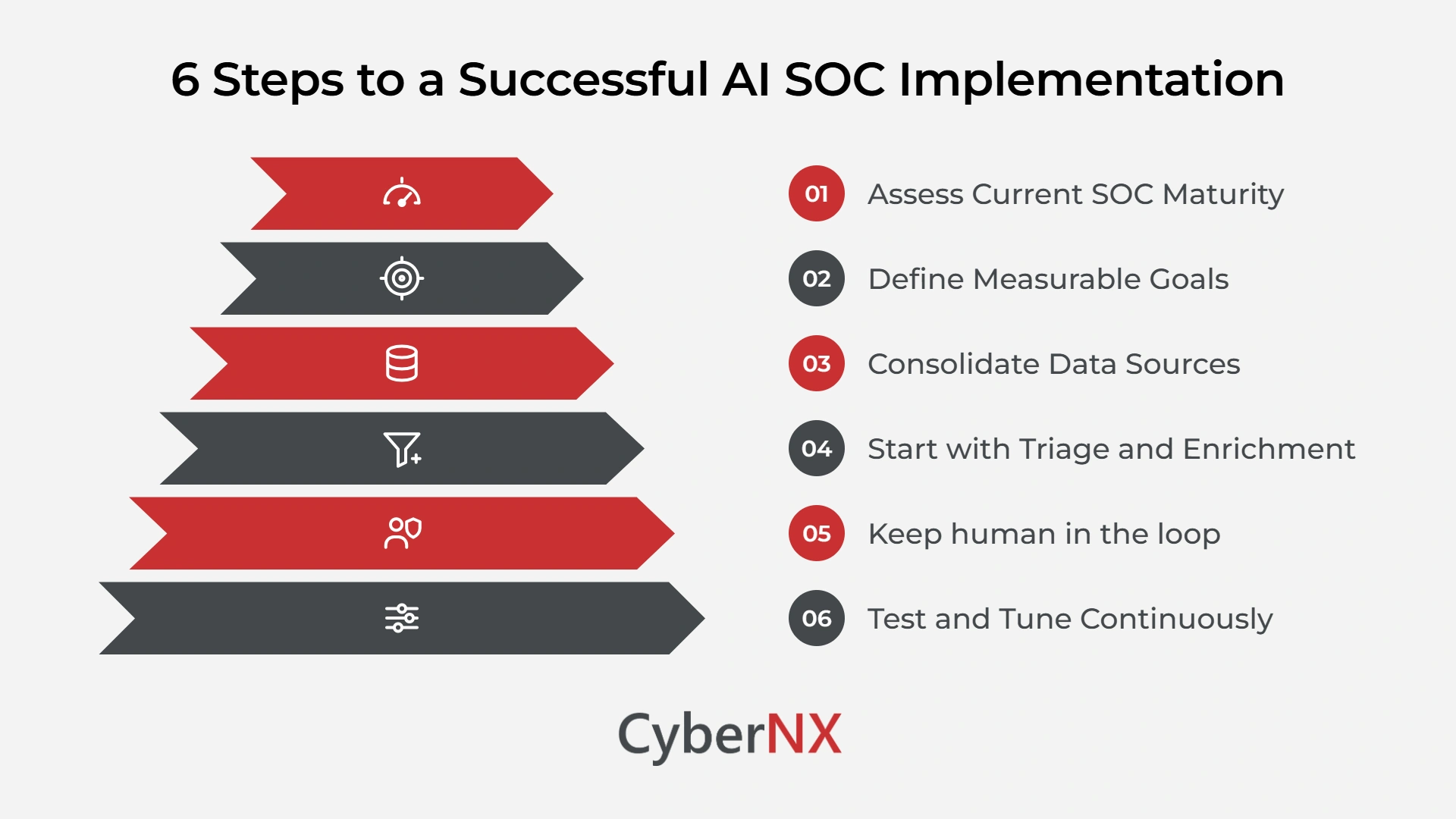
- Assess current SOC maturity: Review existing tools, log sources and analyst workflows before adding AI on top of them.
- Define measurable goals: Set specific targets, such as reduced mean time to detect (MTTD) or mean time to respond (MTTR), instead of a vague “add AI” objective.
- Consolidate data sources: Feed models from SIEM, EDR and cloud telemetry so detection has full context.
- Start with triage and enrichment: Let AI handle initial alert scoring and context-gathering before expanding into automated response.
- Build human oversight into every stage/Keep human in the loop: Keep analysts reviewing flagged incidents and auditing automated actions before they run unsupervised.
- Test and tune continuously: Refine detection rules and models as attack patterns and business systems change.
Common challenges in AI SOC implementation
A few obstacles come up repeatedly during rollout.
- Alert quality: Models trained on noisy or incomplete data produce false positives just as often as static rules do.
- Data readiness: Fragmented log sources across on-premises and cloud systems limit what AI in security operations can actually see.
- Skill gaps: Analysts need training to work alongside AI tools, not just monitor dashboards passively.
- Governance: Gartner predicts that by 2027, 40% of enterprises will demote or decommission autonomous AI agents because of governance failures, highlighting the importance of oversight and controls.
These challenges point to why a phased, oversight-driven rollout works better than a rushed one.
Conclusion
AI SOC implementation gives security teams the monitoring depth that Indian regulatory expectations increasingly assume, without pushing analysts into constant alert fatigue. Getting it right depends on a phased rollout, clean data and continuous human oversight.
CyberNX’s AI Managed SOC as a Service supports Indian firms with 24/7 monitoring, SEBI CSCRF and RBI-aligned reporting, and a team that keeps analysts in the loop at every stage. Connect with our team to plan AI SOC implementation built for your compliance and threat landscape.
AI SOC Implementation FAQs
What is AI SOC implementation?
It is the process of integrating AI and machine learning into a security operations centre to improve threat detection, alert prioritisation and incident response, while analysts continue to investigate and decide on action.
How long does it take for a mid-size Indian enterprise?
Timelines vary with tool stack complexity and data readiness, but a phased rollout, from initial assessment to triage automation, typically spans a few months rather than a single deployment event.
Does it replace human analysts?
No. This approach supports analysts by reducing noise and adding context. Investigation, judgement and final response decisions stay with people.
Is it required under SEBI CSCRF or RBI guidelines?
Neither framework names AI as mandatory. SEBI CSCRF requires continuous, real-time monitoring and evidence-based reporting, and RBI’s guidelines set similar governance and monitoring expectations, which AI-powered tools can help regulated entities meet at scale.