Seventy percent of large security operations centres are expected to pilot AI agents for Tier 1 and Tier 2 work by 2028, but only 15% will see measurable improvement without a proper approach to it, according to Gartner’s report on validating AI SOC agents. In other words, most teams will adopt the technology but very few will actually get it right. Simply adding AI tools on top of an old process does not fix anything. It just automates the same gaps, faster.
Getting AI SOC best practices right is what separates a security operations centre that catches real threats early from one that drowns in alerts with a new AI label on top. This guide covers the best practices for AI-powered security operations centre SOC teams in India, why they matter and how you can incorporate it.
What are AI SOC best practices?
These practices consist of the practical habits and processes that make an AI-powered security operations centre effective, not just automated. Adding AI models to a SOC changes what alerts look like and how fast they arrive. Without the right practices around that shift, teams end up automating noise instead of removing it.
The strongest programmes pair AI with clear ownership. Automation handles repetitive triage, while analysts focus on validating high-risk alerts, tuning models and investigating the incidents that matter most.
Why these practices matter for Indian enterprises
Cyberattacks against Indian organisations, particularly in BFSI, continue to grow in scale. CERT-In handled 29.4 lakh cybersecurity incidents in 2025, according to its own incident data. At that volume, an AI-powered SOC without strong practices around model tuning and analyst oversight can generate as much noise as it removes.
Regulatory obligations add another layer. CERT-In’s Directions under Section 70B of the IT Act require organisations to report qualifying incidents within six hours of detection and retain logs for 180 days. Following these practices, including continuous baseline tuning and clear escalation paths, helps teams meet that timeline consistently rather than by exception.
Core AI SOC best practices
A working AI-powered SOC usually follows these practices:
- Keep a human in the loop: Use AI to triage and prioritise, but route high-risk alerts to analysts for validation.
- Tune models continuously: Update behavioural baselines as the business changes to keep false positives low.
- Integrate the full stack: Connect AI detection with existing SIEM, EDR and cloud tools, rather than running it in isolation.
- Track the right metrics: Monitor false positive rate, mean time to detect and mean time to respond, not just alert volume.
- Plan for compliance from day one: Align retention, reporting and escalation processes with frameworks such as CERT-In’s Directions.
Skipping any one of these can show up quickly, usually as alert fatigue or missed detections.
How to build AI SOC best practices into daily operations
Turning these principles into a working routine follows a similar path across most organisations. The core steps are:
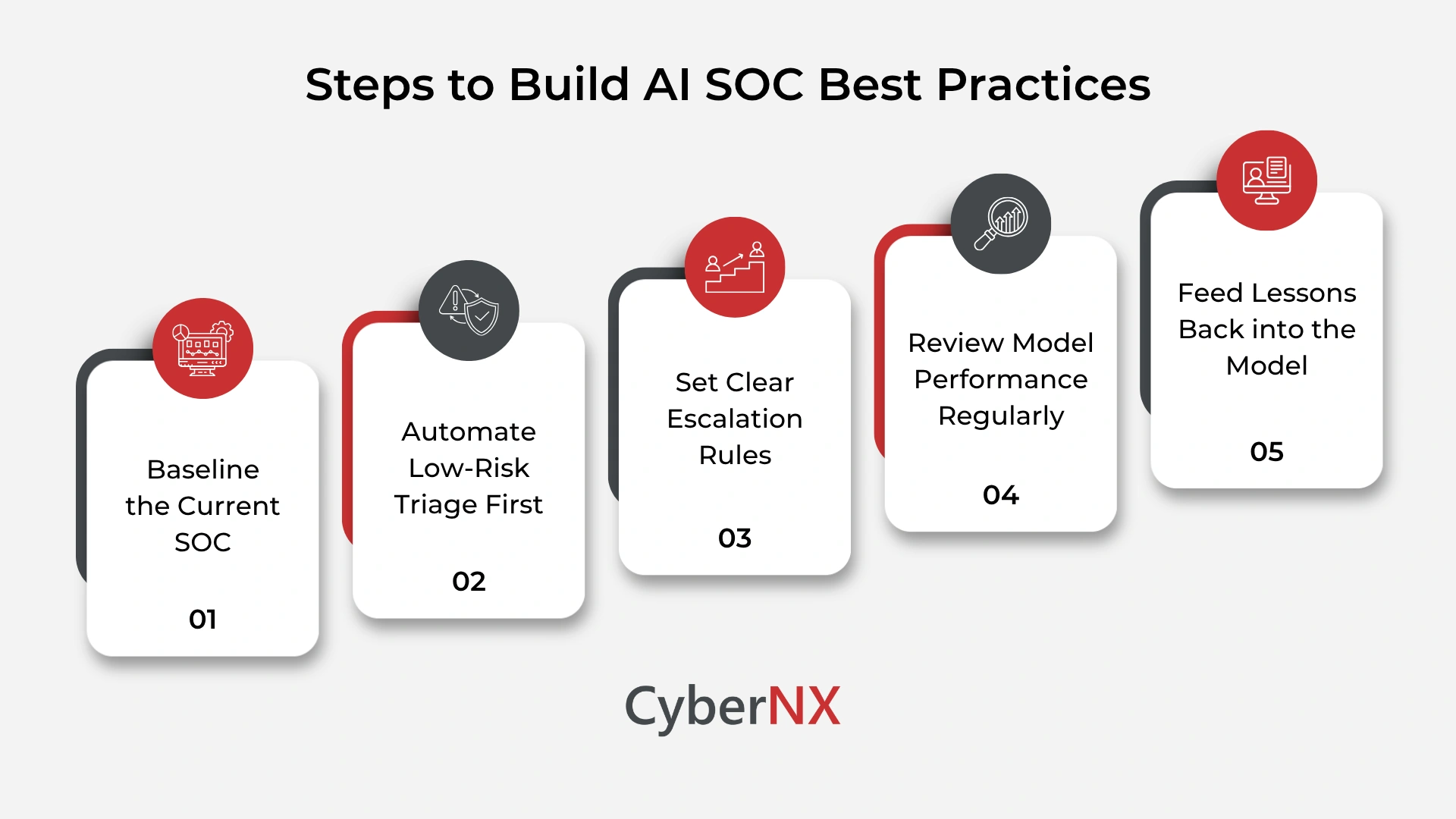
- Baseline the current SOC: Document existing alert volume, false positive rate and response times before adding AI.
- Automate low-risk triage first: Start with high-confidence, repetitive alerts so analysts see quick wins early.
- Set clear escalation rules: Define what AI can close automatically and what always goes to a human analyst.
- Review model performance regularly: Check for drift and retrain baselines as the environment changes.
- Feed lessons back into the model: Use analyst findings from real incidents to keep detection accurate over time.
Conclusion
These practices are what turn an AI-powered security operations centre into a genuine improvement. For Indian firms managing complex, fast-changing environments, getting them right directly reduces both response time and analyst burnout.
CyberNX applies these practices through its AI Managed SOC as a Service, which pairs machine learning and behaviour-based detection with 24/7 analyst oversight, full-stack integration and commercial threat intelligence. The service is built to cut through alert noise and reduce response time significantly, without adding headcount. To bring AI SOC best practices into your security operations, connect with our team today.
AI SOC Best Practices FAQs
What are AI SOC best practices?
AI SOC best practices are the habits and processes, such as human oversight, continuous model tuning and full-stack integration, that keep an AI-powered SOC accurate and effective.
How do best practices for AI-powered security operations centre SOC teams differ from a traditional SOC?
A traditional SOC relies mainly on manual triage and correlation. An AI-powered one needs added practices around model tuning, escalation rules and metric tracking to keep automation accurate.
Does adding AI reduce the need for SOC analysts?
It changes their focus rather than removing the role. Analysts spend less time on repetitive triage and more time validating high-risk alerts and investigating confirmed incidents.
Are AI SOC best practices relevant for compliance in India?
Yes. Following them consistently supports CERT-In’s six-hour incident reporting mandate and 180-day log retention rule, along with broader compliance obligations across BFSI.