Choose Language
Google Translate
Skip to content
Facebook X-twitter Instagram Linkedin Youtube
  • sales@cybernx.com
  • +91 90823 52813
CyberNX Logo
  • Home
  • About
    • About Us
    • CERT-In Empanelled Cybersecurity Auditor
    • Awards & Recognition
    • Our Customers
  • Services

    Peregrine

    • Managed Detection & Response
    • AI Managed SOC Services
    • Elastic Stack Consulting
    • CrowdStrike Consulting 
    • Threat Hunting Services
    • Digital Risk Protection Services
    • Threat Intelligence Services
    • Digital Forensics Services
    • Brand Risk & Dark Web Monitoring
    • Full Stack Observability

    Pinpoint

    • Red Teaming Services
    • Vulnerability Assessment
    • Penetration Testing Services
    • Secure Code Review Services
    • Cloud Security Assessment
    • Phishing Simulation Services
    • Breach and Attack Simulation Services

    nCompass

    • Cybersecurity Audit Services
    • Virtual CISO Services
    • DPDP Act Consulting
    • ISO 27001 Consulting
    • RBI Master Direction Compliance
    • SEBI CSCRF Framework Consulting
    • SEBI Cloud Framework Consulting
    • Security Awareness Training
    • Cybersecurity Staffing Services

    NXRadar

    • SBOM Solutions
    • CBOM Solutions
    • AIBOM Solutions
  • Industries
    • Banking
    • Financial Services
    • Insurance
  • Resources
    Blogs
    Case Studies
    Downloads
    Whitepapers
    Buyer’s Guide
    Research & Guides
  • Careers
  • English
    • English (US)
Contact Us
CyberNX Logo
  • English
    • English (US)
  • Home
  • About
    • About Us
    • CERT-In Empanelled Cybersecurity Auditor
    • Awards & Recognition
    • Our Customers
  • Services

    Peregrine

    • Managed Detection & Response
    • AI Managed SOC Services
    • Elastic Stack Consulting
    • CrowdStrike Consulting
    • Threat Hunting Services
    • Digital Risk Protection Services
    • Threat Intelligence Services
    • Digital Forensics Services
    • Brand Risk & Dark Web Monitoring
    • Full Stack Observability

    Pinpoint

    • Red Teaming Services
    • Vulnerability Assessment
    • Penetration Testing Services 
    • Secure Code Review Services
    • Cloud Security Assessment
    • Phishing Simulation Services
    • Breach and Attack Simulation Services

    nCompass

    • Cybersecurity Audit Services
    • Virtual CISO Services
    • DPDP Act Consulting
    • ISO 27001 Consulting
    • RBI Master Direction Compliance
    • SEBI CSCRF Framework Consulting
    • SEBI Cloud Framework Consulting
    • Security Awareness Training
    • Cybersecurity Staffing Services

    NXRadar

    • SBOM Solutions
    • CBOM Solutions
    • AIBOM Solutions
  • Industries
    • Banking
    • Financial Services
    • Insurance
  • Resources
    Blogs
    Case Studies
    Downloads
    Whitepapers
    Buyer’s Guide
    Research & Guides
  • Careers
  • Contact

Beyond the Rulebook: How AI Anomaly Detection Spots Hidden Threats

3 min read
39 Views
  • MDR

Every security team wants to catch an intruder the moment they slip in. But in practice, that rarely happens. Attackers now spend typically around 14 days inside a network before anyone notices – up from 11 days the year before, according to Mandiant’s M-Trends 2026 report. That gap gives an attacker plenty of time to look around, take data and cause damage, often without tripping a single rule-based alert.

This is the gap AI anomaly detection can help you close. Instead of waiting for an attacker to break a known rule, it learns what normal activity looks like for every user, device and application, then flags anything that does not fit. This guide explains how it works in simple terms, why it matters for Indian enterprises and how CyberNX builds it into its security services.

Table of Contents

What is AI anomaly detection?

This technology is a way of spotting unusual activity in a network by using machine learning instead of fixed rules. Older tools worked off a checklist. If an action matches a known bad pattern, an alert fires. If it does not match anything on the list, nothing happens, even if the behaviour is suspicious.

Using AI for anomaly detection flips this approach. Rather than checking activity against a list of known threats, the system builds a picture of what normal looks like for each user, device and application, based on real historical behaviour. Once that baseline exists, it can flag anything that moves away from it, including attack patterns nobody has documented before. This makes it far better suited to catching zero-day threats and slow, quiet intrusions that a rule-based system would let through.

Why AI anomaly detection matters for Indian enterprises

Cyberattacks against Indian organisations, particularly in BFSI, keep growing in volume and complexity. CERT-In handled 29.4 lakh cybersecurity incidents in 2025, up nearly 44% from 2024, according to its own incident data. At that scale, manual review alone cannot keep pace, and small deviations in behaviour are easy to miss until they turn into a full incident.

Regulatory pressure adds to the case for faster detection. CERT-In’s mandate under Section 70B of the IT Act requires organisations to report qualifying incidents within six hours of detection. Catching an anomaly early, before it escalates into a confirmed breach, gives security teams the time they need to investigate and report within that window instead of scrambling after the fact.

Core capabilities of AI anomaly detection

This approach brings several capabilities that a static, rule-based system cannot match:

  • Behavioural baselining: Learns normal patterns for users, devices and applications, then flags deviations
  • Pattern correlation: Connects related signals across endpoints, network and cloud data to build a fuller picture
  • Automated scoring: Ranks anomalies by risk so analysts focus on what matters most first
  • Continuous adaptation: Updates its baseline as the business changes, reducing false alerts over time
  • Coverage for unknown threats: Flags novel or zero-day attack patterns that have no matching signature

Each of these reduces the manual effort security teams spend chasing alerts that turn out to be nothing.

How AI anomaly detection works in practice

This capability does not operate as a standalone tool. It sits inside a broader security workflow and feeds analysts better, faster context. The process typically follows five steps.
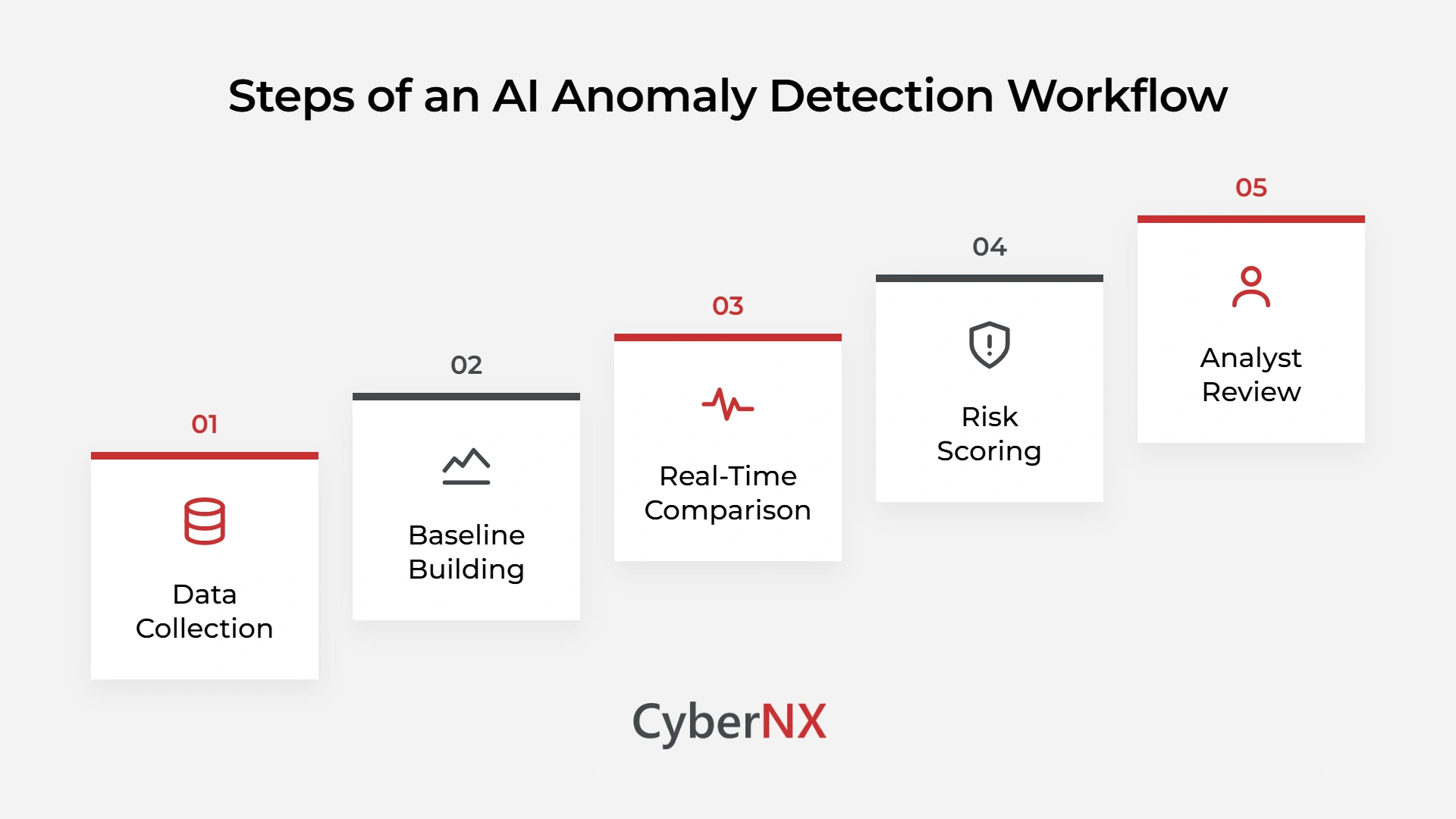
Steps of an AI for Anomaly Detection Workflow

  • Data collection: Activity logs from endpoints, networks, cloud platforms and applications are gathered into a single view.
  • Baseline building: The system studies historical activity to learn what normal behaviour looks like for each user and asset.
  • Real-time comparison: New activity is checked against the baseline to spot deviations as they happen.
  • Risk scoring: Detected anomalies are ranked by potential impact, so the most urgent ones surface first.
  • Analyst review and response: Security analysts validate high-risk anomalies and take action to contain any confirmed threat.

Conclusion

This kind of detection helps security teams spot threats that traditional, rule-based tools were never built to catch, at a time when attackers are getting better at moving quietly through network. For Indian companies managing complex, fast-changing environments, that earlier warning translates directly into less damage and lower recovery cost.

CyberNX delivers this through its AI-enabled Managed Detection and Response (MDR) service, which layers behavioural anomaly detection on top of round-the-clock monitoring across endpoints, networks and cloud environments. A dedicated team of analysts and threat hunters investigates every high-risk anomaly backed by machine learning, generative AI and real-time reporting through a live threat management dashboard. To bring AI anomaly detection into your security operations, connect with our team today.

AI Anomaly Detection FAQs

What is AI anomaly detection?

AI anomaly detection uses machine learning to identify unusual activity in a network by comparing it against a learned baseline of normal behaviour, rather than relying only on fixed rules.

How is AI anomaly detection different from traditional monitoring?

Traditional monitoring flags activity that matches a known bad pattern. This approach flags activity that deviates from normal behaviour, which helps it catch threats nobody has seen before.

Can AI anomaly detection replace human security analysts?

No. It reduces the noise analysts have to sift through and ranks anomalies by risk, but analysts still validate findings and lead the response.

Is AI for anomaly detection relevant for compliance in India?

Yes. Faster detection supports reporting timelines under frameworks such as CERT-In’s six-hour incident reporting mandate and broader compliance obligations across BFSI.

Author
Krishnakant Mathuria
LinkedIn

With 12+ years in the ICT & cybersecurity ecosystem, Krishnakant has built high-performance security teams and strengthened organisational resilience by leading effective initiatives. His expertise spans regulatory and compliance frameworks, security engineering and secure software practices. Known for uniting technical depth with strategic clarity, he advises enterprises on how to modernise their security posture, align with evolving regulations, and drive measurable, long-term security outcomes.

Share on

WhatsApp
LinkedIn
Facebook
X
Pinterest

For Customized Plans Tailored to Your Needs, Get in Touch Today!

Connect with us

RESOURCES

Related Blogs

Explore our resources section for insightful blogs, articles, infographics and case studies, covering everything in Cyber Security.
Why Security Log Analysis Matters

Reading between the Logs: Why Security Log Analysis Matters

One of the first things many attackers do after breaking in is quiet, and easy to miss: they clear the

Smarter Detection Starts Here: Parsing in CrowdStrike NG-SIEM

Data Normalization & Parsing Best Practices in CrowdStrike NG-SIEM

A modern enterprise generates massive amount of data, which is then fed into a SIEM. A centralized plcatform which assesses

Learn How to Design Detection Rules in CrowdStrike NG-SIEM

How to Design Detection Rules in CrowdStrike NG-SIEM: Expert Guide

Raw data alone does not help security teams stop attacks. The real value comes from well-designed detection logic that identifies

RESOURCES

Cyber Security Knowledge Hub

Explore our resources section for insightful blogs, articles, infographics and case studies, covering everything in Cyber Security.

BLOGS

Stay informed with the latest cybersecurity trends, insights, and expert tips to keep your organization protected.

CASE STUDIES

Explore real-world examples of how CyberNX has successfully defended businesses and delivered measurable security improvements.

DOWNLOADS

Learn about our wide range of cybersecurity solutions designed to safeguard your business against evolving threats.
CyberNX Footer Logo
Book a Free Call

Peregrine

  • Managed Detection & Response
  • AI Managed SOC Services
  • Elastic Stack Consulting
  • CrowdStrike Consulting
  • Threat Hunting Services
  • Digital Risk Protection Services
  • Threat Intelligence Services
  • Digital Forensics Services
  • Brand Risk & Dark Web Monitoring
  • Full Stack Observability

Pinpoint

  • Red Teaming Services
  • Vulnerability Assessment
  • Penetration Testing Services
  • Secure Code Review Services
  • Cloud Security Assessment
  • Phishing Simulation Services
  • Breach and Attack Simulation Services

nCompass

  • Cybersecurity Audit Services
  • Virtual CISO Services
  • DPDP Act Consulting
  • ISO 27001 Consulting
  • RBI Master Direction Compliance
  • SEBI CSCRF Framework Consulting
  • SEBI Cloud Framework Consulting
  • Security Awareness Training
  • Cybersecurity Staffing Services

NXRadar

  • SBOM Solutions
  • CBOM Solutions
  • AIBOM Solutions
  • About
  • CERT-In
  • Awards
  • Careers
  • Sitemap
Facebook Twitter Instagram Youtube

Copyright © 2026 CyberNX | All Rights Reserved | Terms and Conditions | Privacy Policy

  • English
    • English (US)
Copyright © 2026 CyberNX | All Rights Reserved | Terms and Conditions | Privacy Policy
Scroll to Top

WhatsApp us

Not Sure Where to Start with Cybersecurity?

We value your privacy. Your personal information is collected and used only for legitimate business purposes in accordance with our Privacy Policy.