Modern cyberattacks are not governed by rulebooks. They are sophisticated, evasive, and target the most valuable, and often most complex, parts of your organization: your business processes, trusted systems, and critical workflows. These adversaries are strategically exploiting the human, logic, and configuration gaps within your infrastructure.
Yet, a dangerous reality persists: many organizations still treat their security assessments, even Red Teaming, as a mandatory, check-the-box chore for auditors. This creates The Checkbox Problem, a costly cycle where engagements produce dense reports but fail to deliver tangible, real-world security improvements or business value. The need of the hour is advanced red teaming.
The checkbox problem: why traditional approaches fall short
If your security assessment feels like a predictable routine, it is likely suffering from critical shortcomings that limit its effectiveness and ROI:
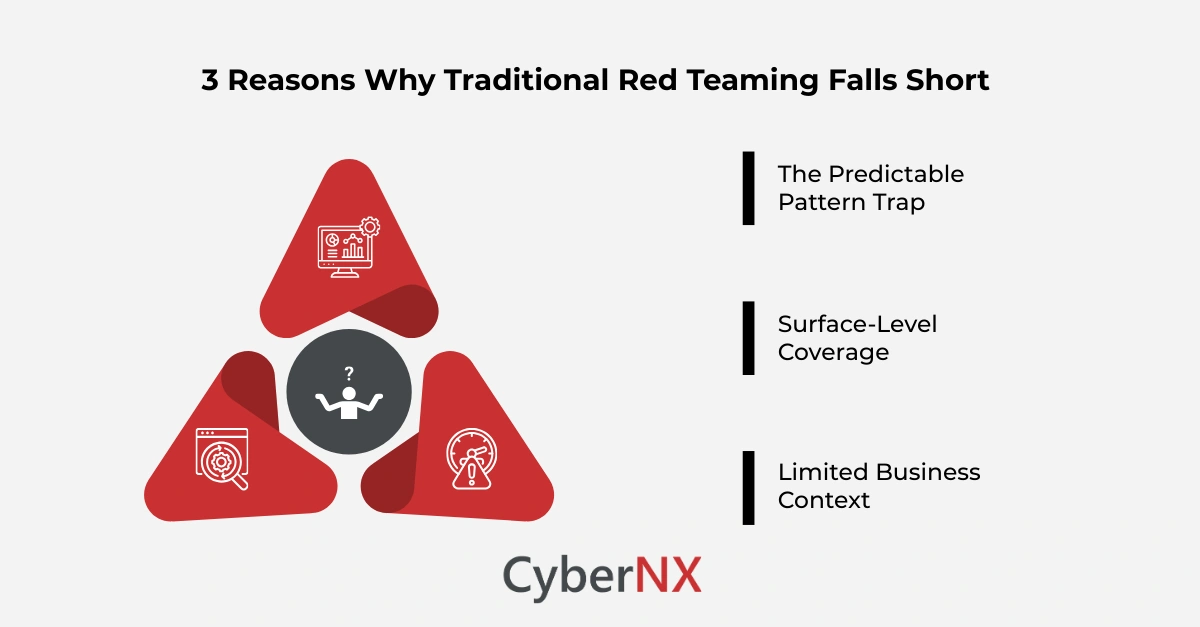
- The predictable pattern trap: Real-world threats evolve rapidly. “Basic” red teams, however, often rely on recycled, known techniques, resulting in repeated findings and creating dangerous security blind spots for novel or evasive attacks.
- Surface-level coverage: The most damaging breaches rarely start with simple CVEs. They exploit deep-seated, complex flaws: Business logic flaws (manipulating app logic), Misconfigured APIs (bypassing authentication), Abuse of privileged workflows, and Human-focused social engineering areas traditional methods rarely test.
- Limited business context: An advanced attacker’s goal is not a “Domain Admin” status; it is Money, Sensitive Data, Operational Downtime, or Market Manipulation. If the assessment objectives don’t translate into quantifiable financial and operational risk, the results are irrelevant to executive leadership.
These gaps undermine the return on security investment and fail to prepare teams for real-world threats. This is where advanced red teaming shifts the entire outcome.
Move toward business-focused adversarial simulation
The path to turning a security expense into a strategic investment is clear: Shift the focus from a purely technical hunt for exploits to a realistic, business-focused adversarial simulation. The goal changes from documenting weaknesses to validating your organization’s ability to Detect, Respond, and Contain a sophisticated, persistent threat.
Advanced red teaming aims to validate resilience, not just identify issues. It gives leadership confidence that the organisation can withstand the tactics of a determined attacker – not just a compliance audit.
Basic vs. Advanced Red Teaming: A Comparison of Objectives
In an advanced model, a defensive success – whether detection or containment – is a positive outcome. When an attack succeeds, it becomes a clear measure of business-critical risk and shapes the roadmap for the next quarter.
| FEATURE | BASIC “CHECKBOX” OBJECTIVES (TECHNICAL FOCUS) | ADVANCED BUSINESS-FOCUSED OBJECTIVES (RESILIENCE & IMPACT) |
| Primary Goal | Identify and document technical vulnerabilities within a defined scope. | Achieve a specific business-critical impact and test the effectiveness of defence (people, process, technology). |
| Typical Objective |
|
Compromise trading API without detection, Manipulate transaction workflows, Exfiltrate customer PII. |
| Scope | Narrow: Focuses almost exclusively on IT systems and network perimeter. | Broad: Includes IT, cloud, OT (if applicable), social engineering, physical access, and application logic. |
| Duration | Short (Days to 1-2 Weeks). | Long-term (Weeks to Months) to mimic real APT persistence. |
| Outcome | 100% Technical Success Rate—Zero insights on defence capability or business impact. | 71% Success Rate (Example)—Deep, prioritized insights into actual business risk and quantifiable detection gaps. |
In the advanced model, a successful defence (a detection or containment) is celebrated as a validated control. A successful attack is not just a finding; it is a quantified, critical business risk that dictates the security roadmap for the next fiscal quarter.
Case study: value multiplier in financial services
A basic red team might deliver a vulnerability list (useful for IT patch management). An advanced, value-driven engagement, however, delivers intelligence on operational risk:
| AREA | ACTIVITY DETAIL | STRATEGIC BUSINESS INSIGHT |
| Threat Intelligence | Research on financial-sector APT TTPs. Business Analysis mapping key transaction paths. | Ensures simulation is relevant to the company’s highest-risk financial assets, not generic threats. |
| Logic & API Attacks | Targeted testing of trading/approval logic and business-critical APIs. | Identifies systemic flaws that bypass traditional perimeter defences and could lead to unauthorized capital movement. |
| Defence Validation | Covert lateral movement, data exfiltration, and persistence activities. | Measurable failure rates: IR team detected only 50% of activities; fraud detection rules were bypassed. Validates gaps across People, Process, and Technology. |
The advanced approach, while more resource-intensive, delivers a 10x return on value by moving from a technical checklist to a Resilience Report.
Why the advanced approach is a strategic must-have
Advanced, Threat-Led Adversarial Simulation is the ultimate evolution of a mature security program, delivering four core strategic benefits:
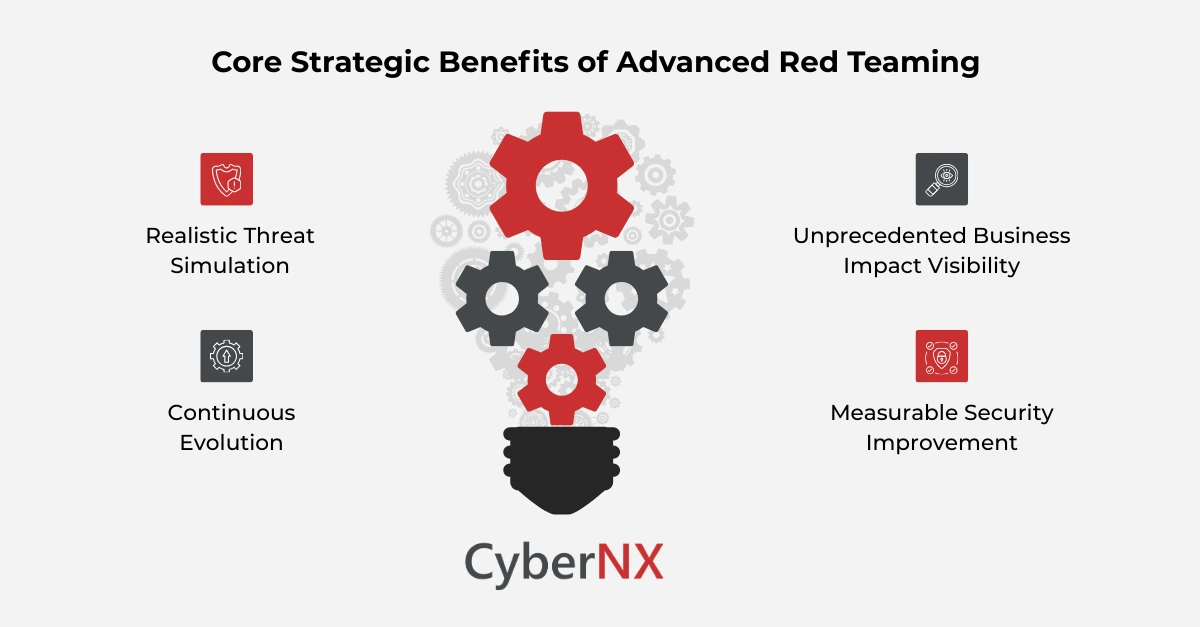
- Realistic Threat Simulation: By modelling TTPs from known adversaries (APTs, e-crime syndicates), the exercise pressure-tests your defences against the threats you are actually facing.
- Unprecedented Business Impact Visibility: Leaders get clear, non-technical answers: How much money could be lost? Which key workflow was manipulated? Did our SOC detect the threat before the critical breach point?
- Measurable Security Improvement: It establishes clear KPIs for detection rate, Mean Time To Respond (MTTR), and MITRE ATT&CK coverage, ensuring security investment translates into demonstrable progress.
- Continuous Evolution: Threats evolve, and so must your testing. This approach is an ongoing feedback loop, integrating findings back into defence, security training, and technology investment.4
Conclusion
Checkbox red teaming answers the question: “Can we be breached?”
Advanced adversarial simulation answers the questions that truly define your organization’s security maturity and resilience:5
- “How will attackers specifically target our core business processes?”
- “How quickly can we detect and contain them?”6
- “What is the real financial and operational impact if they succeed?”
Organizations that embrace business-focused red teaming gain clarity, maturity, and a battle-tested defence, not just another report to file for an audit.
At CyberNX, our advanced red teaming engagements help organisations validate their defences against real-world threat actors. If you want support in assessing attack readiness, strengthening detection and response, or benchmarking your resilience against sophisticated adversaries, connect with us for a consultation. Every engagement with us moves your organisation closer to a truly hardened security posture.
Advanced Red Teaming FAQs
How does advanced red teaming improve security compared to a standard assessment?
It tests real attacker behaviour across people, process and technology. Rather than listing issues, it gives measurable insight into how well the organisation can detect and contain a determined adversary.
How long does an advanced red team exercise typically run?
These engagements usually run for weeks or months. The goal of a red team exercise is to mirror persistent threat behaviour rather than short, predictable testing cycles.
Who benefits most from advanced red teaming?
Leadership teams, SOC analysts, risk owners and technology leaders gain clarity on true business impact, defensive gaps and the maturity of real-time detection.
Does advanced red teaming replace penetration testing?
No. Penetration tests address technical weaknesses. Advanced red teaming validates overall resilience and complements regular testing.