In October, we published two blogs for non-banking financial companies (NBFCs). The first covered NBFC cybersecurity readiness under the 2026 Directions from the Reserve Bank of India (RBI). The second covered what NBFCs should test across lending apps, APIs and cloud. We wrote both because we felt NBFCs were becoming a bigger target, and many were not ready for it.
Within a week of publishing, that risk turned into real losses. Attackers drained crores from smaller NBFCs. CERT-In named an AI-assisted threat actor behind many of the attacks. RBI then set firm deadlines for the APIs that move money between banks and NBFCs.
This blog post picks up where those two guides left off. You will see what changed in the last six weeks and where our earlier advice needs an update. We also cover what to fix before the first deadline on 3 Dec 2026.
What has happened since our two NBFC guides
The last six weeks moved fast. Here is what happened, in order.
October brought real losses, mostly at smaller NBFCs
On Oct 29, trusted media reports revealed that:
- Close to ₹300 crore had been taken from NBFCs over two months
- Around 150 police complaints and first information reports had been filed. Most victims were smaller lenders.
- One Delhi NBFC reportedly lost ₹7.5 crore, then another ₹7.25 crore a few days later
- A Hyderabad NBFC allegedly saw 183 unauthorised disbursements, worth about ₹3.3 crore, in just 87 minutes.
CERT-In names Crafty Falcon
CERT-In first warned about these attacks on Oct 9. Its advisory flagged campaigns abusing payment and disbursement APIs at NBFCs, digital lenders, fintechs and payment firms.
On Nov 4, it issued a critical-rated update and named the attacker Crafty Falcon. CERT-In describes it as an AI-assisted group that studies its targets with machine help. It moves money through the victim’s own payment APIs, often starting with ₹1 test transfers. It also hunts for test and development systems left open to the internet, where shared credentials can lead into production.
The most worrying detail is repeat targeting. Some NBFCs fixed the issues flagged in October and were still hit again. However, note that CERT-In has not linked every incident to this one group.
RBI turns its attention to APIs
RBI responded on Nov 3 with a confidential advisory to banks that offer API-based fund transfers to NBFCs. Media reports say a companion advisory sets matching duties for NBFCs.
Based on those reports, these are the dates and duties that matter most:
- Existing API integrations need at least one safeguard by 3 December 2026. That means beneficiary whitelisting or maker-checker approval, where one person creates a payment and another approves it.
- NBFCs using bank APIs need a security audit by a CERT-In-empanelled auditor. New NBFC clients must finish it before onboarding. Existing ones have until 3 February 2027.
- Banks must watch for warning signs such as value spikes, payments just under limits, odd-hour activity and bursts of new beneficiaries.
In the same week, the Indian Cyber Crime Coordination Centre issued a public warning about AI-assisted attacks on banks, NBFCs and fintechs.
Where NBFCs should focus first
The attacks expose two gaps in our earlier guidance. One is who is at risk and the other is where the money moves.
Smaller NBFCs need their own priority list
Our readiness guide noted that its seven areas apply most fully to middle layer and larger base layer NBFCs. The October losses tell a different story. The lenders losing money were mostly smaller ones.
Base layer NBFCs below ₹500 crore have a lighter baseline under the 2026 Directions. But from what has been reported, RBI’s API advisory does not scale by layer. If your NBFC moves money through a bank API, the audit and the Dec 3 safeguard apply to you.
Your first step is to list every bank, gateway and partner connection that can send money out, and name one owner for each. Then ask your partner bank what evidence it now needs from you.
How the attackers moved money
CERT-In’s analysis shows the attackers rarely needed the lending app. They broke into internet-facing systems and exposed APIs. From there, they stole credentials for payment gateways, aggregators and partner banks.
With those credentials, they called the disbursement API directly. That skipped every check that should come first, from loan creation and Know Your Customer checks to sanction and limits. Some payouts carried dummy loan numbers. Funds went to mule accounts at several banks.
Our lending app guide treated partner APIs mainly as inputs, checking what your systems trust when partners send data back. These attacks went the other way. They used your own outbound credentials to push money out.
Five API controls to put in place now
CERT-In found the weak points were basic. They included unauthenticated or outdated APIs, passwords stored in code and config files, and remote access without MFA. These five controls close most of that gap:
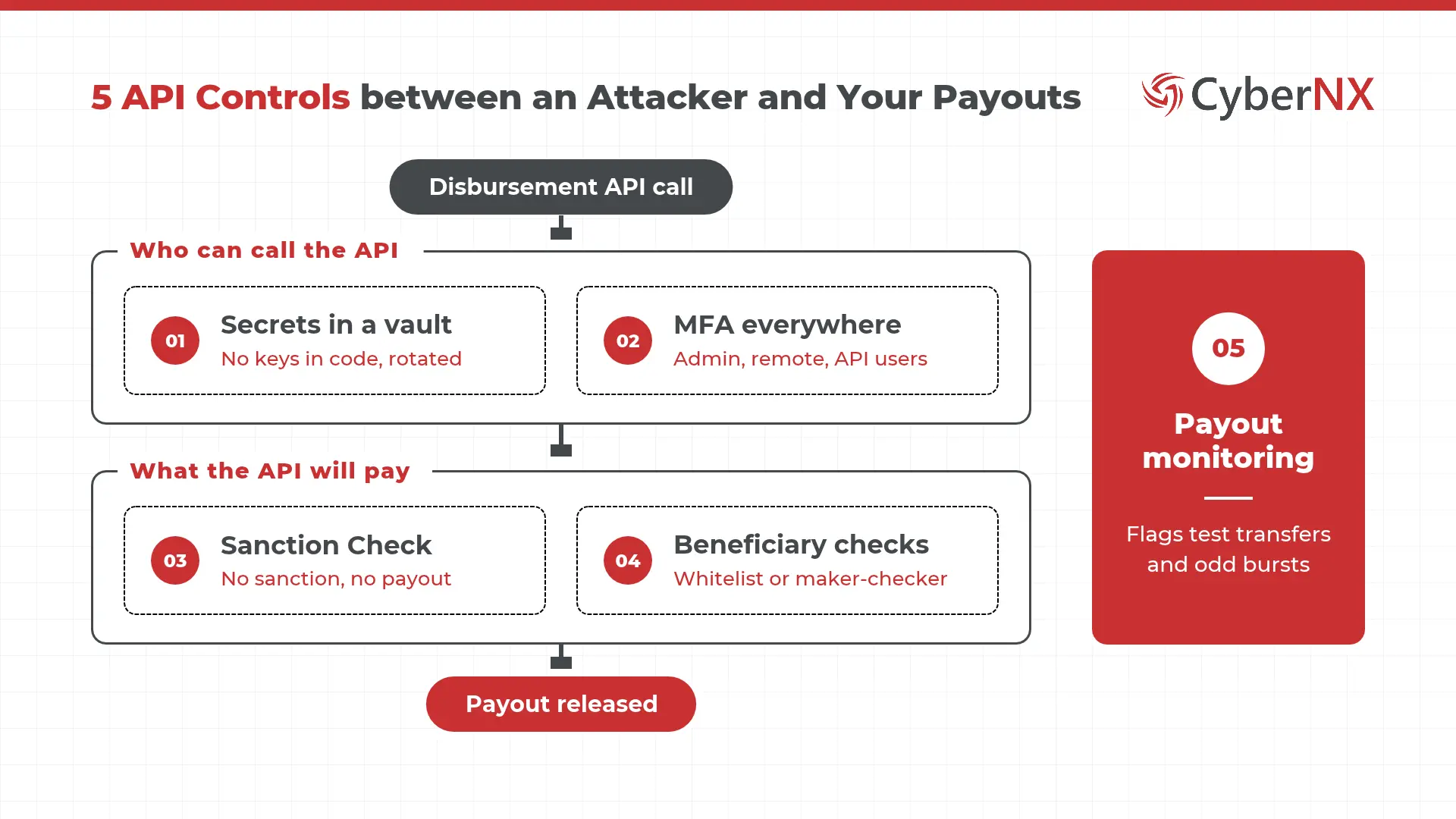
- Move API keys and partner credentials out of code and into a secrets vault, and rotate them on a schedule.
- Require MFA on every admin console, remote service and privileged API user.
- Make the disbursement API reject any payout that does not match an approved loan record.
- Add beneficiary whitelisting or maker-checker approval for fund transfers, as RBI now expects.
- Watch your own payout patterns for test transfers and unusual bursts, rather than waiting for your bank to spot them.
Then test it the way an attacker would. A good API test calls disbursement endpoints out of sequence, with reused or stolen tokens.
Conclusion
Six weeks changed the NBFC threat picture. The biggest risk has moved from data exposure to direct money movement through APIs and smaller NBFCs are taking most of the losses. Our two earlier guides still give you the foundation for governance, audits and testing. This post adds the API controls and corrections that the past six weeks made urgent.
At CyberNX, we work alongside NBFC teams on exactly these gaps, from API testing to audit readiness. Not sure where your payout flows stand? Talk to our team, and we will help you find and fix the gaps ahead of the deadline.
FAQs
Does RBI’s Nov 3 API advisory apply to small NBFCs?
Based on media reports, yes, if your NBFC uses a bank’s API to move funds. The audit and safeguard rules attach to the API connection rather than the NBFC’s layer. Check with your partner bank, since it must enforce them.
What is Crafty Falcon?
Crafty Falcon is CERT-In’s name for an AI-assisted threat actor targeting Indian financial firms. It abuses payment and disbursement APIs to make unauthorised transfers, often testing with ₹1 payments first.
Should NBFCs report incidents to both RBI and CERT-In?
Yes. Both expect a report within six hours. Housing finance companies send their regulatory report to the National Housing Bank but still report to CERT-In.