AI is sprinting ahead: AI agent now generates content, supports software development, assists customers, processes documents, analyses data and automate workflows. Many of these experiments have demonstrated enough value to justify the next question: how do we take AI into production and scale it across the enterprise?
Scaling AI means connecting it to sensitive enterprise data, business applications, customer-facing systems and increasingly autonomous AI agents. More users, integrations and data flows create a broader attack surface and introduce questions around access, privacy, governance, third-party risk, monitoring and accountability.
Research from IDC found that 88% of AI pilots never reach production, with failures clustering around governance, data readiness and observability rather than model quality.
For the enterprise leader responsible for AI transformation, the practical challenge is to establish a structured path from experimentation to secure, controlled adoption.
This means deciding which use cases are ready to scale, understanding what they can access and do, assessing the associated risks, putting appropriate security controls in place, and establishing continuous monitoring once they enter production.
The following steps provide that path.
Decide which AI experiments are ready to scale
Not every successful AI experiment needs to become an enterprise-wide deployment.
Start by assessing the use case against a few questions:
- Does it deliver measurable business value?
- What data does it require?
- Does it handle sensitive, personal or regulated information?
- What systems does it connect to?
- Will it make recommendations or take actions?
- How many users will eventually depend on it?
- What would happen if it produced an incorrect or manipulated output?
The answers determine the level of scrutiny required. They are not pass or fail. Two use cases can both be worth scaling and still deserve very different levels of control, which is what Step 3 sets out.
Use-Case
Consider a bank that has tested an AI assistant internally to answer employee questions. Moving that assistant into customer-facing banking services changes its risk profile. It may now interact with customer information, identity systems and banking applications.
Similarly, an insurer may begin by using AI to summarise claims documents. Scaling the use case to support claims assessment introduces questions around sensitive policyholder information, decision accuracy and auditability.
In healthcare, an AI tool that helps one clinician prepare documentation is very different from an organisation-wide deployment connected to electronic health records and patient information.
The first step is to identify what is ready to scale and understand what changes when it does.
Map the AI environment before securing it
Before moving an AI use case into production, map the components involved:
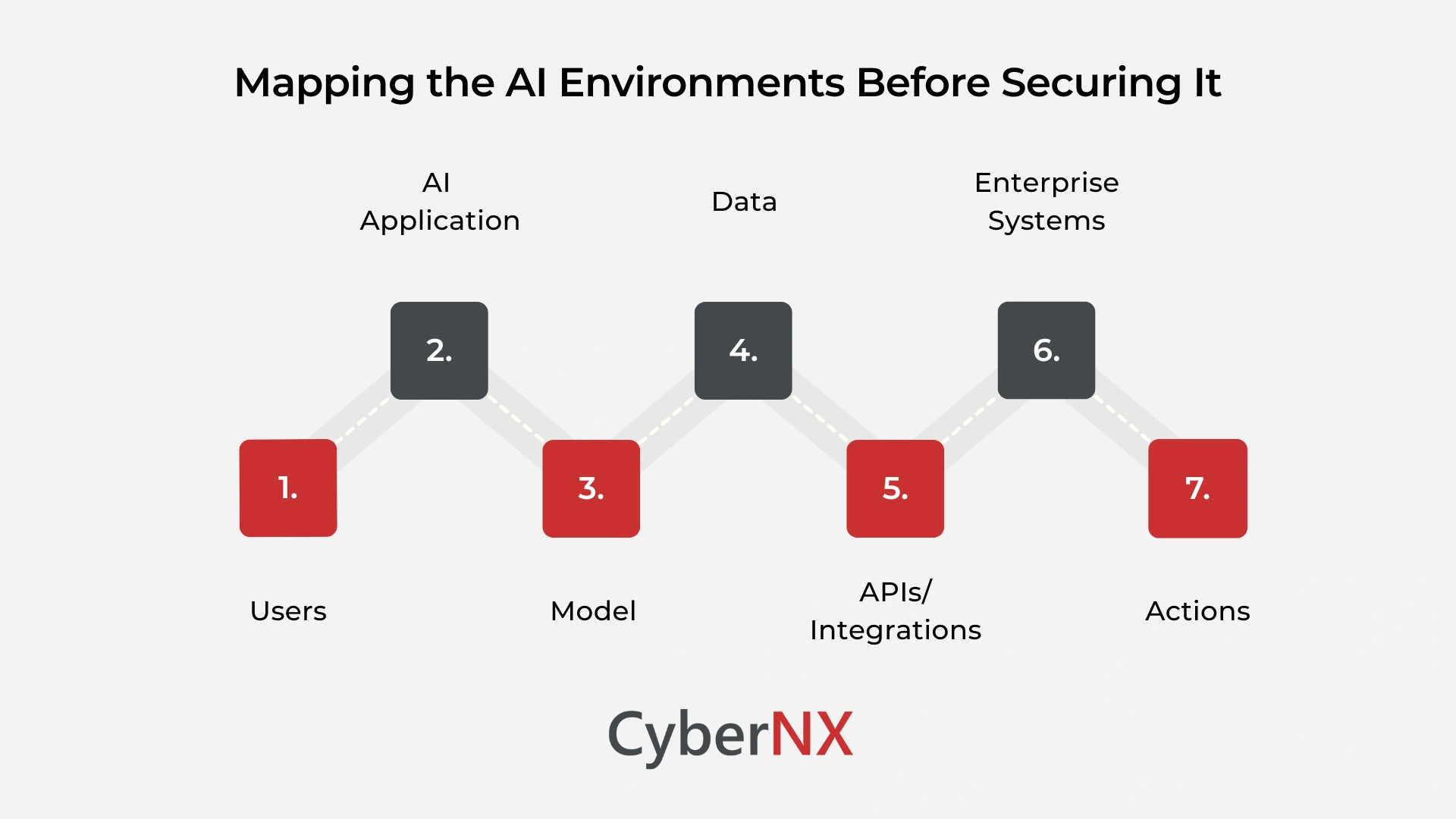
This should include approved AI tools as well as AI applications that employees may have adopted independently. That second category is not a footnote. IBM’s 2026 Cost of a Data Breach report found shadow AI incidents in 43% of breached organisations, more than double the 20% recorded a year earlier.
The objective is to establish:
- Which AI applications are being used
- Which models and providers they depend on
- What data they receive
- Where that data comes from
- Which APIs and enterprise systems they connect to
- What permissions they have
- What actions they can perform
- Who owns and operates them
This becomes particularly important as organisations move from generative AI tools toward AI agents.
An AI system that generates a summary presents one set of risks. An agent that can retrieve customer information, update a record or trigger a workflow has a much greater operational impact. Visibility provides the foundation for deciding what needs to be protected.
Assess risk based on what the AI can access and do
Assess the use case across four practical dimensions:
- Data: What information can the AI access? Public information presents a different risk from customer records, financial information, intellectual property or patient data.
- Access: Who can use the AI and what can it access? A tool available to a small internal team is different from one exposed to thousands of employees or external customers.
- Action: What can the AI do? Generating text is different from making decisions, modifying records, executing transactions or triggering downstream processes.
- Impact: What happens if the AI is compromised, manipulated or produces an incorrect output? The consequences could range from an inaccurate response to data exposure, financial loss, regulatory action or disruption to a critical business process.
Turning the four dimensions into a tier
Together, these four dimensions place any use case in one of three tiers. The tier then determines the depth of control it earns.
| Tier | Typical profile | Control depth |
| Low | Public or internal non-sensitive data, small internal user group, generates text only, human reads every output | Acceptable use policy, basic logging, a named owner |
| Medium | Internal confidential or limited personal data, broad internal use, drafts or recommends with human approval | Add data classification, least-privilege retrieval, output review, usage monitoring |
| High | Regulated, personal, financial or health data, customer-facing or organisation-wide, executes actions or decides autonomously | Add adversarial testing, tool allow-listing, human approval for consequential actions, full audit trail, continuous monitoring |
The greater the sensitivity of the data, level of access, degree of autonomy and potential business impact, the stronger the controls need to be.
Tiering matters because it prevents the two failure modes that stall AI programmes: applying heavyweight review to trivial use cases until nothing ships, and waving through the one deployment that genuinely needed scrutiny.
Understand what makes AI risk different
Before deciding on controls, it is worth being specific about which risks are new. Many AI security discussions stop at controls any enterprise application would need. Those still apply, but they do not cover the risks that exist only because a model sits in the path.
The OWASP Top 10 for Large Language Model Applications is the reference worth knowing, and five entries matter most at enterprise scale.
1. Prompt injection
Instructions and data reach the model through the same channel, so it cannot reliably tell a user’s request from text that merely looks like one. The version that matters in production is indirect injection: a hidden instruction inside a document, email or web page that your AI application later retrieves. The user asked something innocent. The attacker wrote the instruction.
2. Sensitive information disclosure
An AI application often inherits broader retrieval permissions than the person querying it, and returns something that person was never entitled to see.
3. Excessive agency
An agent granted more tools, more permissions or more autonomy than its task requires becomes an attack path. The question is not what the agent is for. It is what the agent is capable of, and who authorised that.
4. Improper output handling
Model output passed to a downstream system without validation can carry injection or code execution into that system. This chains directly with prompt injection: the attacker manipulates the model, and the application executes the result.
5. Supply chain and model poisoning
Third-party models, hosted APIs, open-source frameworks and embedding stores enter the environment as dependencies, and manipulated training or retrieval data can alter behaviour quietly.
No technique eliminates prompt injection. Layered controls reduce likelihood and cap the damage, which is what the next section covers.
Put security controls around the AI lifecycle
Once the risks are understood, organisations can determine the controls required. These should cover the entire AI environment rather than focusing only on the model.
1. Protect the data
Define what information AI applications can access and what employees are permitted to submit to them.
Data classification, access controls, encryption and data-loss prevention can help reduce unintended exposure. Enforce this at the point content reaches the AI system, not in a policy document afterwards.
2. Secure identities and access
AI applications, users and agents need appropriate authentication and authorisation.
Apply least privilege so that an AI system receives only the access required for its intended task.
For agents, this becomes even more important: what an agent is capable of doing should be explicitly controlled. Allow-list tools, require human approval for actions that move money or change records, and log every tool call alongside the prompt that triggered it. An agent’s permissions are the ceiling on what a successful prompt injection can achieve.
3. Validate outputs
Treat model output as untrusted input. Sanitise and encode it before any downstream system consumes it, using the same discipline already applied to user input.
4. Secure applications and integrations
AI applications increasingly connect to APIs, SaaS platforms, databases and internal systems. These connections need to be assessed and secured as part of the AI deployment rather than treated as separate infrastructure.
5. Assess models and third parties
Enterprises may depend on external models, APIs, AI platforms, open-source components and vendors. The security and privacy implications of these dependencies should form part of third-party and AI risk assessments.
6. Govern AI use
Define ownership, acceptable use, risk assessment requirements, approval processes and accountability. Governance should answer a basic question:
Who is responsible when an AI system creates a security, privacy or business risk?
If that question has no name attached to it, nothing else on this list will hold. IBM found that 68% of breached organisations had no AI governance policy in place at all.
7. Monitor AI activity
Security controls cannot end when an AI application goes live. Organisations need visibility into usage, data access, unusual behaviour, policy violations and potentially malicious activity.
Together, these controls create a security foundation that can support AI adoption rather than becoming an obstacle to it.
Scale in stages
The safest path from experimentation to enterprise adoption is not a single jump from pilot to full deployment. A staged approach provides opportunities to validate both business value and security controls. Each stage should have an exit criterion – something specific that must be true before the use case moves forward.
Stage 1 – Experiment
Test the use case in a controlled environment with defined users and data.
Exit criterion: business value demonstrated, not just technical feasibility.
Stage 2 – Validate
Assess business value, data requirements, integrations and security risks.
Exit criterion: a named owner, an agreed risk tier and a documented control set.
Stage 3 – Controlled production
Deploy to a limited user group with appropriate controls and monitoring.
Exit criterion: monitoring live and producing usable signal, with no unresolved high-severity findings.
Stage 4 – Scale
Expand users, data and integrations while maintaining security visibility.
Exit criterion: adversarial testing passed at the target scope, and incident response procedures updated to cover this system.
Stage 5 – Optimise
Continuously assess performance, security, risk and business outcomes.
Exit criterion: none. This stage does not end, and reassessment is triggered by material change rather than by date.
This approach allows organisations to learn from each stage rather than discovering security gaps after enterprise-wide deployment.
What this means for enterprises
The decision facing enterprises is: how do we take the AI use cases that have demonstrated value and make them secure enough, governed enough and operationally mature enough to scale?
Each use case is different. But the path to scale follows the same principle:
- Know what you are deploying
- Know what it can access
- Understand the risk specific to AI
- Put controls around it
- Monitor it continuously
- Then scale
This is the pattern we see working at CyberNX: risk-tiered assessment before deployment, adversarial testing aligned to the OWASP Large Language Model Top 10 and MITRE ATLAS to confirm the controls hold, and AI activity brought into security operations rather than watched separately.
AI security should not be the final checkpoint before adoption. It should be part of the architecture that makes adoption possible.
For organisations standing between AI experimentation and enterprise scale, that is the shift that matters: from proving that AI works to building the conditions in which it can work securely at scale.
FAQs
When is an AI experiment ready to scale?
When its business value is established, its data and integrations are understood, and the security and governance controls required for its intended scale are in place and validated.
What security risks should organisations assess before scaling AI?
Data exposure, excessive access, insecure integrations, third-party and model risks, AI manipulation, privacy, compliance, and the potential impact of incorrect or unauthorised AI actions.
What security controls are needed for enterprise AI adoption?
Data protection, identity and access controls, application and API security, AI/model risk management, governance, monitoring, logging and incident response.
Does AI security end once an AI system goes into production?
No. AI environments change continuously, so organisations need ongoing monitoring, detection, response and periodic reassessment as models, data, users, integrations and capabilities evolve.