A real cyber attacker takes time and studies applications for months before trying to breach. However, the scope for a pentesting team to do the same is far less.
Testers spend many days working out which frameworks, libraries and versions sit inside applications. But if you maintain a Software Bill of Materials (SBOM), you already hold that list. And give that to your testers and it starts with a target list instead of a blank page. Additionally, Recon shrinks, and every finding arrives tied to a specific component and owner.
In this blog, we explain how an SBOM makes pentests faster, deeper and easier to fix. We also cover where it falls short and what to hand your testers before the next engagement starts.
Why grey box penetration testing should start with an SBOM
Grey box engagements usually begin with credentials and an architecture diagram. The most useful document is usually missing from the pack.
Attackers have months, your testers have days
A real attacker doesn’t work to a statement of work. They can fingerprint your applications for weeks and build a detailed picture of your stack. Your testers get a fixed window and a fixed budget. Every hour spent rediscovering your stack is an hour not spent testing it.
The missing piece of partial knowledge
Grey box penetration testing usually means handing testers credentials and an architecture diagram. They rarely receive the one document that lists every component and version inside the application. An SBOM is that list. It is the most useful partial knowledge you can share.
Faster: less time on recon, more on exploitation
Time is the scarcest resource in any pentest. An SBOM hands a good share of it back to your testers.
Targeting known-vulnerable components from day one
With an SBOM in hand, testers skip the guesswork. Before the engagement starts, they can match each component against vulnerability databases and arrive with a target list. Recon shrinks from days to hours.

Transitive dependencies are ready-made attack paths
Most risk hides in the libraries your libraries pull in. Log4Shell is the classic case: a logging library buried deep inside applications whose teams had no idea it was there. The OWASP Top 10 2025 ranks software supply chain failures third, and half of its community survey respondents placed it first. An SBOM exposes these paths on day one.
Internal package names reveal dependency confusion risk
In 2021, researcher breached 35 major companies, with their permission, by publishing public packages that shared names with their private ones. An SBOM lists your internal package names. A tester can check within minutes whether any of them could be hijacked the same way.
What testers find when they start with SBOM
A scan reports what answers from the outside. An SBOM shows what is built into the application, so testers can aim at components they would never have found.
Attack paths that scanning misses
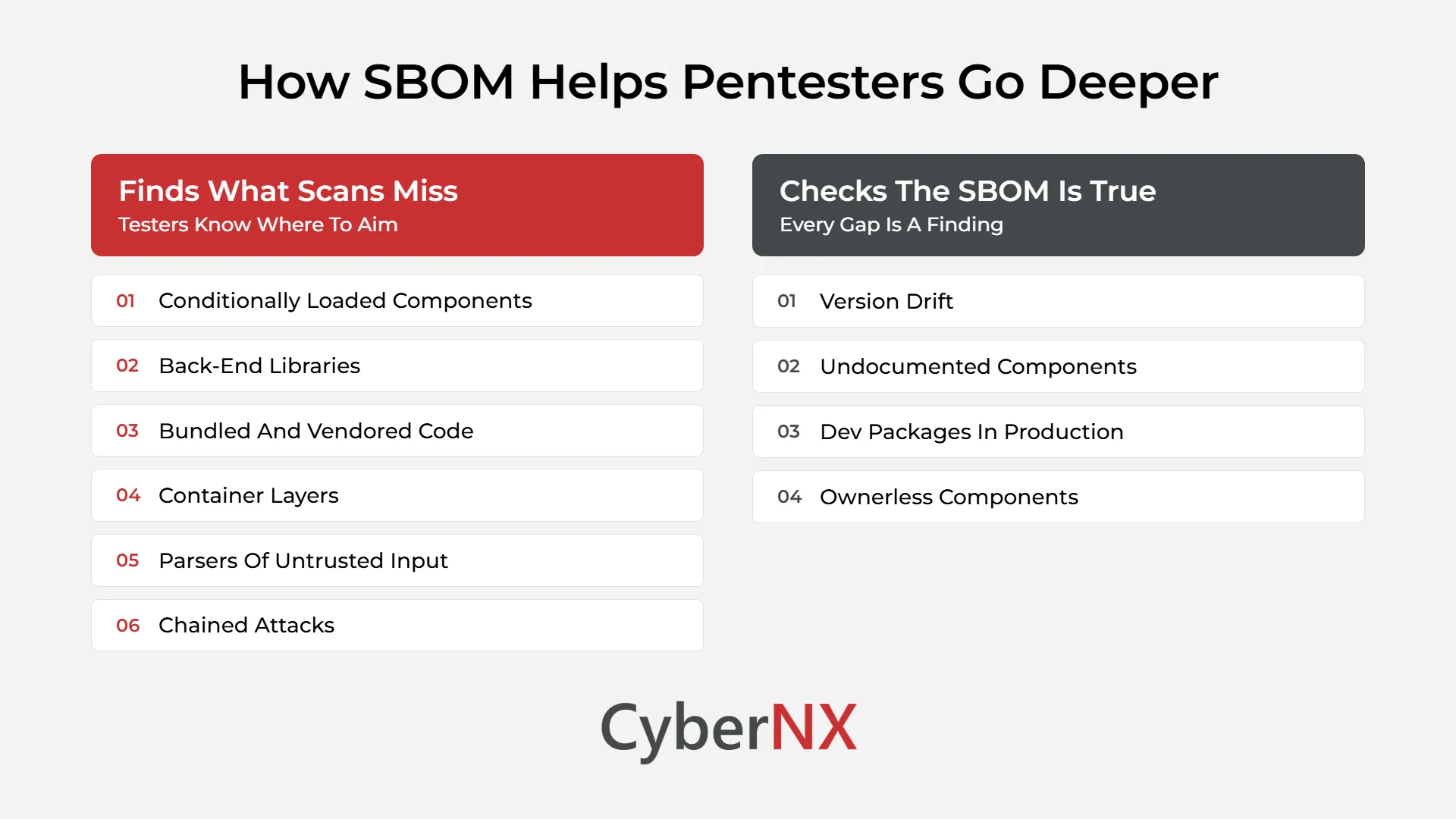
Scanners work from banners and responses. Many components send neither, so they never reach a scan report. An SBOM gives testers six places to start:
- Conditionally loaded components: Some libraries load only for a specific feature, user role or file type. A scan that never triggers that path never sees them.
- Back-end libraries: Components such as PDF renderers and image processors sit behind other services. Testers can see them in the SBOM and build inputs that reach them.
- Bundled and vendored code: Libraries copied into the codebase or packaged into a single file carry no version banner. The build-generated SBOM still lists them.
- Container layers: Base images pull in operating system packages and runtimes that the application never exposes.
- Parsers of untrusted input: The SBOM shows which libraries handle XML, YAML, archives or serialised objects. Testers know exactly where to send crafted input.
- Chained attacks: A known flaw in an internal component becomes reachable when combined with an application-level weakness, such as a request forgery bug. Scanners test each issue alone and don’t connect them.
Does the SBOM match what’s running?
Treat every SBOM as a claim that needs checking. The OWASP Software Component Verification Standard exists because component inventories need verification, not blind trust. A grey box tester compares the SBOM against the live application, and each gap is a finding:
- Version drift: The SBOM lists a patched version, but the running application still uses the older one.
- Undocumented components: The application runs a library that no SBOM entry covers.
- Build-only dependencies in production: Test or development packages shipped to the live environment widen the attack surface.
- Ownerless components: No team can say who maintains or updates the library.
Easier to fix: from present to proven
A long vulnerability list is no remediation plan. Testers turn it into one by proving what an attacker can use.
A listed vulnerability is not yet a finding
Match any SBOM against a vulnerability feed and you get a long list of known flaws. Most won’t be exploitable in your environment. The vulnerable function may never be called, or the component may be unreachable. Testers can use the Exploit Prediction Scoring System (EPSS) to decide which candidates to try first. Then they prove which ones matter.
Pentest results that test vendor claims
Vendors increasingly publish Vulnerability Exploitability eXchange (VEX) statements that say whether their product is affected by a given flaw. Under guidance from the Cybersecurity and Infrastructure Security Agency (CISA), an “affected” status must come with an action statement. A pentest can confirm or challenge these claims with evidence. Your team no longer has to take a vendor’s word for it.
Findings with an owner attached
Every finding maps to a specific component and version, so the fix is clear. Your developers know which library to upgrade and which other applications share it. Patch once, regenerate the SBOM and the fix becomes traceable. That matters when you work to tight patch windows under frameworks such as SEBI’s Cybersecurity and Cyber Resilience Framework (CSCRF).
What an SBOM won’t tell your pentester
An SBOM is a strong input, but it does not cover everything. Know the gaps before you plan the test.
Components, not data flow
An SBOM tells testers what sits inside an application. It doesn’t show how data moves through it or where trust boundaries lie. Architecture reviews and threat modelling still supply that. SBOM-led testing goes deeper on components and leaves the rest of your method intact.
Stale and vendor SBOMs mislead
An SBOM generated six months ago describes software that no longer exists. Vendor SBOMs can mislead too. If you run mostly vendor applications, as many banks and financial institutions do, the SBOMs you receive may be incomplete. Sometimes the most useful result is learning what your vendor left out.
How to make SBOM-led grey box penetration testing your default
This takes little effort. It starts with what you share before kick-off and how you protect it.
What to hand your testers before kick-off
A few inputs turn a standard engagement into an informed one:
- A current SBOM in CycloneDX or SPDX format, generated from the build being tested
- Any VEX statements you hold for the application
- Asset criticality, so testers know which applications carry the most business risk
- Vendor SBOMs for third-party components in scope
Treat the SBOM as sensitive
An SBOM that helps your testers would help an attacker just as much. Share it under the engagement’s confidentiality terms and limit who can access it. Make sure it is returned or destroyed when testing ends. If you need to share it more widely, keep a sanitised copy for external use.
Conclusion
Handing pentesters your SBOM changes the economics. Recon gets faster and testing goes deeper into the components where risk hides. Findings arrive tied to a library, version and owner, so your teams can fix them sooner.
At CyberNX, we treat software inventory and offensive testing as one discipline. Our Vulnerability Assessment and Penetration Testing (VAPT) team works from the same component data our SBOM practice maintains. Every engagement starts informed.
You already have the map. Let our testers show you which routes an attacker can take. Talk to our VAPT team.
FAQs
What is grey box penetration testing?
Grey box penetration testing gives testers partial knowledge of the target, such as credentials, architecture details or a component inventory. It sits between black box testing (no knowledge) and white box testing (full access). It balances realism with efficiency.
Do SBOMs replace penetration testing?
No. An SBOM lists components and helps match them to known vulnerabilities. A pentest proves which of those vulnerabilities an attacker can actually exploit in your environment.
Is it safe to share an SBOM with a pentest provider?
Yes, with controls. Share it under confidentiality terms and restrict access to the testing team. Agree in advance how it will be handled once the engagement ends.