Security teams often ask a simple question. How much does VAPT testing cost?
It sounds like a quick calculation. But VAPT pricing shifts across industries, environments and risks. Many leaders also struggle with inconsistent quotes from vendors. Some fees look too low to trust and others look far higher than expected. Here at CyberNX, we understand why that feels frustrating.
This guide brings clarity, and this is where guessing stops. We explain how VAPT testing cost works, what drives price variations and how you can budget with confidence. Our experience shows that clear information empowers better decisions.
Understanding why VAPT testing cost varies
VAPT is built on context. Every system behaves differently, and every threat surface changes with scale. That is why VAPT pricing is not flat. It depends on depth, scope and effort.
Before comparing quotes, teams need a shared frame that helps avoid confusion and misalignment.
Key factors that shape VAPT pricing
VAPT testing includes two different approaches. Vulnerability assessment uses automated checks. Penetration testing uses human-led techniques to go deeper. The blend of both shapes the effort required.
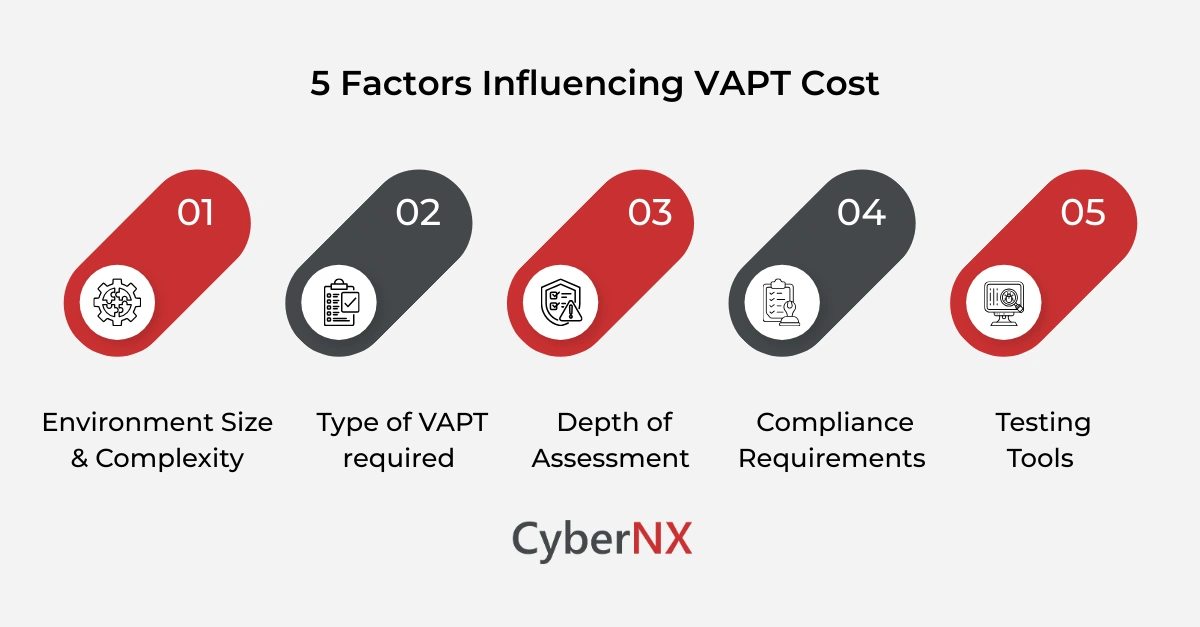
1. Size and complexity of the environment
Large networks demand more time. Multiple apps add new layers, and legacy systems increase testing cycles. All these elements change the VAPT testing cost.
Typical cost drivers include:
- Number of IPs or servers
- Number of web or mobile applications
- Complexity of internal networks
- Cloud or hybrid architecture
A simple web app needs fewer hours, whereas a multi-tiered architecture needs more hands-on testing.
2. Type of VAPT required
Different systems need different VAPT testing types. The cost of VAPT testing changes with the method. Common categories include:
- External network testing
- Internal network testing
- Web application testing
- Mobile app testing
- Cloud configuration testing
- API or microservices testing
Each category carries its own testing depth. Pen testers often need to mimic real attackers. That adds more effort and increases cost.
3. Depth of assessment
A surface-level scan is quick. But a full exploitation cycle takes more work. Testing depth often includes:
- Basic testing
- Standard testing
- Advanced exploitation
- Red team simulation
More depth means higher costs. But it also offers better visibility.
4. Compliance requirements
Compliance audits often demand strict checks. Regulatory bodies in India like RBI, SEBI and CERT-In and others like PCI DSS, HIPAA and ISO standards require detailed validation.
Compliance-driven VAPT needs:
- Specific documentation
- Detailed reporting
- Evidence mapping
This expands the overall VAPT testing cost.
5. Testing methodology and tools
Quality tools ensure accuracy. Mature VAPT service providers combine automated scanners with expert manual tests. Premium testing tools improve:
- False positive reduction
- Test coverage
- Reporting accuracy
Use of VAPT tools may also influence pricing but offers more actionable insights.
Average VAPT testing cost in India
In our experience, VAPT testing cost in India ranges widely. But most enterprises fall within a predictable range. Below is a general view to help you plan budgets. These are industry-wide averages based on typical project scopes.
| SCOPE | ESTIMATED COST RANGE (INDIA) |
| Small web application | INR 25,000 to 60,000 |
| Medium application | INR 60,000 to 1,50,000 |
| Large or complex application | INR 1,50,000 to 4,00,000 |
| External network (up to 25 IPs) | INR 40,000 to 1,20,000 |
| Internal network (up to 50 systems) | INR 80,000 to 2,00,000 |
| Mobile app | INR 60,000 to 2,00,000 |
| Cloud environment | INR 1,00,000 to 5,00,000 |
NOTE: These ranges may shift depending on industry, scope and risk profile.
A recent Gartner report highlighted that security teams value outcome clarity over cost comparison. Buyers look for impact, not just savings. And we also see this often: teams wanting predictable pricing. But they also want confidence that the test aligns with real threats.
Common mistakes while evaluating VAPT pricing
Security leaders sometimes pick the lowest quote. But cheaper tests often come with hidden gaps. We have seen organisations repeat assessments because the initial test lacked depth. That wastes time and increases cost.
Watch out for:
- No manual penetration testing
- Lack of detailed remediation guidance
- Generic templates instead of real findings
- No retesting support
- No compliance mapping
You should always ask for a clear testing plan. That gives you visibility on effort and expected outcomes.
What is the cost of VAPT testing for enterprises?
Enterprises operate across large networks. Their attack surfaces often include on-premise systems, cloud workloads and third-party integrations.
For such environments, VAPT testing cost starts at:
- INR 5 lakhs for mid-sized multi-system environments
- INR 10 lakhs and above for large enterprises
These tests often include:
- Multiple applications
- Internal and external networks
- Cloud workloads
- APIs
- Continuous retesting cycles
Enterprises focus on consistency. They prefer annual or quarterly engagements and these models lower cost per test.
How to optimise your VAPT testing cost
Security budgets are often tight. But cost optimisation is possible with the right approach. Many teams gain efficiency by organising testing cycles around risk.
Steps that help reduce cost without reducing quality
- Prioritise critical assets: Test high-risk systems first. That builds early protection without stretching budgets.
- Use annual contracts: Long-term contracts reduce per-test pricing. It also helps maintain consistent security improvement.
- Prepare the environment: Fix known issues before testing. It reduces testing hours and lowers cost.
- Align scope with business priorities: Clear scope means no surprises. It keeps VAPT pricing predictable.
- Choose providers with transparent models: Good partners show you the work behind the price. That gives you clarity.
ENISA (European Union Agency for Cybersecurity) suggests periodic penetration testing for all businesses using cloud and external-facing systems. Regular testing builds resilience and limits exposure.
As you can see testing frequency influences risk more than cost and consistent testing creates long-term value.
Why VAPT cost should not be the only evaluation point
Cost is important. But effectiveness matters more. A test that misses critical risks leads to higher losses later. Instead of comparing numbers alone, consider:
- Testing skill
- Reporting quality
- Remediation guidance
- Retesting support
- Industry experience
Shortcuts create blind spots, whereas strong testing builds confidence.
How CyberNX helps you plan your VAPT budget
We partner with security teams, design scopes that match your environment and priorities. Our goal is simple: clear pricing with valuable insights and action steps.
As a CERT-In empanelled VAPT auditor, we always share a transparent breakdown before we start and align on depth, tools and deliverables. That gives you predictability in cost and outcomes.
Our work aims to keep your business secure across web applications, networks, cloud systems and mobile environments. And we walk with you through remediation. That is how we build trust.
Conclusion
Understanding VAPT testing cost helps you plan better. In addition, it helps you set the right scope and your team to pick the right approach that protects your business. Budgets feel clearer when the factors behind pricing make sense.
Here at CyberNX, we help teams build clarity and confidence. If you want to understand the right VAPT model for your organisation, we are ready to assist. Contact us for VAPT services and get a customised VAPT cost estimate tailored to your environment.
VAPT Testing Cost FAQs
How often should businesses perform VAPT?
Most organisations conduct a full VAPT engagement once or twice a year. However, businesses with rapidly changing environments – such as those deploying new features frequently or relying heavily on cloud-native architectures – should consider quarterly or continuous testing depending on how often systems and infrastructure change.
Does VAPT include cloud security checks?
Yes. Modern VAPT engagements typically include cloud-specific assessments such as configuration reviews, IAM analysis, misconfiguration discovery, workload exposure checks, and network segmentation validation to ensure complete coverage across on-prem and cloud environments.
Are VAPT and penetration testing the same?
Not exactly. VAPT combines vulnerability assessment with penetration testing. While a vulnerability assessment identifies weaknesses, a penetration test validates and exploits them to show real-world risk. VAPT delivers both breadth and depth, whereas standalone penetration testing focuses mostly on exploitation.
Is VAPT required for compliance audits?
Yes. Many regulatory frameworks – such RBI guidelines, SEBI’s CSCRF and CERT-In mandate periodic security testing. A VAPT report provides essential evidence of due diligence and helps organisations stay compliant while proactively improving their security posture.