Security teams often know their systems hold blind spots. The challenge is spotting them before someone else does. A VAPT audit helps with that. It blends real-world testing with structured assessment, uncovering risks early and offering clear direction for improvement. Many CISOs and IT leaders rely on this approach because it offers practical visibility and turns vague concerns into defined actions.
This guide breaks down the process step by step. In addition, it explains what VAPT audit is, shows what a strong audit report should include and offers clear ways to use these insights to strengthen your security posture.
What is a VAPT audit?
First, you need to understand that VAPT and VAPT audit are a bit different. Vulnerability Assessment and Penetration Testing (VAPT) can be understood as the umbrella term for the process involved in finding and fixing vulnerabilities. On the other hand, VAPT audit is the formal evaluation of your systems using different tools and techniques.
There’s no denying that VAPT audit also brings two methods together. First, vulnerability assessment scans systems for weaknesses and penetration testing goes deeper by attempting to exploit them. When combined, these activities show where gaps exist and how serious they are. Leaders get clarity on risk and impact.
Many teams use it to benchmark their current security controls. Others use it before product launches or after major tech upgrades. A good VAPT approach works across applications, networks, cloud and internal environments.
Why organisations rely on VAPT audit
Security gaps often sit unnoticed. Small misconfigurations turn into larger risks as systems grow. A VAPT audit helps identify these concerns early. Teams gain evidence rather than assumptions. This helps leadership plan budgets, align security controls and support compliance objectives.
At the same time, the process reduces noise. It highlights what matters most and the focus stays on issues that impact business operations.
Common pain points before a VAPT audit
Many organisations come to their first VAPT engagement with similar concerns.
- Uncertainty about hidden vulnerabilities
- Pressure from compliance requirements
- Growing attack surface driven by remote work
- Limited internal bandwidth for security reviews
- Difficulty prioritising remediation
These challenges often prompt leaders to look for structured testing. They want a clear view of risk, not guesswork.
The VAPT audit process
A strong audit uses a staged approach. Each step builds on the one before. It keeps findings accurate and practical for remediation.
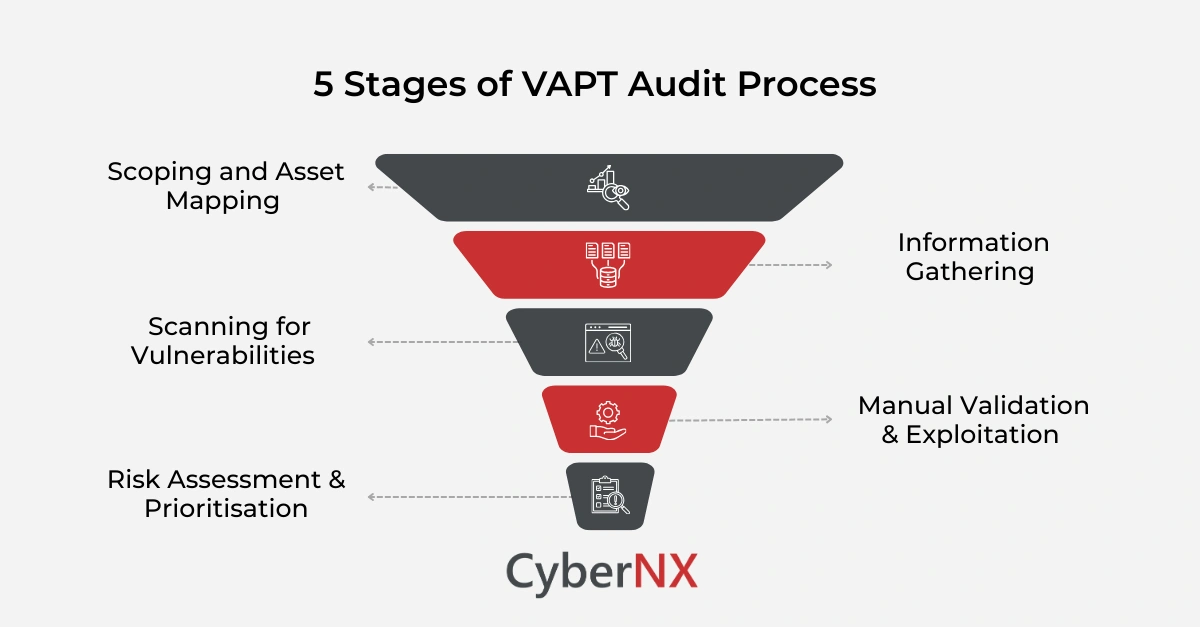
1. Scoping and asset mapping
The team identifies what needs testing. This may include applications, servers, cloud workloads or internal systems. Clear scoping helps avoid blind spots and ensures meaningful results.
2. Information gathering
Testers collect publicly accessible information. They study system behaviour, network structure and access points. This stage helps understand how an attacker might approach the environment.
3. Scanning for vulnerabilities
Automated tools scan for common weaknesses. These may include outdated software, misconfigurations or unsafe services.
4. Manual validation and exploitation
This is where the work deepens. Testers manually review high-risk areas. They attempt controlled exploitation. This helps confirm whether a weakness is real and what access it could provide.
5. Risk assessment and prioritisation
Findings are evaluated based on impact and likelihood. Leadership teams get a clear view of which issues demand fast action.
What a strong VAPT audit report includes
The VAPT audit report provides the final picture. It explains weaknesses in simple terms, includes technical detail for engineers and offers practical steps to fix issues. Most teams use this document to plan remediation and to track progress.
Every organisation benefits from a clean, structured report. It keeps security conversations grounded. It also helps show progress to auditors, regulators and boards.
A strong VAPT audit report usually covers:
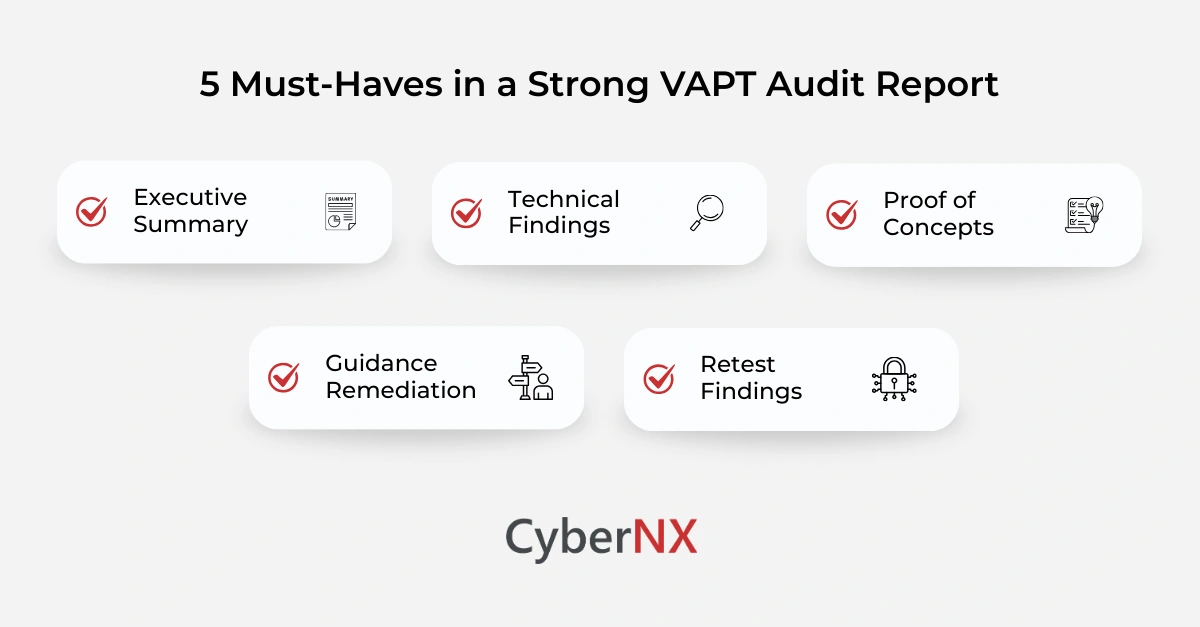
- Executive summary: This section offers leadership a quick, clear understanding of risk. It explains the severity and potential impact of findings. It filters noise and highlights the core issues.
- Technical findings: This part includes confirmed vulnerabilities. Each entry has supporting evidence. Each also carries a risk rating. Engineers use this section to plan remediation.
- Proof of concepts: Where exploitation is possible, screenshots or logs show how it works. This reduces doubt and helps teams prioritise.
- Clear remediation guidance: Recommendations offer direct steps. They help teams fix issues without confusion or delay.
- Retest findings: After remediation, a retest validates that fixes work. This keeps systems aligned with expected security standards.
How VAPT supports compliance objectives
Many regulatory frameworks expect structured testing. An audit often fits these needs. It supports RBI, SEBI, CERT-In, ISO 27001, PCI DSS and other industry standards. Leaders use VAPT to validate controls and reports to support audit evidence.
Compliance becomes easier when testing is consistent. It also boosts stakeholder confidence.
Using VAPT audit insights effectively
Testing alone does not build resilience. The value lies in how organisations use the results.
- Create a remediation roadmap: A clear plan helps teams tackle issues by severity. It also builds accountability across engineering and operations.
- Align findings with business context: Some vulnerabilities affect critical systems. Others sit in low-risk areas. Prioritisation works best when aligned with impact on operations.
- Repeat testing for accuracy: Changes in infrastructure create new risks. Regular testing keeps defences aligned with growth.
When to conduct a VAPT audit
Leaders often schedule audits during key moments.
- Before releasing major applications
- After cloud migrations
- After infrastructure changes
- During compliance preparation
- When security concerns escalate
These checkpoints help ensure that evolving systems stay protected.
Why growing organisations choose structured VAPT support
Many scaling businesses face rising complexity. Systems expand quickly. New integrations create fresh pathways. Structured testing helps teams stay ahead. It supports fast-moving operations without slowing down innovation.
Reliable VAPT also helps maintain trust. Customers expect secure environments. Partners expect consistent controls.
Conclusion
A VAPT audit gives organisations clarity. It turns hidden weaknesses into clear, manageable actions. It also helps teams strengthen controls with confidence. Many leaders use VAPT to improve resilience, simplify compliance and protect critical systems.
CyberNX conducts VAPT with a practical approach. The focus stays on real-world risk. The results guide teams with clear steps. If your organisation plans to strengthen its security posture, our team can help. Book a VAPT consultation with us to get started.
VAPT audit FAQs
How can a VAPT audit support long term security planning?
An audit gives teams a clear understanding of where weaknesses sit and how they could affect operations. This visibility helps leaders plan investments, schedule upgrades and strengthen controls in stages. Over time, these insights support a structured roadmap that keeps pace with business growth. Many organisations use the final audit report as a reference point for annual planning.
Can teams prepare in advance to get better outcomes from a VAPT audit?
Preparation helps improve accuracy. Teams often start by mapping assets, updating system inventories and reviewing access controls. This ensures the testing covers all important systems. Clear scoping also helps testers focus on areas that matter most. Preparation speeds up testing and improves the relevance of findings in the final VAPT audit report.
What skills should VAPT auditors have to deliver reliable results?
Auditors should combine technical expertise with practical testing experience. They need strong understanding of networks, applications, cloud environments and security controls. Manual testing skills are essential. The ability to identify business impact and translate findings into simple remediation steps is equally important. These skills ensure the organisation receives a clear, usable VAPT audit report.
Is a VAPT audit only useful for large enterprises?
Any organisation with digital systems benefits from structured testing. Smaller businesses often have lean teams and limited oversight, which makes unnoticed vulnerabilities more likely. An audit helps these teams uncover risks early and fix them before they disrupt operations. It scales easily across business sizes and environments.