Organisations today face ever-rising cyber risks. With expanding digital footprints, legacy infrastructure, and remote access – even a small misconfiguration can lead to large scale breaches. A robust VAPT assessment offers a practical solution. It combines automated vulnerability scanning with simulated attacks to uncover weak spots before real hackers exploit them. For Indian businesses, especially in regulated sectors, VAPT is fast becoming a non-negotiable control.
The case for routine VAPT
Static defences cannot protect a dynamic infrastructure that shifts with every code update. Routine VAPT exposes the invisible ‘glitches’ in your system, ensuring you find the exploits before the agents of chaos do.
1. Rising cyber threats across sectors
Recent data shows India recorded over 1.6 million cyber incidents in 2024 – a number that continues to grow in 2025. As organisations adopt cloud, hybrid-work, and digital platforms, their attack surface is expanding. A timely VAPT assessment helps spot weaknesses before attackers can exploit them.
Whether you are a start-up or a large enterprise, the risk is real. VAPT delivers early warning signs, helping you strengthen defences in time.
2. Compliance requirements and rising regulatory scrutiny
Indian regulators now expect more than just ad hoc audits. For many sectors – notably financial – VAPT is a regulatory requirement.
For example, under the Reserve Bank of India (RBI) Master Directions for IT governance, regulated entities – banks, NBFCs, payment institutions – must conduct VAPT on critical systems as part of IT governance and risk‐management controls.
Similarly, the Securities and Exchange Board of India (SEBI) introduced the Cybersecurity and Cyber Resilience Framework (CSCRF) in 2024, which mandates regular VAPT for all regulated entities (stock brokers, AMCs, mutual funds, RTAs, depositories, etc.).
Failing VAPT or neglecting timely assessments could lead to audit failures, regulatory penalties, or reputational damage.
3. Business advantage: reduce risk and build trust
A good VAPT assessment doesn’t just help you meet regulations. It helps you reduce business risk, avoid data breaches, and preserve customer trust. Early detection, clear remediation plans, and periodic testing make your security posture stronger.
For businesses dealing with sensitive data – customer records, financial transactions, personal data – this is increasingly a business imperative, not just a technical one.
VAPT assessment example: what a typical engagement looks like
Here is a simplified sample scope of a VAPT assessment for a mid-sized enterprise or fintech:
| PHASE | ACTIVITIES | PURPOSE |
| Scoping & Planning | Identify critical systems: customer-facing apps, APIs, databases, networks, DMZ, cloud infra | Ensures assessment covers highest-risk assets |
| Vulnerability Assessment (VA) | Automated scanning of OS, software versions, misconfigurations, open ports, outdated libraries, known CVEs | Quick discovery of known, common issues |
| Penetration Testing (PT) | Manual testing by skilled testers: web-app testing (SQLi, XSS), authentication/authorization flaws, API testing, network-level attacks, privilege escalation, misconfig issues, cloud mis-config, business logic flaws | Identify real exploitable vulnerabilities with business impact |
| Exploitation & Proof-of-Concept | Where safe, exploit vulnerabilities (in isolated or non-production environments) to show impact | Helps decision-makers understand severity and risk |
| Reporting & Remediation Guidance | Detailed report with findings, risk rating (High/Medium/Low), impact analysis, remediation suggestions | Provides actionable roadmap for security fixes |
| Retesting | After fixes, retest to confirm closure of vulnerabilities | Ensures fixes are effective and no regressions occur |
Such an assessment enables organisations to move from unknown risk to visible, manageable risk.
VAPT assessment: The mandate for BFSI cyber resilience
Cyber resilience is non-negotiable for capital preservation and public trust in the Indian financial sector. Routine VAPT is the mandate that provides proactive threat intelligence, allowing organizations to continuously fortify their defences and maintain operational stability.
1. Regulatory compliance: RBI, SEBI, CERT-In
If you belong to BFSI (banks, fintech, NBFCs, stock brokers, mutual funds, payment banks), regulatory compliance is a major driver:
- Under RBI’s IT governance guidelines, critical systems must undergo periodic VAPT – typically VA every six months and PT at least annually, depending on risk.
- SEBI’s CSCRF requires regulated entities to perform VAPT and patch critical vulnerabilities promptly (in some cases within 24 hours).
- Many NBFCs and fintech firms also align with data-protection norms (for instance, under the Digital Personal Data Protection Act, 2023), where proper security audits – including VAPT – help demonstrate due diligence.
By staying compliant, BFSI firms avoid regulatory penalties, ensure license renewals, and preserve reputation.
2. Frequent changes and dynamic threat landscape
BFSI firms run complex infrastructure: web apps, mobile apps, APIs, cloud infrastructure, third-party integrations. Every update or new deployment changes the attack surface. Relying on a one-time security check is risky. A regular VAPT assessment ensures you catch new vulnerabilities in time.
3. Accountability and governance
VAPT reports offer boards and senior leadership a clear, measurable view of cyber risk exposure. This transparency helps support resource allocation, remediation prioritisation, and rationalise security investments – especially when audits are due or regulators enquire.
Why CERT-In empanelled VAPT experts are the best vendors to partner with
CERT-In empanelment signifies governmental vetting and adherence to the highest national security and ethical practice benchmarks for VAPT methodology. Partnering with these certified experts strategically validates your security posture, minimizes regulatory risk, and ensures unmatched assessment quality.
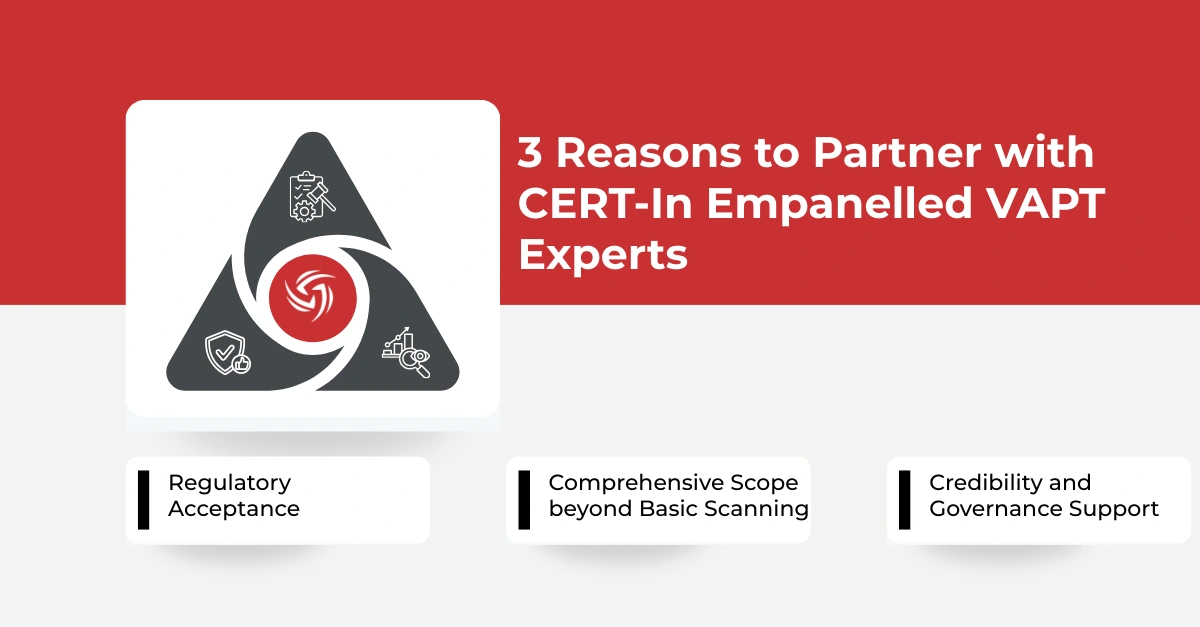
1. Regulatory acceptance
The Indian Computer Emergency Response Team (CERT-In) is the official nodal agency for cybersecurity audits and empanels security auditors for Indian organisations. According to recent guidelines, audits carried out by CERT-In-empanelled auditors meet the criteria defined under law.
When you partner with a CERT-In-empanelled vendor, your VAPT reports and certificates carry regulatory weight – whether you are submitting compliance evidence to RBI, SEBI, or other authorities.
2. Comprehensive scope beyond basic scanning
Empanelled auditors are authorised to conduct a range of assessments: network audits, application security, cloud audits, source-code review, red-teaming, API testing, configuration review.
They follow documented methodologies, risk-based scoping, and deliver structured reports. This ensures that the VAPT assessment is not a one-off compliance exercise, but a thorough evaluation of your security posture.
3. Credibility and governance support
Working with a CERT-In vendor reduces the burden on your internal team. It ensures accountability, helps maintain audit trails, and aligns with regulatory expectations. It signals seriousness to stakeholders and regulators.
What 2025 industry reports and leaders say
Industry data from 2025 paints a clear picture. Indian organisations face more targeted attacks, faster exploit cycles and tougher compliance demands. Leaders now treat VAPT as a dependable way to uncover the risks that hide behind routine deployments. Reports and expert commentary show a shift toward frequent, structured testing instead of occasional checks.
- According to a 2025 review, India recorded over 1.6 million cyber incidents in 2024, underscoring the urgent need for robust security assessments.
- Under the new SEBI CSCRF rollout (effective 2024 and evolving in 2025), regular VAPT and prompt patching of critical vulnerabilities are mandatory for all regulated entities.
This momentum shows that VAPT assessments are no longer optional. They form the backbone of cyber resilience and regulatory compliance.
Conclusion
A well-executed VAPT assessment provides more than just a “scan and fix” exercise. It reveals real-world vulnerabilities, delivers actionable remediation plans, strengthens governance, and helps you stay compliant. For Indian businesses – especially in BFSI – partnering with a CERT-In empanelled vendor ensures regulatory acceptance and audit-ready reports.
If your organisation has critical systems, handles sensitive data, or falls under regulatory oversight, we recommend scheduling a VAPT assessment at the earliest. Periodic testing, continuous monitoring and timely patching will help you stay secure.
If you would like expert help with your VAPT assessment, compliance alignment or audit readiness, reach out to us at CyberNX. Our team of CERT-In empanelled specialists can design a tailored VAPT plan to meet your risk profile and regulatory obligations.
VAPT assessment FAQs
How often should a VAPT assessment be conducted in Indian companies?
It depends on your risk exposure. For most companies, a bi-annual VAPT (scans every six months, penetration testing at least annually) is a good baseline. For high-risk firms (BFSI, fintech, internet-facing infra), quarterly or continuous VAPT is advisable.
Does a VAPT assessment guarantee that my systems are completely secure?
No. VAPT reduces risk by uncovering vulnerabilities at a point in time, but new vulnerabilities can emerge as systems evolve. Hence, VAPT should be part of a broader security programme: patch management, secure development practices, monitoring, and governance.
Are internal teams enough to perform VAPT, or should I hire an external vendor?
While internal teams can help with ongoing scanning, an external, independent vendor – preferably CERT-In empanelled – adds objectivity, regulatory credibility, along with deeper expertise in penetration testing, red-teaming and reporting.
What does a VAPT assessment report typically include?
It includes discovered vulnerabilities (with risk severity), proof-of-concept for exploitability (where safe), remediation recommendations, risk impact analysis, and often a retesting report once fixes are applied.