Most security teams know what sits at the top of their technology stack. What remains unclear is what runs underneath. Modern software relies on thousands of open source and third-party components. Each one introduces risk. Yet many organisations still operate without a clear inventory of what those components are.
This is where practical uses for Software Bill of Materials become impossible to ignore. An SBOM creates a detailed list of software components, versions and dependencies. More importantly, it helps teams act with confidence during incidents, audits and supplier reviews.
We see many leaders struggle with visibility, speed and accountability. An SBOM does not solve every problem. But when used well, it becomes a control point for smarter security decisions. Let us explore how security leaders apply SBOMs in real enterprise environments.
Why security teams struggle without component visibility
Before discussing practical uses for Software Bill of Materials, it helps to understand the core challenges teams face today.
Most applications are assembled, not built. Developers pull in frameworks, libraries and APIs at speed. Over time, this creates hidden complexity. When a vulnerability is disclosed, teams scramble to answer basic questions.
- Which applications are affected
- Which version is running in production
- Which supplier owns the risk
Without clear answers, response slows down. Risk increases. Confidence drops.
We have seen this play out during major supply chain incidents. Teams without component transparency spend days validating exposure. Teams with SBOMs move in hours.
Practical uses for Software Bill of Materials in vulnerability response
One of the most valuable practical uses for Software Bill of Materials is rapid vulnerability assessment.
When a new CVE is announced, time matters. An SBOM allows teams to instantly search for affected components across applications. There is no need to wait for manual checks or developer feedback.
This capability supports faster triage. It also reduces noise. Teams focus on systems that matter, not every system that might.
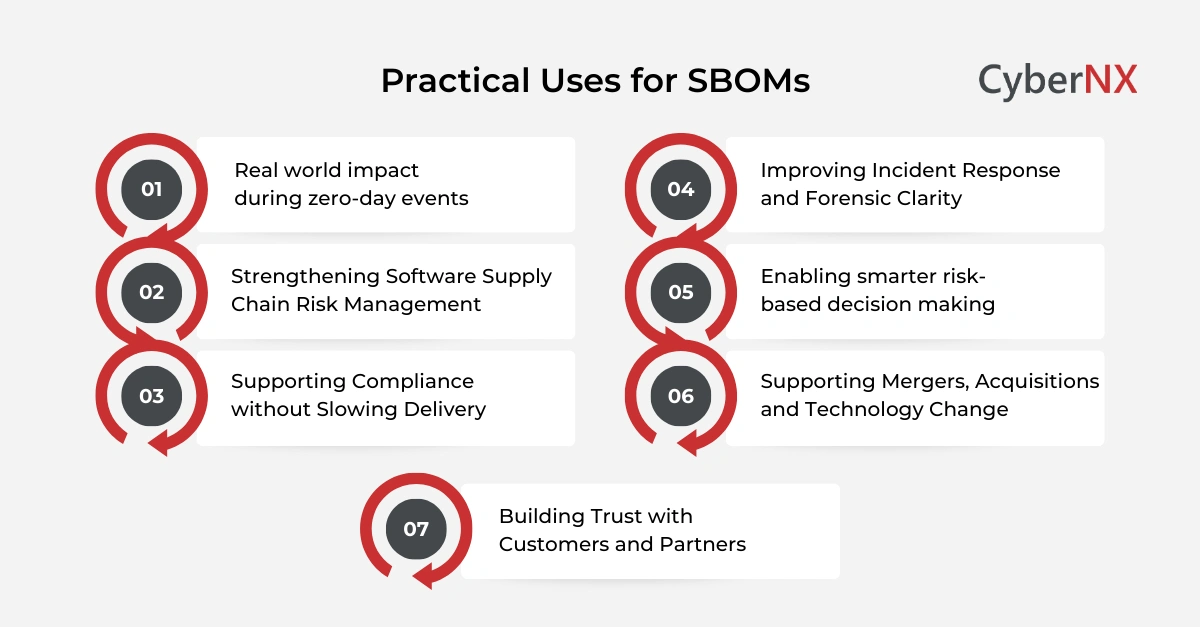
1. Real world impact during zero-day events
During incidents like Log4j, organisations with SBOMs identified exposure quickly. Others relied on email chains and spreadsheets.
- A structured SBOM supports:
- Faster impact analysis
- Clear prioritisation
- Confident communication with leadership
This is one of the clearest practical uses for Software Bill of Materials in high pressure scenarios.
2. Strengthening software supply chain risk management
Third party risk rarely stops at vendors. It extends into the code they ship.
Another key area where practical uses for Software Bill of Materials shine is supply chain security. An SBOM shows not just who you buy from, but what they include.
This matters when assessing trust. It also matters when contracts, liability and accountability come into play.
With an SBOM, security teams can:
- Evaluate component quality
- Identify unsupported libraries
- Challenge suppliers on security hygiene
This shifts conversations from opinion to evidence. Over time, it raises the bar across the ecosystem.
3. Supporting compliance without slowing delivery
Regulatory expectations around software transparency are growing. SBOMs help teams meet these demands without blocking development.
Several frameworks and policies now reference SBOM practices. Examples include guidance from NIST and executive level mandates for software suppliers.
One of the lesser discussed practical uses for Software Bill of Materials is how it simplifies audits. Instead of gathering data repeatedly, teams maintain a living inventory.
This approach supports:
- Faster audits
- Fewer last-minute scrambles
- Better alignment between security and engineering
Compliance becomes a by-product of good visibility, not an annual headache.
4. Improving incident response and forensic clarity
When incidents occur, clarity matters more than perfection.
An SBOM provides responders with immediate context. It shows what is inside the affected application and how components interact. This shortens investigation time.
Among the practical uses for Software Bill of Materials, incident response is often underestimated. Yet it delivers measurable value.
Teams can:
- Trace vulnerable components
- Understand blast radius
- Coordinate remediation across teams
This reduces confusion. It also supports better post incident reviews and lessons learned.
5. Enabling smarter risk-based decision making
Security leaders face constant trade-offs. Fix everything or focus on what matters most.
One of the strategic practical uses for Software Bill of Materials is prioritisation. By combining SBOM data with threat intelligence, teams gain context.
They see:
- Which components are exposed
- Which systems support critical business functions
- Which risks justify immediate action
This supports mature risk conversations at board level. Decisions are based on evidence, not fear.
6. Supporting mergers, acquisitions and technology change
During mergers and acquisitions, visibility gaps create risk. New applications enter the environment with unknown components.
An SBOM provides a baseline. It shows what is inherited and where hidden risk sits.
This is a less obvious but highly valuable practical use for Software Bill of Materials. It helps teams assess integration risk early.
It also supports technology modernisation. Legacy components become visible. Refactoring decisions become clearer.
7. Building trust with customers and partners
Security is a trust conversation. Customers increasingly ask how software risk is managed.
An SBOM offers transparency. It signals maturity. It shows a willingness to stand behind what is delivered.
Among the practical uses for Software Bill of Materials, trust building is often overlooked. Yet it matters deeply in regulated and high-risk industries.
Providing SBOMs during procurement or assurance reviews strengthens credibility. It also reduces friction during security questionnaires.
Conclusion
The practical uses for Software Bill of Materials extend far beyond compliance checklists. They support faster response, smarter risk decisions and stronger trust.
For security leaders, SBOMs provide something rare. Control in a complex environment.
We have seen small changes deliver big impact. When SBOMs are treated as living assets, they reshape how teams manage software risk.
CyberNX works alongside organisations to operationalise SBOMs in a way that fits real environments. Every step taken toward visibility strengthens resilience.
If you want to explore how our SBOM management tool can support your security goals, our team is ready to help. Contact us today.
Use Cases of Software Bill of Materials FAQs
How often should a Software Bill of Materials be updated?
An SBOM should update with every build or release. Stale SBOMs reduce accuracy and trust.
Are SBOMs only useful for large enterprises?
No. Smaller organisations often benefit faster because visibility gaps are easier to close early.
Can SBOMs replace vulnerability scanning?
No. SBOMs complement vulnerability scanning by providing component context. Both work better together.
What formats are commonly used for SBOMs?
Popular formats include SPDX and CycloneDX. The choice depends on tooling and integration needs.