“If you know the enemy and know yourself, you need not fear the result of a hundred battles.”
– Sun Tzu
Modern cyber threats follow this principle more closely than ever.
Attackers today start studying organisations long before launching an attack. They quietly check digital footprints, monitor exposed systems, mimic brands and misuse leaked data that might be circulating across online ecosystems. And by the time security teams notice suspicious activity inside the network, it’s often too late. The attackers may have already mapped the organisation’s external environment.
This is why visibility beyond the corporate perimeter has become very important.
Sensitive info may appear in dark web marketplaces. Fake social media accounts may impersonate executives. Phishing websites may clone your brand identity to target customers. These threats appear across multiple digital environments simultaneously.
Unified digital risk monitoring helps you understand this threat landscape in a structured way. Instead of monitoring isolated channels, companies get constant visibility across dark web forums, deep web data repositories, social platforms and open web infrastructure.
For CISOs and security leaders, it helps with early detection of threats, faster response to brand abuse and stronger protection of customer trust.
What is unified digital risk monitoring?
It is the practice of monitoring multiple external digital environments through a single intelligence framework.
Instead of focusing on only one threat source, organisations monitor several environments at the same time, including:
- Dark web forums and marketplaces
- Deep web repositories and breach databases
- Social media platforms
- Domain registrations and phishing infrastructure
- Mobile applications and app stores
The goal is to detect early signals of brand abuse, fraud campaigns, credential leaks and data exposure across the internet.
Why organisations need unified digital risk monitoring
Traditional security monitoring focuses on internal infrastructure. However, most brand-related cyber threats now originate outside the corporate network.
Attackers often exploit external digital environments to:
- impersonate brands
- launch phishing campaigns
- distribute malware
- sell stolen credentials
- coordinate fraud schemes
Without it, organisations may detect these threats only after customers report them. Unified monitoring allows security teams to identify threats earlier and respond faster.
Key environments covered in unified digital risk monitoring
To understand its importance, look at the different environments where these threats appear.
Dark web intelligence
The dark web hosts underground forums and marketplaces where cybercriminals exchange stolen data.
Security teams monitor these spaces to identify:
- leaked credentials
- ransomware leak sites
- stolen databases
- threat actor discussions
Dark web monitoring helps confirm whether stolen information is being circulated.
Deep web data exposure
The deep web includes non-indexed online environments like private repositories, databases and internal platforms. Sensitive information sometimes appears here due to misconfigurations or breaches.
Monitoring the deep web helps organisations detect:
- exposed documents
- leaked credentials
- compromised APIs
- breached cloud storage
Deep web intelligence provides early warning signals before attackers exploit exposed data.
Social media and open web monitoring
Threat actors frequently exploit social platforms to impersonate brands and conduct scams.
Monitoring these platforms helps detect:
- fake customer support accounts
- impersonation of executives
- phishing campaigns using brand identity
- fraud targeting customers
Social media monitoring is an important part of unified digital risk monitoring because many attacks start in public environments.
How unified digital risk monitoring works in practice
Organisations usually implement it through a structured intelligence workflow. Security teams follow several steps to identify and respond to threats.
- Identify the organisation’s digital footprint
- Monitor digital environments continuously
- Validate potential threats
- Prioritise high-risk exposures
- Initiate takedown or remediation actions
This approach helps organisations convert raw monitoring signals into actionable intelligence.
Real-world threats detected through unified monitoring
Security teams use unified digital risk monitoring to detect threats affecting enterprise brands.
Common examples include:
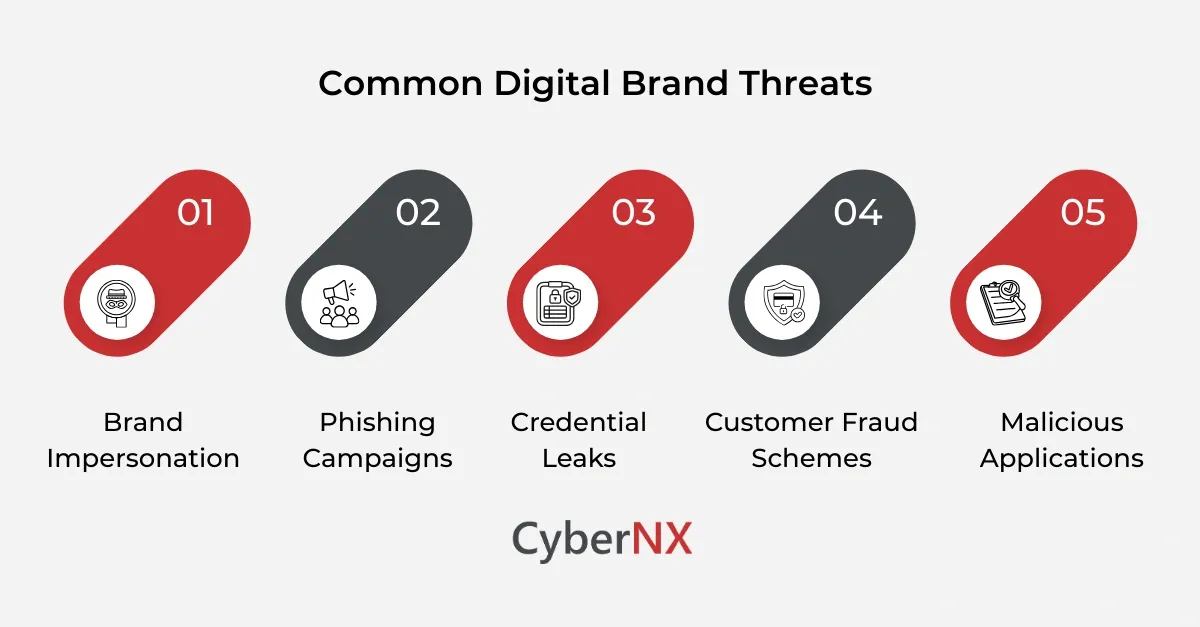
- Brand impersonation: Attackers create fake domains or social media accounts to deceive customers.
- Phishing campaigns: Threat actors launch phishing pages using brand identity.
- Credential leaks: Employee usernames and passwords appear in breach datasets.
- Customer fraud schemes: Scammers impersonate companies to trick customers into payments.
- Malicious applications: Fake mobile apps distribute malware or steal login information.
Unified monitoring helps security teams identify these threats quickly.
Challenges organisations face without unified monitoring
Many organisations monitor individual threat sources separately. This fragmented approach creates several challenges:
- Limited visibility: Security teams see only one part of the threat landscape.
- Delayed detection: Threats spread across multiple platforms before being detected.
- Operational inefficiency: Teams must investigate multiple tools and intelligence feeds.
Without unified digital risk monitoring, it becomes difficult to identify coordinated attack campaigns.
Conclusion
Modern cyber threats rarely originate from a single source. They appear across social platforms, phishing infrastructure, data leak repositories and cybercrime marketplaces simultaneously. This is why organisations are moving toward unified digital risk monitoring.
This approach helps organisations detect brand abuse, identify credential leaks, disrupt fraud campaigns and protect customer trust.
We help organisations implement this advanced monitoring to map, monitor and manage their digital footprint across global threat environments.
If you want to understand how unified digital risk monitoring can strengthen your security strategy, speak with our experts and explore how our digital risk protection services can turn threat intelligence into proactive defence.
Unified digital risk monitoring FAQs
What is unified digital risk monitoring?
It is the process of monitoring multiple external environments including dark web forums, deep web repositories, and social media platforms to detect threats affecting an organisation.
Why is unified monitoring better than separate monitoring tools?
Unified monitoring provides correlated intelligence across multiple threat sources, allowing organisations to detect coordinated attacks earlier.
What threats can unified digital risk monitoring detect?
It can detect phishing campaigns, brand impersonation, credential leaks, data exposure incidents and fraud schemes targeting customers.
Which industries benefit most from unified digital risk monitoring?
Industries like banking, fintech, healthcare, e-commerce, and technology companies benefit greatly because attackers often target their digital presence.
How often should you perform digital risk monitoring?
It should be continuous because threat actors always operate across global platforms.