ISO 27001 certification has shifted from an optional service to a genuine business requirement for Indian companies – whether you’re a fintech trying to win a large bank as a client, an IT services company bidding for an enterprise contract or a regulated entity under SEBI or RBI frameworks.
But there is a part most guides skip: getting certified is only half the challenge. Picking the right partner is equally important. The wrong choice can cost you time, money and in some cases – a failed audit that sets your programme back by months.
This guide covers what ISO 27001 involves in the Indian context, what to test in a consulting partner and who the top ISO 27001 certification companies in India are today.
What is ISO 27001 and why does it matter for Indian businesses?
ISO/IEC 27001 is an internationally recognised standard for information security management systems (ISMS). It gives organisations a structured way to identify security risks, implement controls and maintain them over time.
In India, the standard has taken on specific regulatory weight:
- Under SEBI’s CSCRF framework, ISO 27001 is mandatory for Market Infrastructure Institutions (MIIs), covering their primary data centres, DR sites, near-DR sites, SOC and colocation facilities.
- Across the BFSI sector, RBI cybersecurity directions increasingly expect ISMS frameworks aligned with ISO 27001 principles.
- For enterprise sales, procurement teams at large Indian corporates and global clients routinely require ISO 27001 certification before onboarding technology vendors.
Certification runs on a three-year cycle, with mandatory surveillance audits in Year 1 and Year 2. It is a living programme, not a one-time exercise.
What to look for when shortlisting an ISO 27001 partner
Here are five things to evaluate before you sign with anyone.
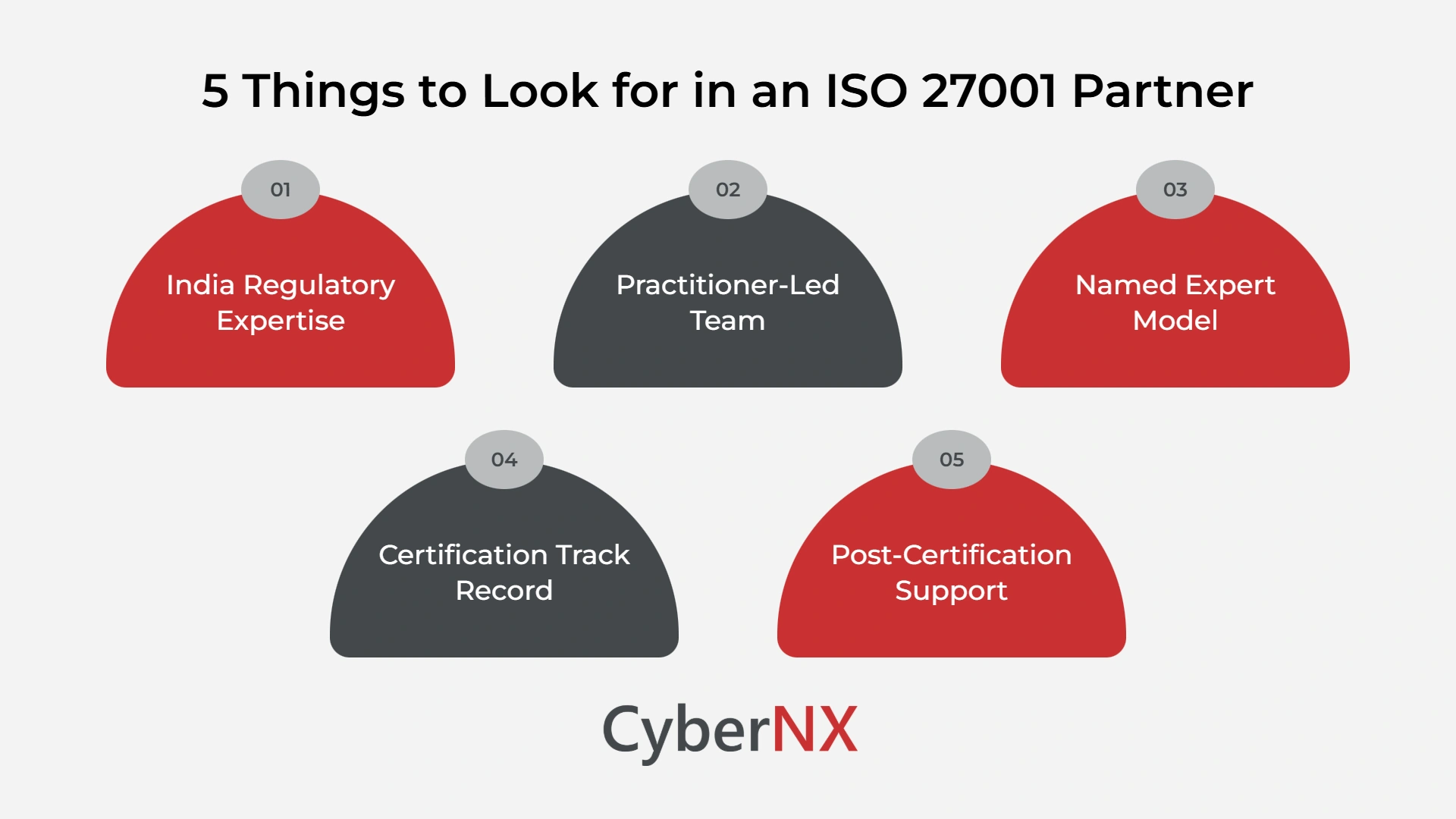
- India-specific regulatory knowledge: A good partner maps your ISMS to your actual regulatory obligations: SEBI CSCRF, RBI guidelines, DPDPA Act security requirements. A partner who treats these as separate workstreams creates duplication and increases your compliance cost.
- Practitioner-led team: There is a real difference between a team that has operated security programmes and one that knows ISO 27001 as a documentation checklist. Practitioner-led implementation builds systems that actually reduce risk.
- Named expert model: Rotating consultants lose context constantly. Look for a named senior practitioner who owns your engagement from gap assessment through to surveillance audits.
- Certification track record: Ask the consultant how many organisations they have taken through ISO/IEC 27001 certification, how they prepare clients for Stage 1 and Stage 2, and whether they can provide relevant client references.
- Post-certification support: The ISMS must keep running after Stage 2. Confirm what ongoing support looks like before you commit.
Top ISO 27001 certification companies in India
These are the companies often referenced in the Indian market for ISO 27001 consulting and implementation.
1. CyberNX
CyberNX is a CERT-In empanelled cybersecurity firm with a strong track record across BFSI, fintech and IT services. Its ISO 27001 consulting practice gives clients the implementation that is already integrated with SEBI CSCRF, RBI Master Direction and DPDP Act requirements.
The team brings hands-on experience across security operations, VAPT, red teaming and compliance, so the ISMS built reflects real-world threat context rather than standard templates.
Services include:
- Gap assessment against ISO/IEC 27001:2022
- ISMS design, risk assessment methodology and Statement of Applicability
- Annex A control implementation with tools and automation support
- Internal audit and management review preparation
- Stage 1 and Stage 2 audit coordination and support
- Ongoing monitoring and sustenance through surveillance cycles
- Security awareness training as part of the people controls
Clients span banking, financial services, insurance and mid-market IT – sectors where regulatory alignment is not optional. For firms navigating both enterprise client requirements and Indian regulatory obligations, CyberNX offers a consulting model built around that combination.
2. Kratikal Tech
Kratikal is a recognised name in Indian cybersecurity, with its primary strength in VAPT. Their ISO 27001 practice sits alongside that technical capability, making them a reasonable choice for companies that need penetration testing and ISMS implementation delivered in parallel.
3. SISA Information Security
SISA has a strong presence in the BFSI sector, built initially through PCI DSS work. Their data security expertise transfers well to ISO 27001, especially in access control and cryptography. For banks and NBFCs already engaged with SISA on PCI compliance, extending the relationship to ISO 27001 is a practical option.
4. NxgSecure
NxgSecure is a boutique consultancy focused on mid-market Indian businesses. They differentiate on continuity – one named practitioner owns the engagement end-to-end, and integrate SEBI CSCRF and RBI mapping into their standard ISO 27001 programme. It is a strong option for fintech, SaaS and healthtech companies that want accountability built into the consulting relationship.
5. BSI Group India
BSI is one of the most globally recognised names in ISO certification, and their India presence covers training, consulting and certification. The brand carries weight with international clients, particularly in Europe. For companies primarily selling to Indian enterprise clients, an India-native specialist typically offers better regulatory alignment and more competitive pricing. Note also that using the same organisation for both consulting and certification raises independence questions some procurement teams take seriously.
Conclusion
ISO 27001 is not getting less relevant for Indian businesses. With SEBI CSCRF mandating it for MIIs and their critical third-party providers, RBI frameworks tightening across BFSI and enterprise procurement increasingly treating it as a baseline vendor requirement, deciding who to work with, has become extremely important.
The right partner builds an ISMS that reduces real risk, aligns with your regulatory obligations and holds up at surveillance, not just at the initial audit.
If you are planning your ISO 27001 journey and looking for the top ISO 27001 certification companies or consulting partners in India, the CyberNX team works with organisations across BFSI, fintech and IT services on end-to-end ISO 27001 certification consulting – from gap assessment and implementation through to certification and sustained compliance. Talk to our ISO 27001 consulting experts today.
Top ISO 27001 certification companies FAQs
Who are the top ISO 27001 certification companies in India?
CyberNX, Kratikal Tech, SISA Information Security and NxgSecure are among the most referenced firms for ISO 27001 consulting in India. The right choice depends on your sector, size and regulatory context. For BFSI and SEBI-regulated organisations, prioritise partners with demonstrated regulatory alignment.
How much does ISO 27001 certification cost in India?
The costs vary a lot based on your organisation’s size, the number of locations in scope and the engagement model you choose. What stays consistent across the market: choosing the cheapest option rarely works in your favour A failed Stage 2 audit adds re-audit costs and months of delay on top of your original investment, so value and track record matter more than the lowest quote.
Is ISO 27001 mandatory under SEBI CSCRF?
ISO 27001 certification is mandatory for Market Infrastructure Institutions (MIIs) under SEBI CSCRF. The scope must cover primary data centres, DR sites, near-DR sites, SOC and colocation facilities. Third-party providers handling these critical functions for MIIs must also hold the certification. For Qualified REs, it is strongly encouraged but not mandatory as per the August 2025 technical clarifications.
What is the difference between an ISO 27001 consultant and a certification body?
A consultant helps you build and implement your ISMS – gap analysis, documentation, control implementation and audit preparation. A certification body independently audits and certifies your ISMS. You need both, and they must preferably be separate organisations. Using the same entity for consulting and certification creates an independence issue that undermines the certificate’s credibility.