Cyberattacks are a constant threat. But what if you could fight fire with fire? Penetration testing methodologies are the tools that let you do just that! Penetration testing methodologies are structured frameworks that guide security professionals through the process of identifying and exploiting vulnerabilities in systems and networks. They provide a systematic approach to simulating real-world cyberattacks, allowing organizations to proactively strengthen their defenses.
Why are pen testing methodologies important?
In cybersecurity, consistency and precision are vital. Penetration testing methodology provide the necessary framework, ensuring a standardized and repeatable process. This consistency is crucial for tracking security posture and measuring mitigation effectiveness.
Without a structured pentest methodology, testing risks becoming chaotic, potentially missing critical vulnerabilities and leading to incomplete risk assessments. A well-defined methodology provides a clear roadmap, ensuring all steps are taken and no crucial aspect is overlooked. This approach not only enhances thoroughness but also ensures reliable and actionable results, allowing you to confidently prioritize remediation efforts.
Penetration Testing Methodologies and Standards (Pen Test Methodology)
Here are six prominent penetration testing methodologies and standards:
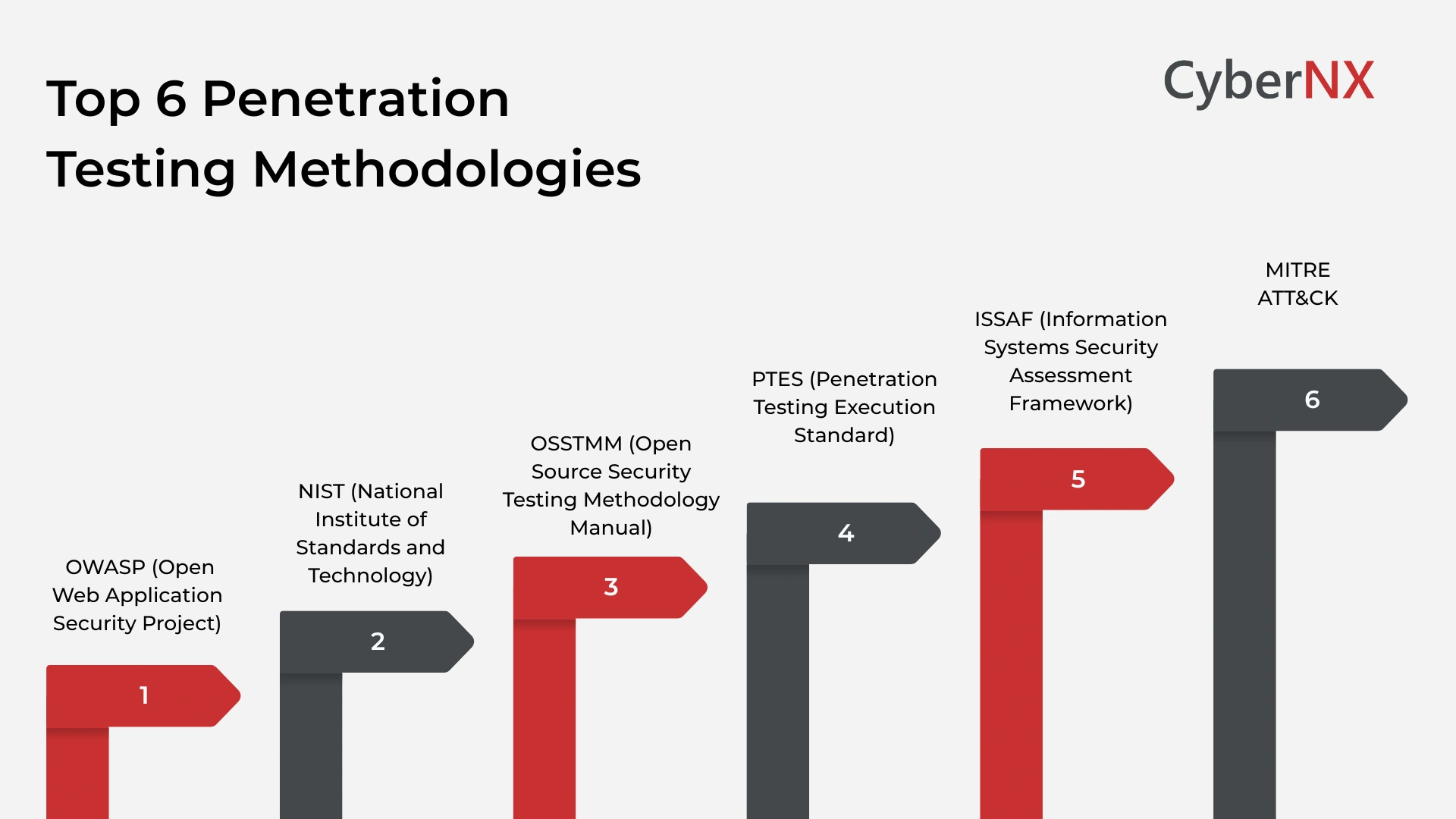
1. OWASP (Open Web Application Security Project)
OWASP is a non-profit foundation that works to improve the security of software. It provides a wealth of resources, including the OWASP Testing Guide and the OWASP Top 10, which identifies the most critical web application security risks.
Who Needs OWASP?
Web application developers, security testers, and organizations that rely on web applications. OWASP’s resources are essential for securing web-based systems.
2. NIST (National Institute of Standards and Technology)
NIST provides standards, guidelines, and best practices for cybersecurity. NIST’s Special Publication 800-115, “Technical Guide to Information Security Testing and Assessment,” is a key resource for penetration testing.
Who Needs NIST?
Government agencies, organizations in regulated industries, and any entity that requires a robust and standardized approach to security testing.
3. OSSTMM (Open Source Security Testing Methodology Manual)
OSSTMM is a comprehensive open source penetration testing methodology that covers various aspects of security testing, including information, process, internet, wireless, and physical security. It emphasizes a scientific approach to security testing.
Who Needs OSSTMM?
Security professionals who require a detailed and rigorous testing methodology, particularly those involved in comprehensive security assessments.
4. PTES (Penetration Testing Execution Standard)
PTES is a standard that outlines seven phases of penetration testing, from pre-engagement to reporting. It provides a detailed framework for conducting thorough and consistent penetration tests.
Who Needs PTES?
Penetration testers, security consultants, and organizations that want a structured and comprehensive approach to penetration testing.
5. ISSAF (Information Systems Security Assessment Framework)
ISSAF provides a detailed framework for conducting security assessments, including penetration testing. It covers various aspects of security, from information gathering to vulnerability analysis and exploitation.
Who Needs ISSAF?
Experienced security professionals and organizations that require a deep and thorough security assessment methodology.
6. MITRE ATT&CK
MITRE ATT&CK is a globally recognised knowledge base of real-world adversary tactics and techniques. Unlike other frameworks, it maps how attackers behave, making it the go-to framework for threat-informed testing and adversary emulation rather than just vulnerability discovery.
Who Needs MITRE ATT&CK?
Security teams running red team exercises, organisations facing advanced persistent threats (APTs), and any BFSI or enterprise firm that wants pentest findings mapped to real attacker behaviour — not just CVSS scores.
Pentesting Methodologies that Satisfy Indian Compliance Requirements
For Indian organisations, methodology choice directly affects whether your pentest report is accepted by regulators. Picking the wrong framework can result in findings that don’t meet audit expectations – wasting budget on retesting.
Here’s how the frameworks map to Indian regulatory requirements:
1. RBI Master Direction on IT Governance (2024)
RBI’s Master Direction on Information Technology Governance, Risk, Controls and Assurance Practices requires regulated entities – banks, NBFCs, payment institutions – to conduct periodic security assessments of critical systems. NIST SP 800-115 aligns most directly here due to its structured, documentation-heavy approach, which produces the audit-trail evidence RBI examiners expect. PTES complements it by providing the practical testing lifecycle.
2. SEBI CSCRF (2024)
Under SEBI’s Cybersecurity and Cyber Resilience Framework, all regulated entities – stock brokers, AMCs, depositories, RTAs – must conduct regular VAPT and patch critical vulnerabilities promptly. OWASP is the strongest fit for web-facing systems and APIs. For broader infrastructure coverage, PTES provides the end-to-end structure SEBI’s framework demands.
3. CERT-In Empanelment Guidelines
CERT-In’s empanelment criteria for security auditors require demonstrated capability across network, application, cloud, and wireless testing – with documented methodologies and structured reporting. OSSTMM’s scientific, measurable approach aligns with CERT-In’s emphasis on rigour. Partnering with a CERT-In empanelled vendor ensures your report carries regulatory weight when submitted to RBI, SEBI, or other authorities.
Practical Recommendation
No single framework covers everything. A mature engagement combines PTES for lifecycle structure with OWASP for application layers and MITRE ATT&CK for threat emulation, validated by a CERT-In empanelled vendor to ensure regulatory acceptance. Always consult with experts.
Common Stages in Penetration Testing Methodologies
While methodologies vary, they typically include these core stages in Penetration Testing Process:
- Pre-Engagement and Planning: Defining the scope, objectives, and rules of engagement for the penetration test.
- Intelligence Gathering: Collecting information about the target system or network, including network topology, operating systems, and applications.
- Vulnerability Analysis & Exploitation: Identifying and exploiting vulnerabilities to assess their impact and potential for unauthorized access.
- Solution Development: Recommending remediation steps to address identified vulnerabilities.
- Report Drafting & Certificate Issuance: Documenting the findings, providing recommendations, and issuing a certificate of completion.
Importance of Penetration Testing Methodologies (Pen Testing Techniques)
The pentesting methodology is fundamental for robust cybersecurity. It enables in-depth security evaluations, systematically uncovering vulnerabilities that might be missed in ad-hoc testing. By following a structured approach, organizations gain a comprehensive understanding of their security posture, allowing them to prioritize remediation efforts effectively and ultimately strengthen their defences against real-world cyber threats.
- Standardization: Methodologies ensure a consistent and repeatable testing process.
- Compliance: Many regulatory standards require organizations to perform regular penetration testing using recognized methodologies.
- In-depth Security Assessments: Methodologies provide a structured approach to identifying and addressing a wide range of security vulnerabilities.
Penetration Testing by CyberNX
Our approach to penetration testing goes beyond checkbox assessments. Our experts have mastered frameworks including PTES, OWASP, NIST SP 800-115, OSSTMM, and MITRE ATT&CK, applying them in combination to mirror how real-world attackers think, move, and exploit.
By simulating advanced persistent threats (APTs) and sophisticated attack vectors across network, application, cloud, and hardware layers, we deliver findings that reflect actual business risk. This multi-framework, hacker-style methodology ensures even the most well-hidden weaknesses are surfaced and addressed before attackers find them.
As a CERT-In empanelled cybersecurity firm, our team also brings deep expertise in Indian regulatory compliance. We structure engagements and reports to satisfy the specific requirements of RBI Master Direction on IT Governance, SEBI’s Cybersecurity and Cyber Resilience Framework (CSCRF), and CERT-In audit standards, giving your organisation both technical assurance and regulatory acceptance in a single engagement.
Final Thoughts
Penetration testing methodologies are essential for any organization that wants to maintain a strong security posture. By providing a structured and comprehensive approach to security testing, penetration testing methodology help organizations identify and mitigate vulnerabilities before they can be exploited by malicious actors.
Selecting the right methodology depends on your organization’s specific needs and requirements. Consider factors such as the scope of the test, the type of systems being tested, and the level of expertise required.
Enhance your security posture today! Contact CyberNX for a comprehensive penetration testing assessment tailored to your organization’s needs. Learn how our hacker-style techniques can uncover hidden vulnerabilities and strengthen your defences.