Most security tools work with the assumption that attacks will announce themselves. Which means alerts triggered by known malicious patterns. But in real-world, real intrusions rarely do. Skilled adversaries blend into normal activity, stay quiet, and move slowly.
Elastic SIEM approaches this problem in a unique manner. It works on the assumption that a breach may already exist and gives analysts the tools to search for it. Advanced query languages, ML and centralized data help uncover actor-agnostic intrusions. And that’s precisely why recommend using Elastic.
We often see organisations overwhelmed by alerts yet still unsure if they are compromised. Threat hunting using Elastic SIEM helps teams regain control. It enables structured, evidence-led investigations across large and complex environments, without relying only on known indicators or signatures.
The foundation: data centralisation and scalability
Threat hunting only works when analysts can see the full picture. Elastic SIEM is built around centralised log management that brings security data together in one place before analysis even begins.
Elastic ingests logs and events from firewalls, servers, endpoints across Windows, Linux, and macOS, applications, and cloud platforms including CSPs and SaaS services. All of this data is normalised into a common schema, making cross-environment analysis far easier.
This foundation supports several critical outcomes.
1. Visibility
Analysts gain petabyte-scale visibility. They can search years of historical data to check whether newly discovered indicators relate to past activity. Dormant threats that evaded detection at the time often surface during these retrospective hunts.
2. Dwell time
Dwell time reduces because archived or frozen data remains accessible. Investigations do not stall while teams wait for logs to be restored. This matters when dealing with persistent actors who may have been active for months.
3. Normalised data
Normalised data removes friction. Instead of translating formats or guessing field meanings, hunters focus on behaviour. Subtle anomalies across network, endpoint, and identity activity become easier to spot.
Our experience shows that this centralisation is what turns threat hunting from theory into daily practice.
Core tools for hunting
Elastic SIEM includes a set of tools that support different stages of the hunt, from forming questions to validating findings.
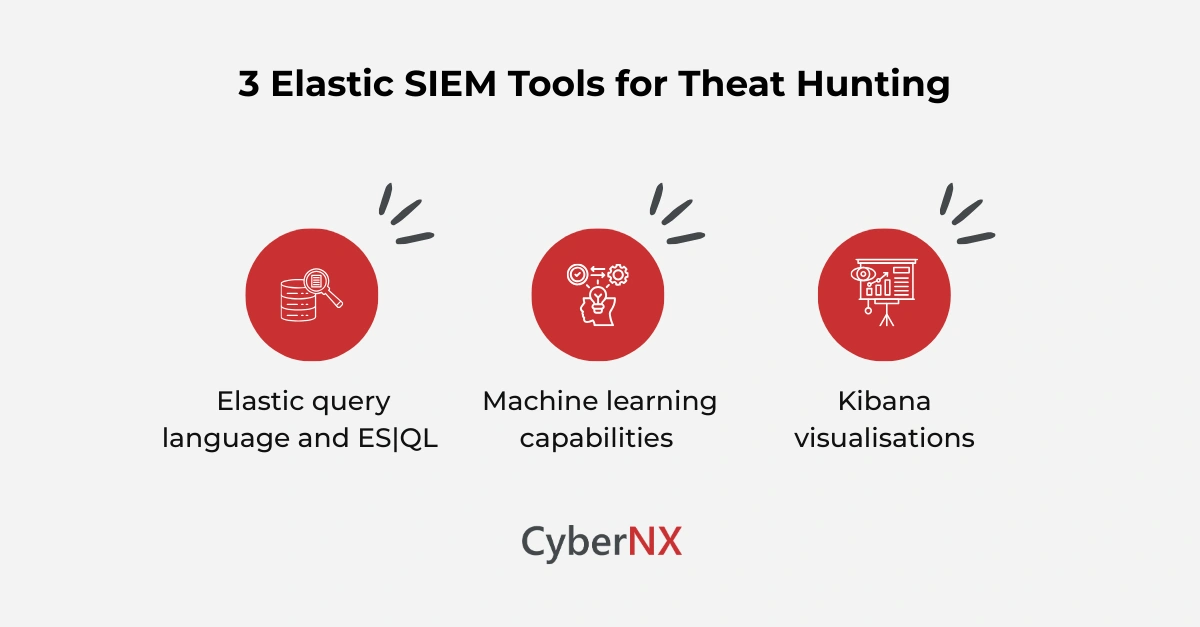
1. Elastic query language and ES|QL
Threat hunting using Elastic SIEM relies heavily on query-driven analysis. Elastic Query Language and ES|QL allow analysts to search massive datasets efficiently.
EQL is especially effective for behavioural and sequence-based analysis. It helps answer questions like whether a suspicious process launch followed a specific login pattern. ES|QL builds on this by improving scalability and performance as data volumes grow. These languages allow hunters to remain precise while working at scale, which is essential in enterprise environments.
2. Machine learning capabilities
Elastic SIEM integrates machine learning models that establish behavioural baselines. Instead of relying only on static rules, ML highlights anomalies and outliers that deserve attention.
Examples include unusual login times, abnormal data transfers, or rare parent-child process relationships. These signals often represent early-stage attacks that have not yet triggered traditional alerts. Machine learning does not replace analysts. It sharpens their focus by narrowing the search space.
3. Kibana visualisations
Kibana turns raw data into visual context. Dashboards and timelines reveal trends, spikes, and correlations that are easy to miss in text-based searches. Analysts often use visualisations to identify off-hours access to sensitive systems or sudden changes in network behaviour. These patterns then become starting points for deeper investigation. Visual hunting also helps teams communicate findings clearly to stakeholders.
4. Threat intelligence integration
Elastic SIEM correlates internal telemetry with external threat intelligence feeds. When a hunt surfaces an IP address, domain, or file hash, the platform adds context automatically. This enrichment helps analysts assess severity quickly. It also reduces guesswork during early investigation stages.
The hypothesis-driven hunting methodology
Threat hunting using Elastic SIEM typically follows a structured, hypothesis-driven approach. This keeps hunts focused and repeatable.
1. Hypothesis generation
Every hunt starts with an assumption. The assumption might be based on industry reports, recent attacker techniques, or internal observations.
For example, a team may hypothesise that attackers are targeting identity providers such as Okta through compromised CI or CD pipelines. The hypothesis defines what success looks like before data is queried. This step prevents random searching and aligns hunts with real risk.
2. Evidence gathering and querying
Once the hypothesis is defined, analysts identify relevant data sources. In the identity example, this could include Okta system logs showing API activity. Using KQL, EQL, or OsQuery, hunters filter for specific evidence. They might look for failed access token requests from public clients using unusual grant types. This phase is iterative. Queries are refined as new patterns emerge.
3. Investigation and pivoting
When results appear, analysts pivot. They examine timelines, host risk scores, user behaviour, and related events. Elastic Security provides a unified interface that makes these pivots fast. Hunters move from one clue to the next without losing context. This stage often reveals whether activity is benign, misconfigured, or malicious.
4. Response and preservation
Confirmed threats are escalated to incident response. Containment and remediation follow established workflows. Equally important is preserving the knowledge gained. Queries that are useful but too noisy for permanent detection rules are saved as hunting queries. They become part of future investigations. Over time, this builds an internal library of proven hunting logic.
The Elastic hunting package
Elastic provides a dedicated hunting package within its Detection Rules repository. This package supports threat hunting using Elastic SIEM by offering behaviour-focused analytics that complement standard detections.
Each hunting analytic includes standardised metadata. Queries are stored in TOML for programmatic use and Markdown for manual execution. This flexibility suits both automation and hands-on hunting.
Every analytic aligns with MITRE ATT&CK tactics and techniques. This mapping helps teams prioritise hunts based on known adversary behaviour. Hunters can search the repository by MITRE ID or data source. They can then run queries directly against their environment to identify potential matches. This structured approach reduces the effort needed to design hunts from scratch.
Operationalising the hunt
Threat hunting succeeds when it becomes routine, not occasional. Elastic SIEM supports collaboration through case management. Multiple analysts can document findings, share context, and track progress in one place.
Automated workflows help once malicious activity is confirmed. Actions such as isolating endpoints or blocking IP addresses can be triggered quickly, reducing impact. Continuous improvement ties everything together. Each hunt feeds lessons back into detections, playbooks, and response plans. Over time, the security posture strengthens in measurable ways.
We often see organisations mature fastest when they treat hunting as a cycle, not a project.
Implementation challenges
Threat hunting using Elastic SIEM delivers strong results, but it comes with practical challenges.
Initial setup can feel complex. Elastic’s flexibility is a strength, but it requires careful planning and tuning. Many teams benefit from expert guidance during early stages.
There is a learning curve. Analysts need time to become comfortable with EQL, ES|QL, and advanced features. Training and hands-on practice are essential.
Resource requirements matter. Large-scale data ingestion and querying demand solid infrastructure. Elastic Cloud can help teams scale without overloading internal systems.
Acknowledging these challenges early makes adoption smoother.
Conclusion
Threat hunting using Elastic SIEM shifts security teams from reacting to alerts to actively searching for hidden threats. By combining centralised data, powerful query languages, machine learning, and a structured hunting framework, Elastic enables deeper visibility and faster discovery of adversary behaviour.
When implemented well, this approach reduces attacker dwell time and improves confidence in security decisions. It also builds a culture of curiosity and continuous improvement within security teams.
At CyberNX, we help organisations design, deploy, and mature threat hunting programs using Elastic SIEM. If you want to strengthen your detection capability and gain clearer insight into real risk, our team is ready to help. Talk to us to know how our Elastic Stack consultation can help your security program.
Threat hunting using Elastic SIEM FAQs
How is threat hunting different from detection engineering?
Threat hunting focuses on exploratory investigations driven by hypotheses, while detection engineering builds automated rules for known patterns.
Can small security teams use Elastic SIEM for threat hunting?
Yes, but success depends on prioritisation, training, and focusing hunts on high-risk areas first.
How often should threat hunts be conducted?
Many organisations run scheduled hunts monthly, with ad hoc hunts triggered by new threats or incidents.
Does threat hunting replace traditional SIEM alerts?
No. It complements alerts by uncovering activity that detection rules may miss.