Software supply chain security has moved from a niche engineering concern to a core business requirement. The reason is complexity.
Modern applications are assembled from open-source components, build tools, registries, cloud platforms and vendor code – most of which no single team formally reviewed or controls. Securing that chain is now a distinct discipline, separate from application security or vendor management.
This guide covers what the software supply chain includes, how risk differs for those who build software versus those that buy it, what global and Indian regulators expect, and the controls that reduce real exposure.
What is software supply chain security?
Software supply chain security is the practice of protecting everything that touches software before it reaches production. It includes every input that shaped it along the way.
Consider how software gets built today. A development team writes business logic and picks a handful of libraries. Those libraries pull in others, which pull in others still. Build tools compile the whole thing.
If you go further along: a container image hosts it, registry distributes it and a vendor’s platform handles part of what happens on the other end. By the time software reaches production, dozens of parties – most unknown to the team shipping it – have contributed something.
What the software supply chain includes
The chain spans further than most security programmes formally own:
- Open-source libraries and their transitive dependencies: what arrives indirectly, not what was chosen
- Source code repositories: access controls, branch protections, contributor trust
- CI/CD pipelines: the automated systems that build and deploy software
- Artifact registries: where built packages are stored and pulled from
- Container base images: the inherited foundation for containerised workloads
- Commercial software and vendor code: third-party applications running inside the estate
- SaaS platforms: external services the product connects to or depends on
Why software supply chain risk is growing
The risk profile here has not changed because software got more assembled but because the assembly process itself became a valuable target.
Dependency depth has outpaced review
A typical application today carries hundreds of components, most arriving as dependencies of dependencies. Development teams knowingly select a small fraction of what eventually ships; the rest passes through automated processes with little individual scrutiny. The gap between what an organisation approved and what it runs has become wide enough that closing it requires deliberate effort.
The assembly line itself is now a target
The second shift is about where in the chain pressure is applied. Compromises have moved from individual packages toward the tools and infrastructure used to build software.
In 2026, a campaign against widely used TanStack packages spread through development pipelines within hours, harvesting repository credentials, cloud secrets and CI/CD tokens from thousands of projects. The trust that developers place in automated workflows became the exposure, not a specific library vulnerability.
The downstream effect shows up in incident data. Third-party involvement in breaches doubled to 30% in a single year – the largest single-year shift Verizon’s annual breach report has ever recorded.
That number reflects how much of the attack surface now lives outside the organisation’s direct control.
Risk differs for software makers and software buyers
Generic supply chain guidance tends to assume every reader controls a build pipeline. Most organisations do not, or do not exclusively. The right starting point is understanding which side of the chain an organisation primarily sits on because the exposure looks different and so do the controls.
Organisations that build software
For software product companies, technology teams and in-house development functions, exposure lives in the composition of what gets built.
Every library, pipeline plugin and build script is an input that shapes the final artifact. Transitive dependency depth – the libraries a team never consciously chose but ships regardless – is one part of that. AI-assisted development adds another.
Organisations that buy software
Banks, manufacturers, hospitals and most large enterprises are primarily software consumers. Their exposure sits in vendors, subcontractors and update mechanisms they cannot inspect from the inside.
The engineering controls designed for the build side – pinned dependencies, signed commits, isolated build environments – simply do not apply here. What matters instead is governance: due diligence that evaluates how a vendor develops and maintains software, contract terms that create enforceable obligations around breach notification, and visibility into the subcontractors that vendor in turn depends on. Accountability does not end at the first supplier.
Most organisations are both
A bank that builds customer-facing applications and buys its core banking platform sits on both sides simultaneously. The practical consequence is that supply chain security cannot be a single programme with a single owner. Both sides need attention – but not necessarily at once. The right starting point is the highest criticality systems, and working outward from there.
How to secure the software supply chain
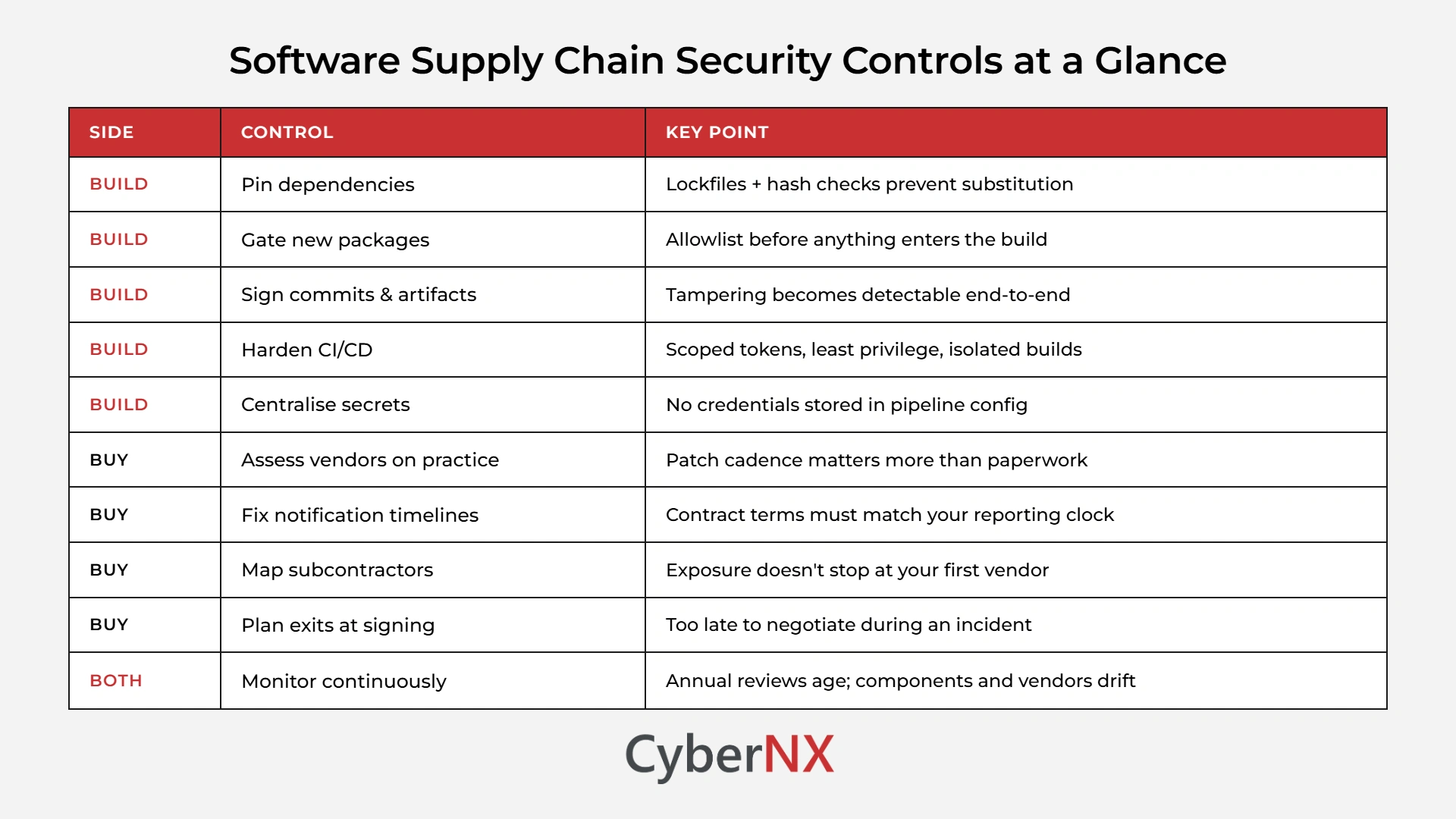
A functional programme combines engineering controls on the build side with governance controls on the buy side. Neither alone is sufficient.
Build-side controls
For organisations that produce software, the priority is ensuring that every input to the build is verified and that the pipeline itself cannot be tampered with:
- Pin dependencies using lockfiles and verify package hashes at install time to prevent substitution
- Gate new packages through an internal allowlist before they enter the build environment
- Sign commits and artifacts so that tampering at any stage of the pipeline is detectable downstream
- Harden CI/CD with least-privilege service accounts, scoped tokens and isolated build environments
- Centralise secret management and rotate credentials routinely
Buy-side controls
For software consumers, the defining challenge is the gap between what can be contractually required and what can be technically enforced:
- Evaluate vendors on practice – patching cadence, incident history and development standards reveal more than a completed questionnaire
- Fix notification obligations in contract, aligned to the regulatory reporting windows that apply
- Map subcontractor relationships so that fourth-party exposure is visible before it surfaces as an incident
- Build exit provisions into agreements at signing, not during a crisis
What both sides need
Neither build-side nor buy-side controls work well as point-in-time activities. Components change. Vendors change. Pipeline configurations drift. Supply chain security requires continuous monitoring to remain current.
IBM research puts the average time to detect and contain a supply chain compromise at 267 days, the longest of any attack category. That figure underlines a practical reality: by the time a compromise surfaces, a great deal has already happened. Monitoring, not periodic audit, is what closes that gap.
Build the foundation before the gap widens
Software supply chain security has become necessary because software is assembled rather than written, and complex because responsibility is spread across parties no single team controls.
Risk looks different depending on whether an organisation builds software, buys it or – as is true for most – does both. Regulators in India and internationally are moving from guidance to enforcement, and what they want to see is evidence.
Every control in this guide depends on one capability first: an accurate, current picture of what components are in play – across internal builds and vendor-supplied software alike. That is exactly what CyberNX’s SBOM solutions provide: component-level visibility and continuous tracking as software evolves. Have questions about where to start? Talk to our team.
Software supply chain security FAQs
What is the difference between software supply chain security and third-party risk management?
Third-party risk management evaluates the organisations an enterprise depends on – their financial stability, contractual compliance and operational reliability. Software supply chain security evaluates the software itself, including open source components that have no vendor behind them. The two disciplines overlap on procured commercial software but neither replaces the other.
Who owns software supply chain security inside an organisation?
Ownership is shared across functions – which is why it often falls through gaps. Engineering owns build integrity and dependency hygiene. Security owns monitoring and incident response. Procurement and legal own vendor terms and subcontractor visibility. The programmes that work have one accountable senior owner coordinating all three, rather than each function managing its piece independently.
How should an organisation assess whether a vendor’s software is safe to use?
Start with what the vendor can demonstrate: documented component inventory, a clear patching process, evidence of past incident handling and a verifiable secure development practice. Then look past the point of sale – specifically, how quickly the vendor is contractually obligated to notify customers of a compromise, and what access they will provide for audit if required.