Social media is a critical component that supports marketing, customer engagement, and brand positioning. However, it also introduces risks galore that could be underestimated by those at the top.
From account compromise to accidental data exposure, a single incident can disrupt operations and damage trust. Many organisations struggle in this aspect because they lack structure and clearly defined responsibilities. A well-defined social media risk management policy provides that structure. So, how does it help? By ensuring accountability, strong security controls, and alignment with teams.
In this blog, we outline key components required to manage social media risks effectively.
Roles and responsibilities
If you are keen to develop a social media risk management policy, begin the initiative by assigning clear roles across the organization. Typical roles include:
1. Chief Information Security Officer (CISO)
CISOs should oversee the policy, coordinate with other functions and ensure that the policy aligns with overall cybersecurity strategy.
2. IT/Security team
Implement technical controls such as authentication, logging and monitoring. In addition, the IT or security team should manage account provisioning, and assists other departments. According to the existing best practices, IT must lay down clear terms to authenticate and authorize social media platforms and be responsible for implementation, reporting, and monitoring of social media security.
3. Legal/Compliance
This team should advise on regulatory requirements (e.g. data privacy, advertising law, FINRA) and reviews content policies. Legal should collaborate with IT on compliance issues such as archiving and disclosures.
4. Human Resources
The HR team should take the responsibility of educating employees, enforce the social media risk management policy, and disciplines violations. HR also vets third-party contributors and coordinates training.
5. Business Unit Owners/Community Managers
These groups must manage specific branded accounts, and they must follow the policy and liaise with IT and Comms. For instance, a “Community Manager” role should have defined objectives and understand acceptable content.
6. Third Parties (Agencies/Contractors)
Third-party vendors today are very much part of a business. They shouldn’t be considered as an external component, especially when it comes to cybersecurity. They must be subject to the same rules. Contracts should require adherence to the organization’s social media standards.
Each group’s duties should be strictly documented. For example, one model policy outlines IT responsibilities (authentication, authorization, monitoring), and parallel responsibilities for Marketing, HR, and Legal to collaborate with IT. This ensures that social media is treated like any other IT resource, with oversight and accountability across departments.
Acceptable use and account lifecycle
Acceptable use must clearly restrict sharing sensitive data, personal matters, or unlawful content. Employees should follow brand guidelines, maintain confidentiality, and distinguish personal opinions from official communication.
Social accounts should be managed as corporate assets with defined lifecycle controls. Account creation must follow formal approval using organisation-owned credentials. Strong authentication, including MFA and centralised access management, is essential. Role-based access and content approval workflows help control publishing risks. Continuous monitoring and logging ensure visibility into activity.
Timely deprovisioning prevents misuse when roles change. Enforcing enterprise ownership and control reduces the risk of orphaned or compromised accounts and strengthens governance.
Technical controls
Protective social media monitoring strategies should be applied where feasible to social media use:
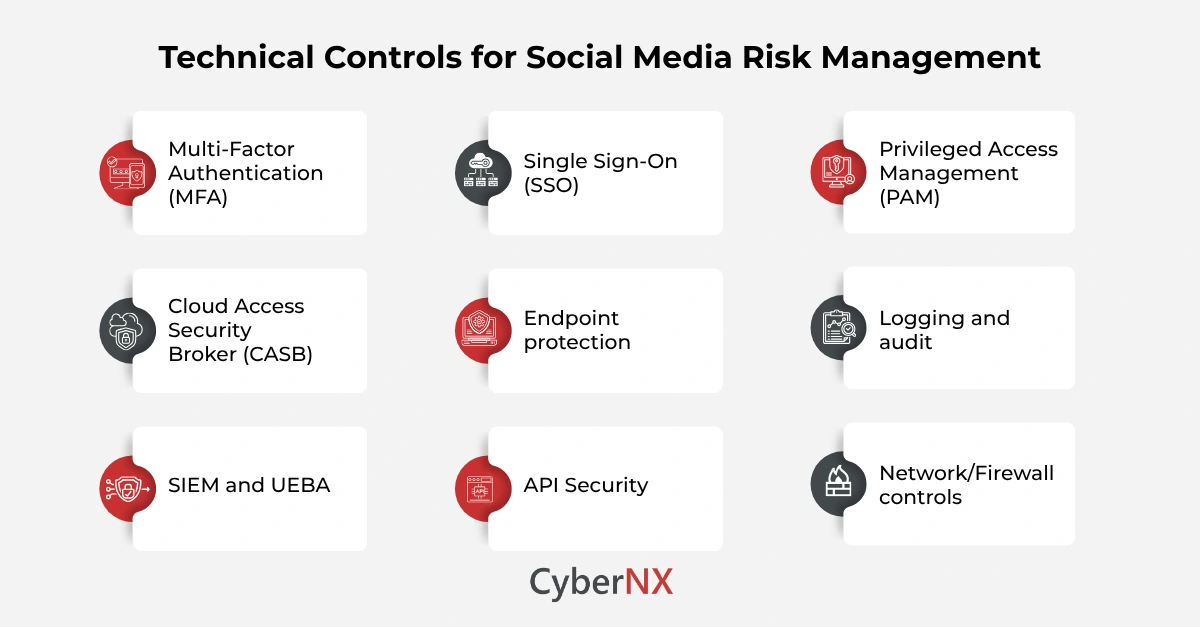
1. Multi-Factor Authentication (MFA)
Mandate MFA on all official social accounts. Use app-based or hardware tokens, not SMS where possible. This thwarts most credential-stuffing and phishing compromises. The 2025 Identity Automation Gap Report by Cerby reports that 89% of enterprises neglect MFA on social accounts, so this is a high-impact control.
2. Single Sign-On (SSO) / Identity Integration
Where supported, integrate social logins with corporate SSO (e.g. SAML, OAuth). If platform supports business federation, use it. If not, enforce organization-owned account credentials and centrally manage them via an IAM/PAM solution. Treat social accounts as privileged assets.
3. Privileged Access Management (PAM)
For shared corporate accounts, use a PAM or vault (e.g. LastPass, 1Password Business, or dedicated social vault) to distribute unique per-user access to the shared credential, and to rotate passwords/MFAs automatically. This provides an audit trail of which user triggered which post.
4. Cloud Access Security Broker (CASB)
Deploy CASB or equivalent to monitor data flows to social apps. A CASB can enforce policies such as block risky activities and filter sensitive data on unmanaged cloud apps. For example, Netskope suggests using CASB rules to watch for PHI or IP being posted and block it. Data Loss Prevention tools can scan outgoing posts/messages for confidential data patterns (PII, credit cards, proprietary terms).
5. Endpoint protection
Ensure employee devices have up-to-date anti-malware and endpoint detection/response (EDR) agents. Malicious links on social can load malware; endpoint defences help catch this. Combine with browser isolation or filters for risky domains.
6. Logging and audit
Enable all available logging on social platforms like admin logs and login history. Integrate these logs into enterprise SIEM/monitoring. Logs should record account creations, permission changes, password resets, and login attempts. Even if the platform is external, some do provide audit logs. Forward these to a SIEM or log management system for correlation.
7. SIEM and UEBA
Ingest social media-related logs into your SIEM for real-time alerting. Define rules to detect anomalies like login from new geolocation, posts outside business hours, spikes in content volume. Use UEBA to detect unusual patterns (a user suddenly accessing multiple social accounts, or API abuse). For example, set alerts on unusual follower counts or outbound links.
8. API Security
If your organization provides or consumes social media APIs (e.g. for analytics, chatbots, or ads), secure them. Enforce OAuth scopes, rotate API keys, and apply rate limits on inbound/outbound API calls. This prevents brute-force or scraping attacks on organizational social data.
9. Network/Firewall controls
Block access to unsanctioned social sites by default, allowing only approved platforms. Use web filters to block known malicious domains that might appear in social links.
In summary, the “defence-in-depth” approach applies: MFA and IAM to protect accounts, DLP/CASB to protect data, EDR and filtering to protect endpoints, and SIEM/UEBA to detect incidents.
Conclusion
A structured social media risk management policy helps organisations bring control, clarity, and consistency to how social platforms are used. It aligns teams, strengthens accountability, and reduces exposure to both technical and operational risks.
Even small improvements, such as enforcing MFA or formalising account ownership, can significantly reduce risk. The key is to treat social media with the same level of discipline as any other enterprise system.
At CyberNX, we help team to strengthen governance and implement practical security controls that support business goals. If you are reviewing your current social media risk management policy or building one from the ground up, this is the right time to take a structured approach. Contact us to know more about our digital risk protection capabilities.
Social media risk management policy FAQs
What is a social media risk management policy?
It is a formal framework that defines how organisations manage risks associated with social media use, including security, compliance, and governance.
Who should own the social media risk management policy?
Typically, ownership sits with the CISO or security team, with collaboration from marketing, legal, and HR.
Why is MFA critical for social media accounts?
MFA significantly reduces the risk of unauthorised access by adding an extra verification layer beyond passwords.
How can organisations prevent social media account misuse?
By enforcing role-based access, continuous monitoring, strong authentication, and clear acceptable use guidelines.