SOC challenges sit at the centre of many security conversations today. Most CISOs we speak with share a similar concern. Their Security Operations Centre works hard, yet pressure keeps rising. Alerts increase. Teams shrink or stay flat. Expectations from the board grow sharper.
A modern SOC must detect threats fast, respond with confidence, and justify every penny spent. However, reality often looks different. Analysts feel stretched. Tools feel noisy. Integration feels painful. Meanwhile, leaders must explain value in business terms, not technical ones.
This blog explores the top five SOC challenges we see across enterprises. Each one connects directly to operational risk, staff wellbeing, and executive trust. More importantly, we share practical insights on how to address them without overhauling everything at once.
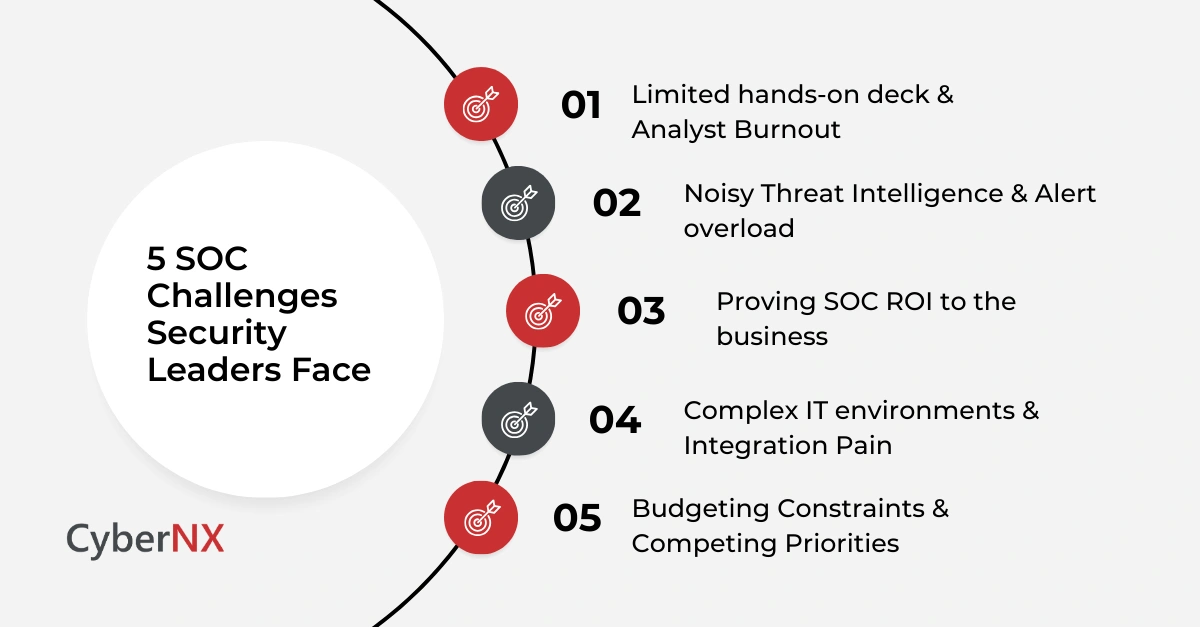
1. Limited hands-on deck and analyst burnout
People remain the heart of every SOC. Yet headcount rarely keeps pace with threat volume. Many teams run lean by design. Over time, this creates deep strain.
Most SOCs rely heavily on Tier 1 analysts. These analysts handle triage, alert validation, and escalation. When alerts flood in, fatigue sets in fast. Burnout follows. Attrition rises. Knowledge walks out the door.
Staffing continuity then becomes fragile. New hires take months to ramp up. Documentation often lags. Knowledge transfer stays informal. As a result, the SOC loses context with every departure.
We often see leaders asking what are the challenges of SOC operations beyond tools. This human factor usually tops the list.
What helps in practice
Reducing burnout starts with smarter workload distribution. Automation for low value tasks helps. Clear runbooks reduce decision fatigue. Rotating analysts across functions builds resilience and keeps skills fresh. We also see strong results when organisations invest in mentoring and structured knowledge sharing.
2. Noisy threat intelligence and alert overload
Threat intelligence promises clarity. In practice, it often delivers noise.
Many SOCs subscribe to multiple threat intelligence feeds. Each feed adds indicators, scores, and alerts. Quantity grows. Quality stays uneven. Metrics look impressive, yet analysts drown.
Tier 1 teams feel this most. They chase alerts with little context. False positives eat hours. Real threats hide in the background. Over time, trust in the tooling erodes. This is one of the most underestimated SOC challenges. Leaders invest in feeds to strengthen detection. Instead, they increase fatigue.
According to insights shared by analysts at Gartner, security teams often use less than half of the threat intelligence they collect. The rest adds operational drag.
What helps in practice
Effective SOCs curate intelligence aggressively. They align feeds to business risk, not vanity metrics. Context matters more than volume. We recommend mapping intelligence directly to detection use cases. If a feed does not improve response quality, it should go.
3. Proving SOC ROI to the business
Boards ask a simple question. What value does the SOC deliver?
Answering that question is harder than it sounds. SOC outputs rarely translate neatly into revenue or savings. Prevented attacks feel hypothetical. Success looks like nothing happening.
This creates a persistent challenge for CISOs. They know the SOC matters. However, proving return on investment in business language feels elusive. Traditional metrics often fall short. Alert counts and mean time to respond do not resonate with finance leaders. As a result, SOC funding discussions become defensive.
This challenge grows sharper during budget reviews. Especially when economic pressure rises.
What helps in practice
Strong SOC leaders reframe ROI around risk reduction and business continuity. They link incidents to avoided downtime. They show how faster response limits regulatory exposure. Clear storytelling matters as much as numbers.
We also see value in aligning SOC metrics with enterprise risk frameworks such as those promoted by MITRE. This creates a shared language with executives.
4. Complex IT environments and integration pain
Enterprise IT rarely looks neat. Hybrid cloud, legacy systems, SaaS platforms, and shadow IT coexist. The SOC must see across all of it.
Integration becomes a major hurdle. Tools struggle to talk to each other. Data arrives in different formats. Context fragments. As infrastructure evolves, the SOC plays catch up. Every new platform adds another integration task. Over time, visibility gaps appear. This complexity also slows response. Analysts jump between consoles. Correlation suffers. Root cause analysis takes longer than it should.
Among all SOC challenges, this one quietly erodes effectiveness day by day.
What helps in practice
Successful teams focus on integration strategy early. They prioritise platforms with open APIs and strong ecosystem support. They also rationalise tooling. Fewer, well integrated tools often outperform sprawling stacks.
We advise starting with the most critical assets. Full visibility everywhere sounds appealing. Targeted visibility where risk is highest delivers results faster.
5. Budgeting constraints and competing priorities
Security budgets face constant scrutiny. SOC costs stand out because they are ongoing. Tools renew annually. Staff costs rise steadily.
Leaders must balance investment across prevention, detection, and response. The SOC often competes with other initiatives such as cloud migration or digital transformation. Budgeting becomes even harder when ROI feels abstract. Leaders may hesitate to invest further in the SOC, even when gaps are clear.
This challenge links back to every other issue discussed here. Limited budget fuels staffing shortages. It restricts integration work. It pushes teams towards cheaper but noisier tools.
What helps in practice
Budget conversations improve when framed around business outcomes. Instead of asking for more spend, effective leaders propose targeted improvements. For example, reducing alert volume by a defined percentage. Or improving response time for high-risk incidents. Phased investment works well. Small wins build confidence and unlock future funding.
Conclusion
SOC challenges rarely exist in isolation. They connect through people, process, and technology. Burnout feeds errors. Noise hides threats. Complexity slows response. Budget pressure magnifies everything.
Our experience shows you do not need to rebuild your SOC overnight. You need clarity on where friction hurts most. At CyberNX, we work alongside your team to strengthen your SOC without adding unnecessary complexity. From process tuning to technology optimisation, we help you regain control and confidence.
Talk to us today for a SOC consultation and see how your operations can work smarter, not harder.
SOC Challenges FAQs
How often should a SOC review its operating model?
Most SOCs benefit from a structured review every 12 months, or sooner after major technology or business changes.
Can automation fully replace Tier 1 SOC analysts?
Automation helps reduce workload, but human judgement remains critical for context, prioritisation, and decision making.
How do managed SOC services help with SOC challenges?
They provide access to skilled analysts, proven processes, and scalable tooling without long hiring cycles.
What metrics matter most for SOC performance?
Metrics tied to risk reduction, response effectiveness, and business impact resonate more than raw alert volumes.