Building a Security Operations Centre from scratch is exciting. It is also uncomfortable. Most teams begin with ambition but limited clarity. Alerts start flowing in. Tickets pile up. Analysts feel busy, yet leaders struggle to see real security value. This is where SOC best practices matter most.
When a SOC is implemented for the first time, the goal is not perfection. It is learning. Metrics, processes and investigations should guide improvement, not punish performance. We often see organisations rush into tools, automation and playbooks before understanding their environment. That approach creates noise, burnout and mistrust.
In this guide, we focus on best practices for teams standing up a SOC for the first time. We explore early challenges, practical metrics and frameworks that help teams mature steadily without overwhelming people or budgets.
Why first-time SOCs struggle early on
A new SOC usually inherits alerts from existing SOC tools such as EDR, identity platforms, cloud logs and email security. The volume feels manageable at first. Then patterns emerge.
Alerts lack context and tickets are inconsistent. Junior analysts follow guesswork. Senior staff spend time re-investigating the same issues while leadership asks why resolution times vary so much.
These challenges are normal and the problem is not effort but the structure. SOC best practices help bring order before complexity takes over.
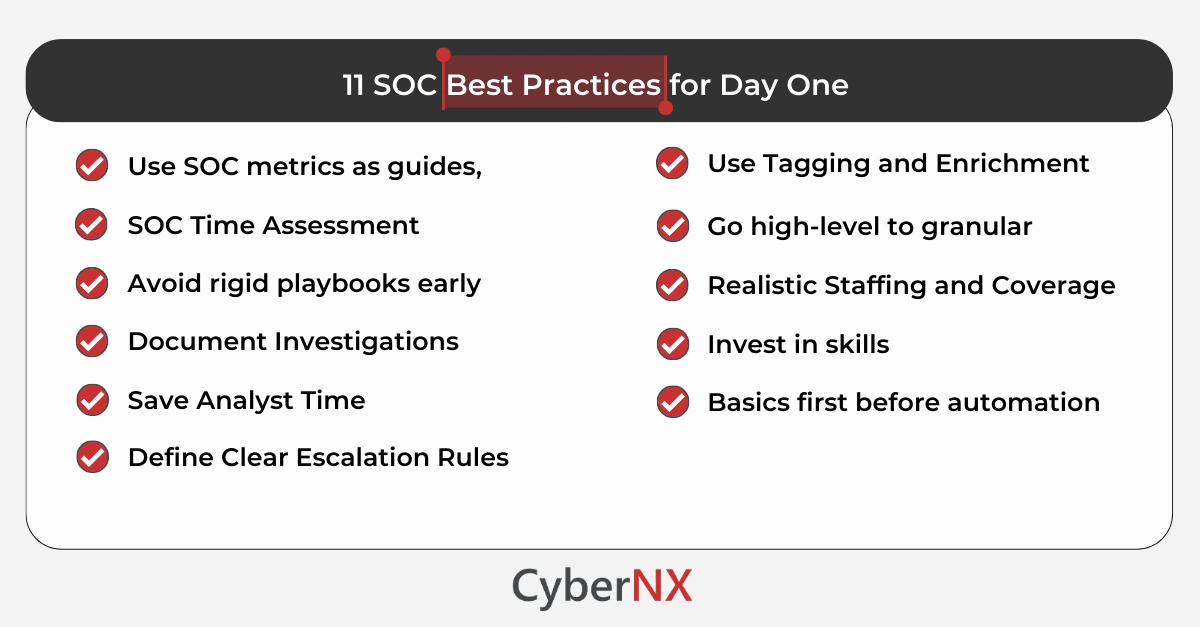
11 SOC best practices revealed
With our extensive experience of building our own SOC team and helping businesses build theirs, here are top 11 SOC best practices to follow:
1. Use SOC metrics as guides
Metrics matter. But early on, they should act like a compass, not a performance review. For a first-time SOC, focus on a small set of operational metrics that reveal where time is being spent.
Core SOC metrics to track early:
- Number of tickets or alerts handled
- Time to initially address a ticket
- Time to remediate or close a ticket
- False positives versus genuine security concerns
- Referrals by department and ticket percentage
- Root cause classification
Root cause deserves special attention. Categorise every alert clearly: was it social engineering, a vulnerability, a successful attack or an internal engineering mistake.
These SOC best practices reveal patterns quickly. You will see where analysts struggle, where tooling falls short and where training is missing. Tip from the field: Metrics should answer “where do we improve next?” not “who did badly this week?”
2. SOC time assessment
Once metrics are visible, the picture becomes clearer. Some teams spend most of their time on false positives. Others lose hours chasing incomplete alerts. Many burn cycles escalating issues that lack evidence.
This insight helps management make informed decisions. Do you need better training, more staff or just better enrichment and tooling.
Best practices emphasise fixing root causes first. Hiring more analysts rarely solves broken investigations.
3. Avoid rigid playbooks early
Playbooks sound comforting. In reality, first-time SOCs often fail with them. Alerts are custom, environments are unique and variations are constant. Rigid playbooks break under pressure.
Instead, focus on building a thinking framework. Every alert should answer a consistent set of questions:
- What does this alert actually mean
- What is the source of detection
- Which asset or identity is involved
- Is this behaviour expected or unusual
- What contextual data confirms or disproves risk
These questions form the backbone of SOC best practices for new teams. They encourage reasoning instead of blind steps.
4. Document investigations
Every alert analysed should leave a trace. Documentation is not busy work. It is leverage. Record investigation steps, queries used, screenshots from OpenSearch or cloud tools. Over time, this creates an internal knowledge base shaped by your environment. Turn this into a checklist for junior analysts to follow and senior analysts to refine. This is how consistency grows without rigid playbooks.
5. Save analyst time
Time is the most precious SOC resource. Early efficiency prevents long-term burnout.
Build simple, modular SOPs. Rather than long playbooks, create modular investigation guides:
- How to investigate an external IP
- How to trace API calls in CloudTrail
- How to review IAM role activity
- How to pivot logs in OpenSearch
These modules combine naturally. Analysts apply only what is relevant. This approach aligns with flexibility and learning.
6. Define clear escalation rules
Unclear escalation wastes time. Analysts hesitate and seniors context-switch repeatedly. Define escalation rules early:
- Escalate after a fixed time without resolution
- Escalate on specific data exfiltration signals
- Require a written hypothesis and supporting evidence
This reduces back-and-forth and builds trust in investigations.
7. Use tagging and enrichment
Tag alerts, enrich data and add context before tickets reach analysts. Do not forward raw alerts that customers or internal teams already receive. Enrichment is the SOC’s value. Strong SOC best practices ensure alerts arrive with context, not confusion.
8. Go high-level to granular
Many first-time SOCs want deep detections immediately. Resist that urge. Begin with high-level handling approaches:
- Malware alerts
- Identity alerts
- Network-based alerts
For each category, define common steps that always apply. Logs to check. Questions to answer. Evidence to gather. Later, refine these into more specific responses. This layered approach keeps the SOC manageable as it grows.
9. Realistic staffing and coverage
Running a true 24/7 SOC is expensive. Staffing models are often underestimated. Shifts, weekends, leave and training – all add pressure. If budgets are limited, consider a hybrid model. Use MDR support while building internal capability. Bring functions in-house gradually. This is a practical application of SOC best practices for sustainability.
10. Invest in skills
A SOC full of juniors without guidance is a risk. If an organisation under-invests in expertise and waits for a breach to justify spend, it is making a dangerous gamble. We believe strongly in building capable teams. Analysts must understand alerts deeply, not just close tickets. SOC Best Practices prioritise technical analysis over volume metrics.
11. Basics first before automation
Automation looks attractive. But it magnifies mistakes. If detections are noisy and enrichment is weak, automation spreads bad outcomes faster. Earn trust first. Deliver alerts that matter. Show consistent investigations. Then automate safely.
Conclusion
Building a SOC for the first time is a journey. There is no single blueprint. But strong SOC best practices provide direction. Start with meaningful metrics. Focus on frameworks, not rigid playbooks. Document everything, protect analyst time and invest in skills. Build trust before speed.
At CyberNX, we work alongside teams at this exact stage. We help you design SOC foundations that scale without chaos. If you are building or rethinking your SOC, let us talk about how our SOC services can help your organisational security program. A short conversation now can prevent years of frustration later. Connect today.
SOC best practices FAQs
How do regulatory requirements influence SOC design?
Regulatory obligations often shape logging, retention and reporting needs. A SOC must align with compliance early to avoid retrofitting controls later. Clear understanding prevents unnecessary tooling and duplicate effort.
What role does threat intelligence play in a small or new SOC?
Threat intelligence helps prioritise alerts and focus investigations. For early-stage SOCs, curated and context-aware intelligence is more valuable than large, unfiltered feeds.
How should a SOC collaborate with IT and engineering teams?
Strong collaboration reduces investigation time and friction. Clear ownership, defined communication paths and shared context improve response speed and trust across teams.
When should a SOC consider red teaming or purple teaming?
Red and purple team exercises become useful once core detections are stable. Running them too early can overwhelm analysts and produce insights the SOC is not ready to act on.