This guide covers what a SOC 2 audit involves-what auditors test, what evidence they request, how exceptions are handled and what the final report means for your buyer.
What is a SOC 2 audit?
A SOC 2 audit is an independent examination of your organisation’s controls by a licensed CPA firm. The auditor assesses whether your controls meet the Trust Services Criteria (TSC) in scope-Security being mandatory, with Availability, Confidentiality, Processing Integrity and Privacy added based on your business.
Who conducts it and why it matters
Only licensed CPA firms can conduct SOC 2 audits. The American Institute of Certified Public Accountants (AICPA) sets the standards; the CPA firm applies them. The rigour of your report-how deeply evidence is tested, how exceptions are documented-depends heavily on the firm you choose.
Type I vs Type II-the key difference
A Type I audit examines whether your controls are designed appropriately at a specific point in time. A Type II audit tests whether those controls operated effectively over an observation window-typically six to twelve months. Type II is what enterprise buyers want because it proves sustained performance, not just good design.
How to prepare for a SOC 2 audit
Preparation is not a formality. Your audit outcome is largely determined before the auditor sends their first evidence request.
The readiness assessment
A readiness assessment maps your current control environment against the Trust Services Criteria in scope. It surfaces three categories of issues: controls that do not exist, controls that exist informally but are not documented and controls that are documented but applied inconsistently. That last category is the one auditors find most reliably.
Building your SOC 2 audit checklist
A practical SOC 2 audit checklist covers the evidence categories your auditor will request. Prepare the following before fieldwork begins:
- Policies and procedures: information security policy, access control policy, incident response plan, change management policy
- Access review records: documented evidence of periodic reviews with dates, reviewers and outcomes
- Vendor risk assessments: third-party review records for subservice organisations in scope
- Incident logs: a complete log of security events throughout the period
- Change management records: approval and testing documentation for system changes
- Offboarding records: evidence that access was revoked promptly for every departure
Choosing the right CPA firm
Look for firms with demonstrable SOC 2 experience and clear sampling methodology. For Indian organisations, consider whether the firm bills in rupees or US dollars-international firms can add significantly to the total cost.
What happens during the SOC 2 audit
The audit unfolds across several weeks of structured fieldwork, not a single review session.
Auditor fieldwork explained
Fieldwork begins with a kickoff call confirming scope and an initial evidence list. The process is iterative-the auditor reviews submissions, raises follow-up queries and requests additional samples. Expect two to four rounds of evidence exchange.
How sampling methodology works
Auditors select a statistically representative sample across the audit period. For a twelve-month Type II window, a quarterly access review sees two to three instances sampled. A monthly vulnerability scan might see four to six months tested. If a sampled instance shows the control did not operate-the review was late, the scan did not run-that becomes an exception in the report.
What evidence auditors request
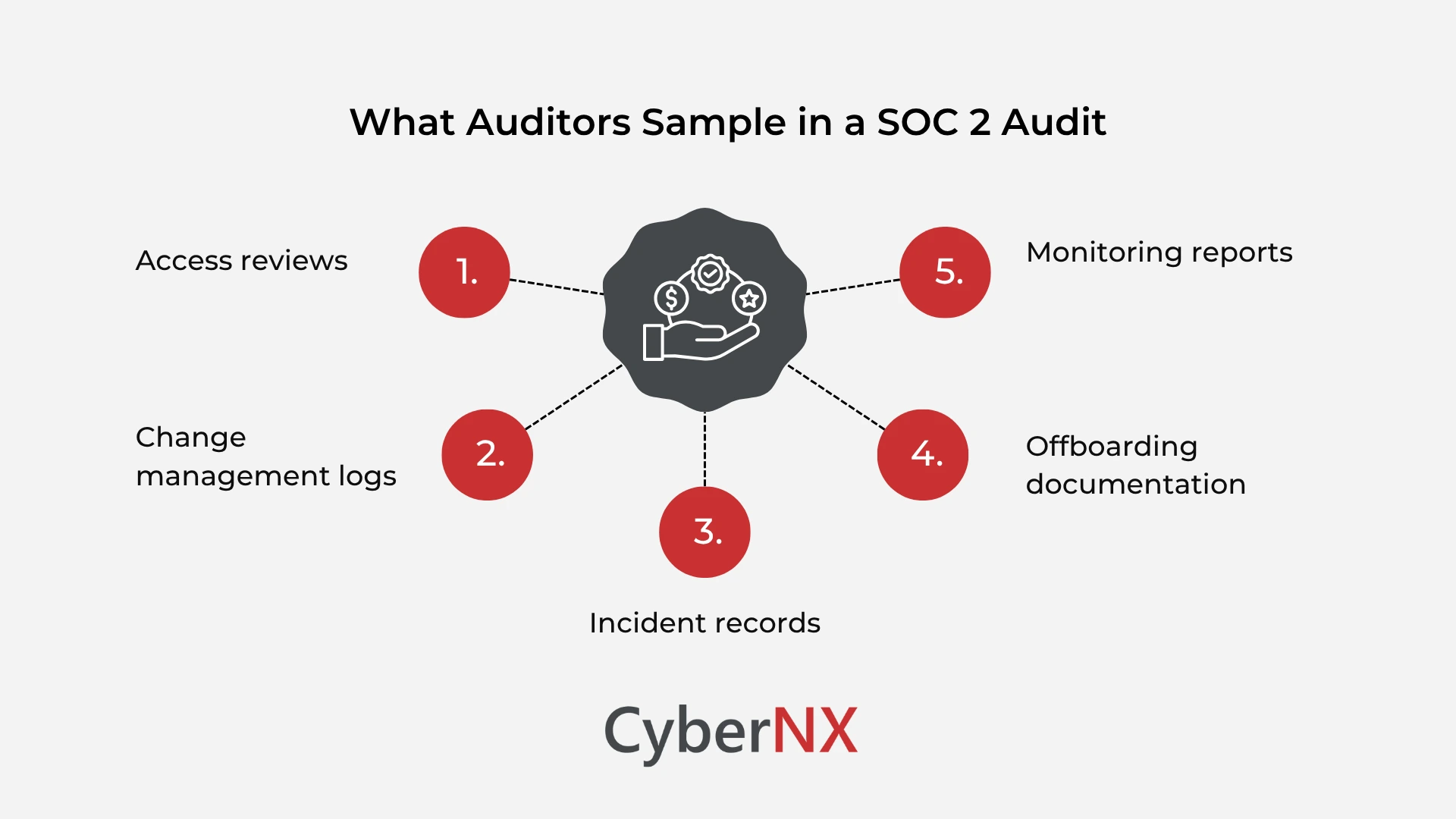
Evidence requests cluster around five categories:
- Access reviews: completed records showing who approved, who was reviewed and what action was taken
- Change management logs: approval chains, testing sign-offs and deployment records
- Incident records: logged events, triage notes and resolution timelines
- Offboarding documentation: access revocation records for every departure during the window
- Monitoring reports: evidence that logging and alerting ran continuously, including any gaps
How the observation window is tested
The observation window is months of proof that your controls ran without gaps. In our experience delivering SOC 2 Type II programmes, evidence most commonly breaks down in three places: access reviews that slipped past the policy deadline, offboarding records missing for contractors who left mid-project and monitoring gaps during system migrations. Each becomes an exception the auditor must report-all avoidable with disciplined programme management throughout the observation period.
Understanding SOC 2 audit exceptions
An exception is not a failure. It is a documented instance where a control did not operate as described.
What an exception is and how it is classified
Auditors assess whether exceptions are isolated or systemic. A single missed access review in twelve months is very different from access reviews that were never completed. The former is a footnote. The latter affects the auditor’s opinion. That judgement determines whether the report carries an unqualified or qualified opinion.
What to do when exceptions are found
When an exception is identified, you can provide a management response in the final report. A strong response explains what happened, why and what has been done to prevent recurrence. Buyers read management responses carefully. A specific, credible response often carries more weight than a report with no exceptions and no context at all.
The SOC 2 audit report explained
The final report is what your buyer will read. Understanding its structure helps you present it with confidence.
What the report contains
A SOC 2 audit report has four sections: the auditor’s opinion letter, management’s description of the system, the auditor’s description of tests and results, and management responses to any exceptions noted. The system description is scoped by you-it defines which systems, processes and data flows the audit covers.
The four opinion types
- Unqualified: controls were designed and operated effectively. This is the outcome you are working towards.
- Qualified: exceptions were found but not pervasive enough to undermine the report. Manageable with the right management response.
- Adverse: controls were inadequate. Rare and commercially serious. Most enterprise buyers will not accept this.
- Disclaimer of opinion: the auditor could not form a conclusion, typically due to insufficient evidence or limited scope.
How buyers read the SOC 2 audit report
Buyers do not start at the opinion. They start at the exceptions section. Then they check the system description to confirm their workloads are in scope. A clean opinion on a narrowly scoped report will still generate follow-up questions if the buyer’s environment sits outside the system boundary.
Conclusion
Policies do not pass a SOC 2 audit. Evidence does. The audit measures what your controls did over an extended period-not what your documentation says they should do.
CyberNX specialises in SOC 2 Type II implementation end-to-end-readiness assessment, policy build, observation period management and CPA coordination. We know exactly where evidence programmes break down-and how to make sure yours does not.
Ready to go into your audit prepared? Explore our SOC 2 Type II implementation service or talk to our team about where your programme stands today.
SOC 2 audit FAQs
How much does a SOC 2 audit cost in India?
CPA firm fees for a Type II engagement typically range from 8 to 20 lakh rupees. Total programme cost including readiness and implementation support runs higher.
Can you do a SOC 2 audit without a readiness assessment?
Technically yes. Practically, it is a significant risk. Teams that skip readiness assessments regularly encounter evidence gaps during fieldwork that delay the audit or generate avoidable exceptions.
What happens if your SOC 2 audit has exceptions?
Exceptions are documented with your management response in the report. Most qualified opinions with a specific, credible response are accepted by enterprise buyers.
How often do you need a SOC 2 audit?
Most organisations conduct an annual Type II audit. Enterprise buyers expect a current report-typically no older than twelve months.