Choose Language
Google Translate
Skip to content
Facebook X-twitter Instagram Linkedin Youtube
  • sales@cybernx.com
  • +91 90823 52813
CyberNX Logo
  • Home
  • About
    • About Us
    • CERT-In Empanelled Cybersecurity Auditor
    • Awards & Recognition
    • Our Customers
  • Services

    Peregrine

    • Managed Detection & Response
    • AI Managed SOC Services
    • Elastic Stack Consulting
    • CrowdStrike Consulting 
    • Threat Hunting Services
    • Digital Risk Protection Services
    • Threat Intelligence Services
    • Digital Forensics Services
    • Brand Risk & Dark Web Monitoring
    • Full Stack Observability

    Pinpoint

    • Red Teaming Services
    • Vulnerability Assessment
    • Penetration Testing Services
    • Secure Code Review Services
    • Cloud Security Assessment
    • Phishing Simulation Services
    • Breach and Attack Simulation Services

    nCompass

    • Cybersecurity Audit Services
    • Virtual CISO Services
    • DPDP Act Consulting
    • ISO 27001 Consulting
    • RBI Master Direction Compliance
    • SEBI CSCRF Framework Consulting
    • SEBI Cloud Framework Consulting
    • Security Awareness Training
    • Cybersecurity Staffing Services

    NXRadar

    • SBOM Solutions
    • CBOM Solutions
    • AIBOM Solutions
  • Industries
    • Banking
    • Financial Services
    • Insurance
  • Resources
    Blogs
    Case Studies
    Downloads
    Whitepapers
    Buyer’s Guide
    Research & Guides
    Data Sheets
  • Careers
  • English
Contact Us
CyberNX Logo
  • English
  • Home
  • About
    • About Us
    • CERT-In Empanelled Cybersecurity Auditor
    • Awards & Recognition
    • Our Customers
  • Services

    Peregrine

    • Managed Detection & Response
    • AI Managed SOC Services
    • Elastic Stack Consulting
    • CrowdStrike Consulting
    • Threat Hunting Services
    • Digital Risk Protection Services
    • Threat Intelligence Services
    • Digital Forensics Services
    • Brand Risk & Dark Web Monitoring
    • Full Stack Observability

    Pinpoint

    • Red Teaming Services
    • Vulnerability Assessment
    • Penetration Testing Services 
    • Secure Code Review Services
    • Cloud Security Assessment
    • Phishing Simulation Services
    • Breach and Attack Simulation Services

    nCompass

    • Cybersecurity Audit Services
    • Virtual CISO Services
    • DPDP Act Consulting
    • ISO 27001 Consulting
    • RBI Master Direction Compliance
    • SEBI CSCRF Framework Consulting
    • SEBI Cloud Framework Consulting
    • Security Awareness Training
    • Cybersecurity Staffing Services

    NXRadar

    • SBOM Solutions
    • CBOM Solutions
    • AIBOM Solutions
  • Industries
    • Banking
    • Financial Services
    • Insurance
  • Resources
    Blogs
    Case Studies
    Downloads
    Whitepapers
    Buyer’s Guide
    Research & Guides
    Data Sheets
  • Careers
  • Contact

SIEM Implementation for SEBI CSCRF Compliance: A BFSI Playbook

4 min read
12 Views
  • SEBI CSCRF

SEBI-regulated entities today face a serious problem: logs are scattered across servers, applications, firewalls and cloud systems, with no single view of what is actually happening. When an incident hits, the six-hour window to report to CERT-In and SEBI’s Incident Reporting Portal starts and there is barely any time to piece together all the data. Auditors expect the same evidence trail, and spreadsheets or manual reviews cannot produce it fast enough.

SIEM implementation for SEBI CSCRF compliance solves this directly. A Security Information and Event Management (SIEM) platform pulls every log source into one place, correlates the data and flags suspicious activity before it turns into a breach. It gives regulated entities the continuous monitoring and audit evidence that CSCRF’s Detect controls call for.

This guide covers what SIEM implementation for SEBI CSCRF compliance involves, the steps to build it and what to look for in an implementation partner.

Table of Contents

What is SIEM implementation for SEBI CSCRF compliance?

It means setting up a system that collects, correlates and analyses security logs across your critical systems. SEBI issued the Cybersecurity and Cyber Resilience Framework (CSCRF) in August 2024 through circular SEBI/HO/ITD-1/ITD_CSC_EXT/P/CIR/2024/113. It replaced older, fragmented cyber circulars with one unified framework built on the NIST Cybersecurity Framework 2.0.

CSCRF groups controls under six functions: Govern, Identify, Protect, Detect, Respond and Recover. SIEM sits mainly under Detect. It gives regulated entities the continuous monitoring capability that CSCRF’s Detect controls call for, including centralised log collection, correlation and alerting.

Your obligations depend on your tier. Market Infrastructure Institutions and Qualified Regulated Entities carry the heaviest monitoring load. Mid-size, small-size and self-certification entities have lighter, but still real, expectations.

Why SIEM matters for SEBI CSCRF compliance

Cyberattacks on Indian financial firms keep getting costlier. The IBM Cost of a Data Breach Report 2025 puts the average breach cost in India at Rs 220 million, with organisations still taking an average of 263 days to identify, contain and recover from an incident. SIEM helps close that gap.

Here is what a well-implemented SIEM brings to your SEBI CSCRF compliance program:

  • Faster detection: Correlated alerts flag suspicious activity in real time, instead of weeks later.
  • Audit-ready evidence: Logs, incident timelines and response records sit in one place when auditors ask.
  • Simpler incident reporting: You can trace what happened quickly enough to meet the six-hour CERT-In and SEBI reporting window.
  • Lower breach impact: Faster identification and containment directly reduce the financial and operational cost of an incident.

For Qualified REs and MIIs, this monitoring capability is not a nice-to-have. It is a core part of the Detect function that CSCRF audits check.

How to approach SIEM implementation for SEBI CSCRF compliance

SIEM implementation for SEBI CSCRF compliance works best as a phased project. Here is a practical path:
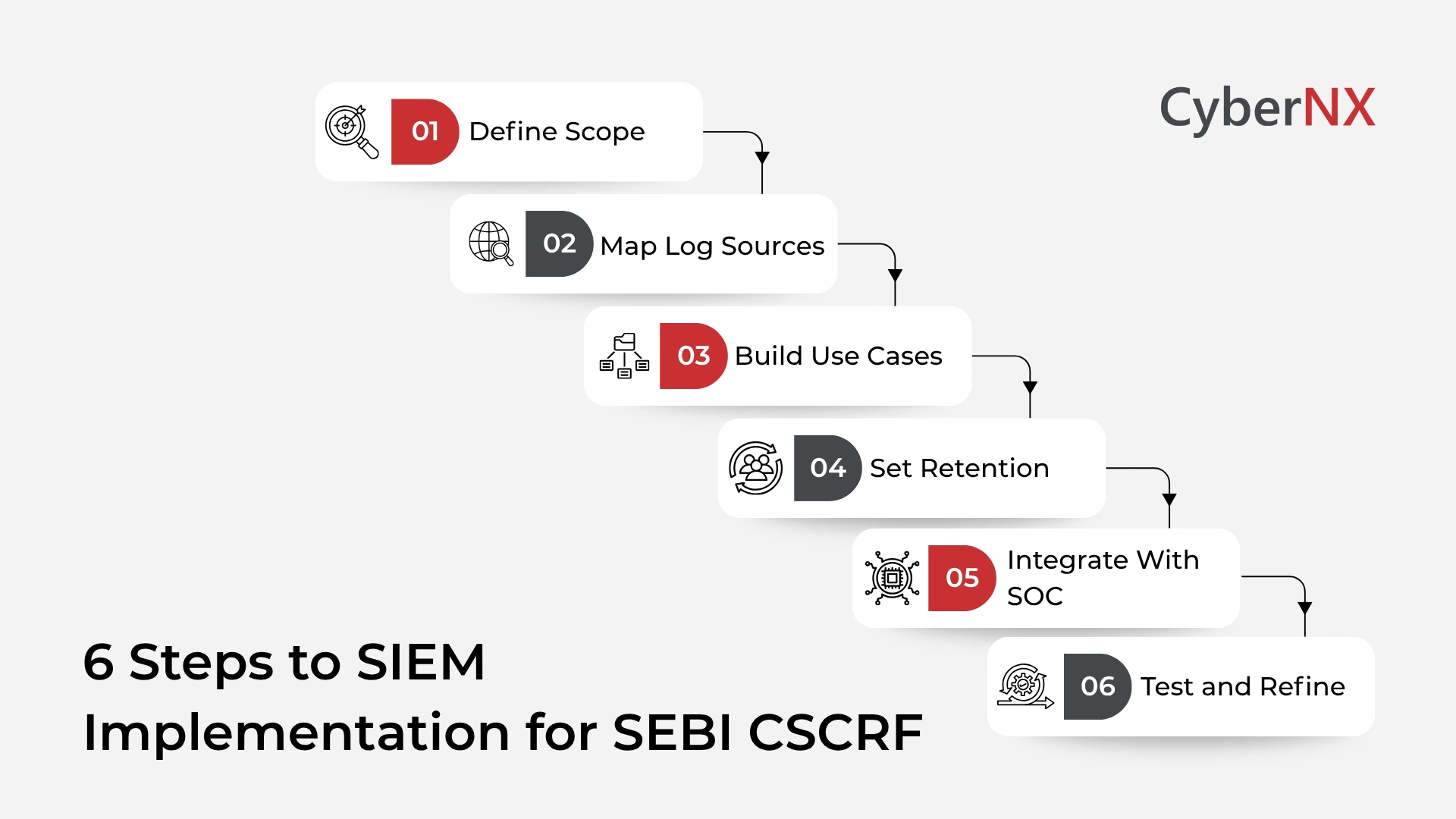
6 Steps to SIEM Implementation for SEBI CSCRF

  • Define scope: List every critical system, application and network segment that needs log coverage, based on your CSCRF asset inventory.
  • Map log sources: Connect servers, firewalls, endpoints, cloud workloads and third-party access points to the SIEM, so nothing is left blind.
  • Build detection use cases: Create correlation rules for known attack patterns, unauthorised access and policy violations relevant to your business.
  • Set retention and residency: Keep logs within India for at least 180 days, in line with CERT-In directions, with an archive plan beyond that.
  • Integrate with your SOC: Route alerts to trained analysts who can investigate, escalate and document response within CSCRF timelines.
  • Test and refine: Run periodic tabletop exercises and tune detection rules based on what they miss.

Each step feeds directly into your CSCRF cyber audit evidence, so document as you go instead of reconstructing records later.

Choosing the right SIEM implementation partner

Not every SIEM vendor understands SEBI’s expectations. When evaluating support for SIEM implementation, look for:

  • BFSI experience: A partner who has mapped SIEM use cases to CSCRF and RBI requirements before.
  • CERT-In alignment: Familiarity with the six-hour reporting timeline and the 180-day log retention rule.
  • SOC integration: The ability to connect SIEM output to a functioning, round-the-clock SOC, not just a dashboard.
  • Audit support: Experience preparing evidence packs for SEBI cyber audits, not only technical deployment.

A good partner treats SIEM as part of the wider cyber resilience program, not an isolated tool.

Conclusion

SIEM implementation gives security teams real visibility, faster incident response and evidence ready data whenever SEBI or CERT-In come asking for it. Getting the scope, log sources and SOC integration correct early – saves a lot of rework later.

CyberNX supports SEBI-regulated entities end to end with SIEM implementation for SEBI CSCRF compliance – from log source mapping to audit-ready reporting. Connect with our SEBI CSCRF framework consulting services team to assess your current monitoring setup and close gaps before the next cyber audit.

SIEM Implementation for SEBI CSCRF Compliance FAQs

What is SIEM implementation for SEBI CSCRF compliance?

It is the process of deploying a Security Information and Event Management platform that collects and correlates security logs to meet the monitoring and detection requirements under SEBI’s Cybersecurity and Cyber Resilience Framework.

How long SIEM logs should be retained under SEBI CSCRF

CERT-In directions require logs to be retained for a minimum of 180 days within India. Regulated entities under CSCRF are expected to meet this baseline as part of their monitoring evidence.

Which SEBI-regulated entities need SIEM?

SIEM is expected across most tiers, but the depth varies. Market Infrastructure Institutions and Qualified Regulated Entities need the fullest monitoring stack, while smaller and self-certification entities carry lighter obligations.

Can an existing SOC provider handle SIEM for SEBI CSCRF compliance?

Yes, if the provider can map detection use cases to CSCRF’s Detect function and support audit evidence needs. Confirm the provider understands SEBI’s reporting timelines and India log retention rules before onboarding.

Gopakumar Panicker

Author
Gopakumar Panicker
LinkedIn

An accomplished security professional with extensive experience in Digital Security, Cloud Security, Cloud Architecture, Security Operations, and BFSI Compliance, Gopa has contributed to designing and strengthening enterprise-grade security environments, ensuring alignment with both technical and regulatory requirements. His work focuses on building resilient, scalable architectures and guiding organisations in elevating their operational maturity while meeting the stringent expectations of modern BFSI and cloud-driven ecosystems.

Share on

WhatsApp
LinkedIn
Facebook
X
Pinterest

For Customized Plans Tailored to Your Needs, Get in Touch Today!

Connect with us

RESOURCES

Related Blogs

Explore our resources section for insightful blogs, articles, infographics and case studies, covering everything in Cyber Security.
Choosing the Right CERT-In Empanelled Auditor for SEBI CSCRF

Choosing a CERT-In Empanelled Auditor for SEBI CSCRF: A Practical Checklist

Picture this – your cyber audit report is complete, signed and ready for submission to your exchange or depository. Then

SEBI CSCRF Compliance for RTAs

SEBI CSCRF for RTAs: Compliance Requirements Explained

A single Registrar and Transfer Agent can hold folio records for millions of investors for dozens of listed companies. That

SEBI CSCRF for Stock Brokers: A Complete Compliance Overview

SEBI CSCRF for Stock Brokers: A Complete Compliance Guide

A stock broker’s trading platform runs on client trust. One breach can freeze that platform, expose client accounts and trigger

RESOURCES

Cyber Security Knowledge Hub

Explore our resources section for insightful blogs, articles, infographics and case studies, covering everything in Cyber Security.

BLOGS

Stay informed with the latest cybersecurity trends, insights, and expert tips to keep your organization protected.

CASE STUDIES

Explore real-world examples of how CyberNX has successfully defended businesses and delivered measurable security improvements.

DOWNLOADS

Learn about our wide range of cybersecurity solutions designed to safeguard your business against evolving threats.
CyberNX Footer Logo
Book a Free Call

Peregrine

  • Managed Detection & Response
  • AI Managed SOC Services
  • Elastic Stack Consulting
  • CrowdStrike Consulting
  • Threat Hunting Services
  • Digital Risk Protection Services
  • Threat Intelligence Services
  • Digital Forensics Services
  • Brand Risk & Dark Web Monitoring
  • Full Stack Observability

Pinpoint

  • Red Teaming Services
  • Vulnerability Assessment
  • Penetration Testing Services
  • Secure Code Review Services
  • Cloud Security Assessment
  • Phishing Simulation Services
  • Breach and Attack Simulation Services

nCompass

  • Cybersecurity Audit Services
  • Virtual CISO Services
  • DPDP Act Consulting
  • ISO 27001 Consulting
  • RBI Master Direction Compliance
  • SEBI CSCRF Framework Consulting
  • SEBI Cloud Framework Consulting
  • Security Awareness Training
  • Cybersecurity Staffing Services

NXRadar

  • SBOM Solutions
  • CBOM Solutions
  • AIBOM Solutions
  • About
  • CERT-In
  • Awards
  • Careers
  • Sitemap
Facebook Twitter Instagram Youtube

Copyright © 2026 CyberNX | All Rights Reserved | Terms and Conditions | Privacy Policy

  • English
Copyright © 2026 CyberNX | All Rights Reserved | Terms and Conditions | Privacy Policy
Scroll to Top

WhatsApp us

Not Sure Where to Start with Cybersecurity?

We value your privacy. Your personal information is collected and used only for legitimate business purposes in accordance with our Privacy Policy.