Regulators from around the world now demand longer retention and faster investigations. It seems like cybersecurity is finally getting due attention and for good. However, many organisations respond by buying separate tools for SIEM, log storage and even compliance reporting. Our experience shows this approach creates more problems than it solves.
When SIEM and log retention live in different platforms, teams struggle with data gaps, high costs and slow response times. Analysts waste hours switching tools instead of investigating threats. Storage costs spiral and visibility remains fragmented.
This is why many security leaders are rethinking their strategy. They want SIEM and log retention in a single Elastic Stack. One platform that shows data layer and risks together.
In this blog, we explore how a unified Elastic Stack approach works, the challenges it solves, and why it resonates with CISOs and IT heads who want clarity, control and scale.
The real problem with split SIEM and log retention
Most enterprises did not design their security architecture in one go. Tools were added over time. Each solved a specific problem. Over the years, this created complexity.
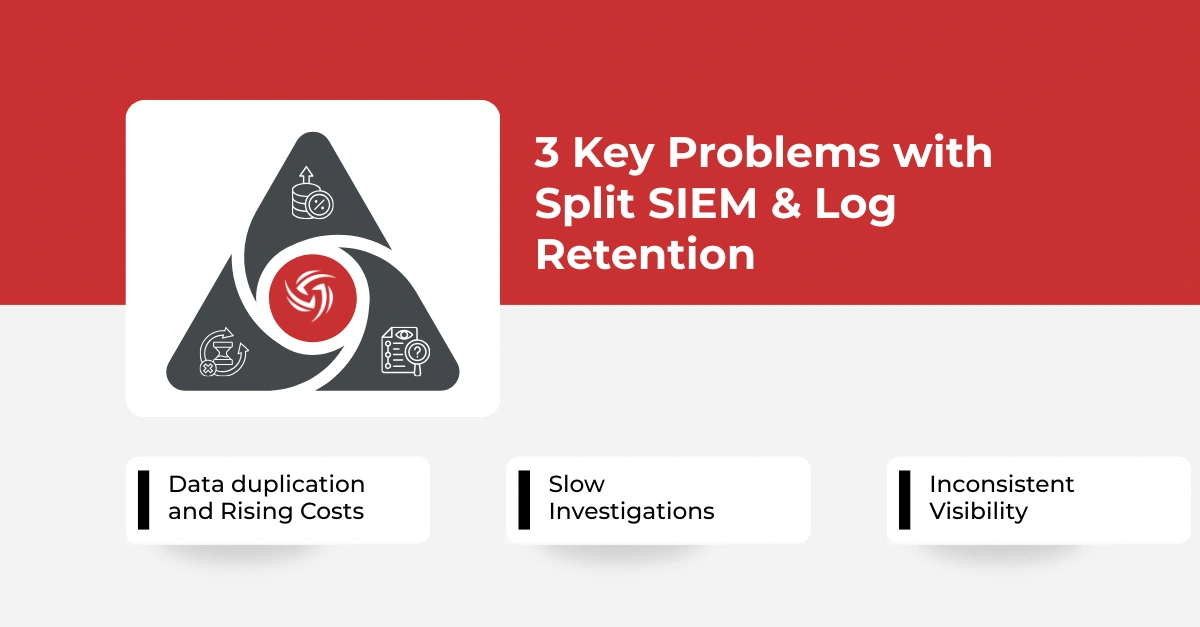
1. Data duplication and rising costs
When SIEM and log retention tools are separate, logs are often copied. One copy feeds the SIEM for detection. Another goes to cold storage for compliance. Storage doubles. Licensing costs follow. As log volumes grow, finance teams start asking difficult questions. Security leaders are forced to justify spend instead of improving defences.
2. Slow investigations
During an incident, speed matters. Analysts need historical context. But if older logs sit in a different system, investigations stall. Requests go to another team. Data must be exported. Correlation breaks.
Attackers do not wait.
3. Inconsistent visibility
Different tools mean different schemas, dashboards and queries. Teams see parts of the story but rarely the full picture. Blind spots appear between platforms. These gaps are exactly what attackers exploit.
Why SIEM and log retention belong together
Keeping SIEM and log retention in a single Elastic Stack changes how security teams operate.
1. One data layer, many use cases
The Elastic Stack was designed for scale. It can ingest, index and search massive volumes of data. The same logs can power real time SIEM analytics and long-term retention. No duplication. No re ingestion. Security teams work with a single source of truth.
2. Seamless access to historical data
With Elastic, hot, warm and cold data tiers work together. Recent logs stay fast. Older logs move to cost effective storage. Yet they remain searchable.
When an investigation needs data from six months ago, it is already there. Analysts do not change tools or workflows.
3. Consistent detection and analytics
Detection rules, dashboards and threat hunting queries work across all retained data. This consistency improves accuracy. It also reduces training overhead for teams.
How the Elastic Stack enables unified SIEM and log retention
So, how does Elastic Stack solve this problem? Find out below:
1. Flexible data ingestion at scale
Elastic supports logs from almost any source. Cloud workloads. On premises servers. Network devices. SaaS platforms. Endpoints.
With Beats and Elastic Agent, data ingestion becomes standardised. Security teams control what is collected and how it is enriched. This foundation matters. Clean data makes SIEM more effective.
2. Intelligent storage tiers
Elastic’s tiered architecture allows organisations to balance performance and cost.
Hot tiers handle real time SIEM workloads. Warm tiers support frequent searches. Cold and frozen tiers store data for months or years at a fraction of the cost. Retention policies align with regulatory needs without breaking budgets.
3. Integrated security analytics
Elastic Security brings SIEM capabilities directly into the platform. Threat detection, alerting, investigation and response all run on the same data. There is no handoff between tools. Context stays intact.
Business value for security leaders
There are many benefits of SIEM and log retention in Elastic Stack. Major ones are discussed below:
1. Lower total cost of ownership
Combining SIEM and log retention in a single Elastic Stack reduces licensing, infrastructure and operational overhead. Fewer tools mean fewer contracts and less integration work. For CISOs under budget pressure, this matters.
2. Faster response times
Unified access to data speeds up detection and investigation. Analysts pivot across time ranges instantly. Mean time to respond improves. This is not just a technical win. It reduces business impact during incidents.
3. Stronger compliance posture
Regulators care about evidence. Elastic makes it easier to retain logs, prove integrity and retrieve data when auditors ask. Retention policies become enforceable rather than aspirational.
Common concerns and how to address them
Here are some questions leaders often raise and how to address them effectively:
Can Elastic handle enterprise scale?
Yes. Elastic is used by large global organisations processing petabytes of data daily. Scaling horizontally is part of its design. The key is architecture. Done right, Elastic grows with your business.
What about performance with long retention?
Tiered storage ensures performance where it matters. Recent data stays fast. Older data remains accessible but cost efficient. Security teams get the best of both worlds.
Is this approach future proof?
Elastic evolves rapidly. New detection capabilities, integrations and analytics features arrive regularly. A unified stack adapts more easily than a collection of siloed tools.
According to Elastic’s own security research, organisations using a unified data platform reduce investigation time by up to 50 percent because analysts no longer switch between tools. Source: Elastic Security Labs
This aligns with what we see across our customer engagements.
Practical use cases we see in the field
In our experience, this unified Elastic Stack has key use cases which are discussed:
- Cloud first enterprises: Organisations running workloads across AWS, Azure and Google Cloud use Elastic to centralise logs and security events. SIEM and retention operate consistently across environments.
- Regulated industries: Banks, healthcare providers and insurers rely on long term log retention. Elastic allows them to meet regulatory timelines while keeping data searchable for investigations.
- SOC modernisation programmes: Many SOCs move away from legacy SIEM platforms. Elastic provides a modern alternative that unifies analytics and storage without heavy constraints.
Conclusion
Security data will only keep growing. Splitting SIEM and log retention across multiple platforms adds friction, cost and risk.
A single Elastic Stack brings them together. One data layer. One operational model. Better outcomes. If you are rethinking your SIEM or struggling with log retention costs, now is the time to simplify. We help organisations design Elastic Stack architectures that scale securely and sensibly.
Speak to our experts today to explore how our Elastic Stack Consulting can strengthen your security operations.
SIEM and Log Retention in a Single Elastic Stack FAQs
How long can logs be retained in the Elastic Stack?
Elastic supports retention from days to several years, depending on storage tiers and compliance needs.
Does Elastic replace traditional SIEM tools completely?
For many organisations, yes. Elastic Security provides core SIEM capabilities with greater flexibility.
Can Elastic handle encrypted and sensitive logs?
Yes. Elastic supports encryption at rest and in transit, along with role-based access controls.
Is Elastic suitable for small security teams?
It can be. With the right design and managed support, even lean teams can benefit.