There’s a pertinent question regulatory bodies are now asking regulated entities: what software, components and cryptography run inside your critical systems today? It is now important to answer it fully, with evidence, on the day a regulator or a zero-day demands it. With Software Bill of Materials (SBOM), the Cryptographic Bill of Materials (CBOM) and post-quantum cryptography (PQC) readiness, you can answer this confidently, but not if three programmes are run separately.
At CyberNX, we treat these as one discipline. Each answers the same question at a different layer: what is inside your systems, where does it live and can you trust it?
This blog sets out three things:
- Why a bill of materials (BOM) should work as a live control rather than a compliance file.
- How Indian regulators treat these inventories as one family.
- Where to begin.
SBOM, CBOM and PQC readiness answer the same question
When something breaks or the threat landscape shifts, your board and regulator will ask what was exposed. The answer depends on an inventory.
What each layer covers
Each programme looks at a different layer of the same estate:
- An SBOM lists software components, including direct and transitive dependencies, versions, suppliers and licences.
- A CBOM lists cryptographic assets, including algorithms, key lengths, protocols, certificates and crypto libraries.
- PQC readiness asks which of those assets will become unsafe once quantum computers can break today’s public-key algorithms.
Why running them separately creates blind spots
Cryptography lives inside software components. An OpenSSL version in your SBOM is also a cryptographic asset. A vendor’s payment switch may carry RSA keys no one internally has seen. When SBOM and crypto teams keep them separate, the overlap is where gaps hide.
CERT-In now extends the same logic to AI models and hardware, as we explain in AIBOM vs SBOM: what changes when code meets data. The practical step is to give one person accountable ownership of the whole inventory programme, even if different teams run each layer.
Why a BOM must be a live control
An inventory that is only correct on the day it was produced is a record and not a control. It cannot tell you what changed last night.
The gap between making a BOM and using one
ENISA’s SBOM Adoption State of Play 2026 surveyed 300+ organisations and found 78% had started implementing SBOMs. Yet an analysis of the survey notes only 7% have closed the gap between creating SBOMs and using them for vulnerability and licence management. Generation is becoming routine. However, consumption, where the security value sits, is not.
Our post on SBOM use cases shows what consumption looks like day to day.
Software changes faster than a quarterly inventory
Pipelines ship code daily, vendors patch on their own schedule, and certificates expire and libraries reach end of life.
SEBI’s Cybersecurity and Cyber Resilience Framework (CSCRF) expects the SBOM to be updated with every upgrade or change. That makes it a pipeline artefact, not a vendor document.
What a live BOM looks like in practice
A live BOM behaves like any other security control. It:
- Regenerates automatically on every build, release or vendor update.
- Matches components continuously against vulnerability feeds such as NVD, OSV and GitHub Advisory.
- Alerts owners before end-of-life and end-of-support dates arrive.
- Feeds the SOC, VAPT testers and patch owners.
- Keeps versioned, tamper-evident history for auditors.

For more detail, our posts on the automated SBOM management lifecycle and CBOM automation explain how this works for software and cryptography.
What we believe about SBOM, CBOM and post-quantum readiness
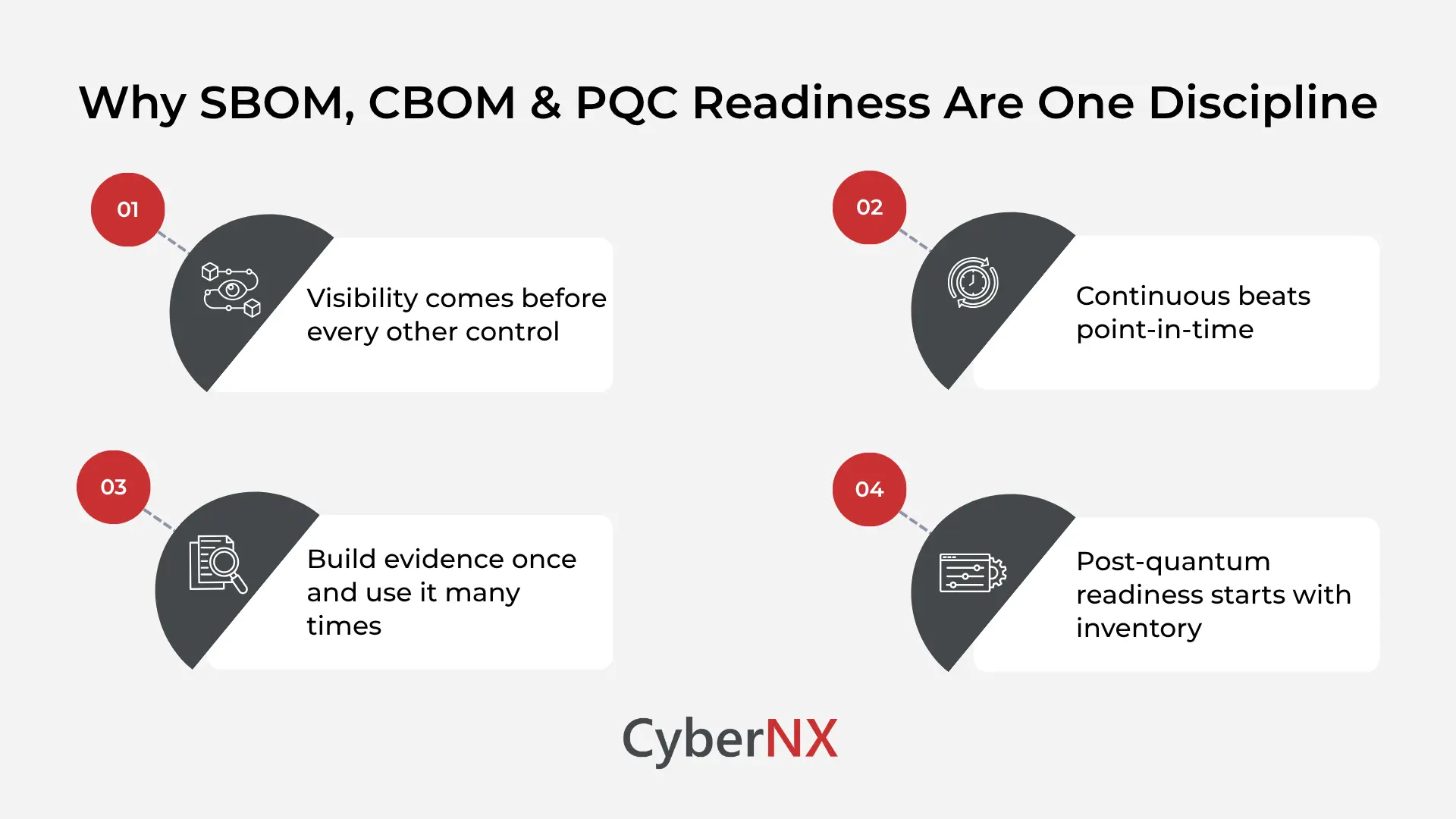
Four beliefs shape how we advise clients and how we built our SBOM solutions. They come from our audit, VAPT and SOC work with regulated entities.
Visibility comes before every other control
When Log4Shell (CVE-2021-44228) was disclosed, the hardest part for most teams was not the patch. It was finding every place Log4j lived, often several dependency levels deep. The fix is usually known quickly. The location is what costs days.
Continuous beats point-in-time
A quarterly inventory satisfies a checklist. It does not reduce risk between snapshots, which is when most incidents happen. Every BOM should be rebuilt and rescored whenever the software changes.
Build evidence once and use it many times
CERT-In, SEBI, RBI and enterprise customers each ask for inventory evidence in different shapes. Separate artefacts for each waste effort and create conflicting answers. One governed inventory, mapped to each framework’s fields, serves all of them.
Post-quantum readiness starts with inventory
NIST finalised its first post-quantum standards in Aug 2024. Its draft transition guidance, NIST IR 8547, proposes that quantum-vulnerable algorithms such as RSA-2048 be deprecated after 2030 and disallowed after 2035.
The harder work is finding where those algorithms live. In a bank, much of it sits inside vendor binaries, payment switches, hardware security module integrations and nested libraries. Our CBOM maturity model maps the stages from discovery to quantum readiness.
Indian regulators already treat bills of materials as one family
Four Indian bodies now point at the same artefact from different directions.
CERT-In widened the scope beyond software
CERT-In’s technical guidelines cover SBOM, QBOM, CBOM, AIBOM and HBOM together. The guidelines are best practice, not a mandate, but they treat these inventories as one family.
Financial regulators are converging
Here is where each body stands today:
- SEBI CSCRF requires a continuously updated SBOM, plus a cryptographic inventory and periodic post-quantum risk assessment.
- RBI formed the Q-SAFE expert committee on May 25, 2026. It will assess the sector’s cryptographic inventory through a CBOM.
- DST’s Feb 2026 roadmap expects critical sectors to begin formal PQC implementation by 2027.
Build once, evidence many
Your organisation will likely be asked for software and cryptographic inventories by more than one authority within two financial years. Map your fields once. Capture CERT-In’s 21 SBOM fields and SEBI’s nine in one schema, then export to each format.
How to start building one visibility discipline
Start narrow, prove value and then scale. A pilot of 10 to 50 critical applications is usually enough to surface the patterns that matter. Good candidates are core banking, payment switches and trading platforms.
Run the pilot in this order
- Generate SBOMs for in-house apps and request vendor SBOMs in CycloneDX or SPDX.
- Validate vendor SBOMs against CERT-In and SEBI fields.
- Discover cryptographic assets and link each to the component that carries it.
- Rank quantum-vulnerable assets by how long the protected data must stay confidential.
Vendor SBOMs are often the hardest step. Our guide on how to get an SBOM from your third-party software vendor covers contract language and common objections.
Make it continuous and connected
Once the pilot works, connect the inventory to the systems and people around it:
- Link generation to build pipelines and vendor intake, so every release refreshes the inventory.
- Route new vulnerability matches to patch owners through Jira or ServiceNow.
- Share affected assets with your SOC and VAPT testers.
- Report one consolidated risk view to the board.
Conclusion
SBOM, CBOM and post-quantum readiness are one visibility discipline applied at three layers. Organisations that treat them this way answer zero-day questions faster, plan crypto migration on evidence and enter audits with artefacts they already maintain.
At CyberNX, we bring this together through our SBOM, CBOM and PQC readiness solutions, alongside our CSCRF, RBI and CERT-In audit practice. If you are planning an inventory programme, speak with our team. We can map where your software and cryptographic dependencies sit today and what your regulators will expect next.
FAQs
What is the difference between an SBOM and a CBOM?
An SBOM lists software components such as libraries, versions and licences. A CBOM lists cryptographic assets such as algorithms, keys and certificates. They overlap because most cryptography lives inside software.
Is a one-time SBOM enough for SEBI CSCRF?
No. CSCRF expects the SBOM to be updated with every upgrade or change. A one-time vendor file goes stale quickly and will not hold up in an audit.
When should Indian banks start PQC readiness work?
Now, starting with inventory. RBI’s Q-SAFE committee is already assessing the sector through a CBOM. Discovery takes time, so an early CBOM leaves room for an orderly migration.