Software vulnerabilities rarely stay contained. A single vulnerable library can expose customer data, disrupt critical services, or halt business operations overnight. Over the last few years, Indian organisations have seen how deeply embedded software risk can ripple across sectors, from banking and capital markets to energy and telecom.
This growing impact is why regulators are tightening expectations around software supply chain security. Bodies such as the Reserve Bank of India, SEBI, and CERT-In are increasingly pushing organisations to demonstrate visibility, control, and accountability over the software they deploy.
SBOM audits are emerging as a practical solution. They help organisations prove what software components they use, understand where risks exist, and show regulators that controls are working, not just documented.
This blog explains what an SBOM audit is, why Indian regulators are focusing on it, and what value it delivers beyond compliance.
What is an SBOM audit?
An SBOM audit is a structured review of an organisation’s Software Bill of Materials and the processes that support it.
At its core, an SBOM audit verifies whether you have an accurate inventory of software components. But effective SBOM audits go further. They assess:
- How SBOMs are generated and maintained
- Whether component data is complete and current
- How vulnerabilities are identified and tracked
- How risks are communicated and remediated
In simple terms, an SBOM audit tests whether your organisation truly understands its software supply chain.
Why auditors care about SBOMs
Auditors are no longer satisfied with high-level assurances. They want evidence. SBOMs provide tangible proof of:
- Third-party dependency awareness
- Secure development practices
- Ongoing vulnerability monitoring
This is why SBOM audits are becoming part of broader technology and cyber risk assessments.
Regulatory push for SBOM audits in India
Indian regulators are not mandating SBOM audits in isolation. They are responding to systemic risk.
1. RBI and operational resilience
The Reserve Bank of India has consistently emphasised technology risk management and operational resilience for regulated entities. While SBOMs are not named explicitly in every guideline, expectations around third-party risk, secure development, and continuous monitoring align closely with SBOM audit outcomes.
For banks and financial institutions, SBOM audits support assurance around:
- Outsourced and vendor-developed software
- Patch and vulnerability management
- Incident impact analysis
2. SEBI and market integrity
SEBI’s focus on cyber resilience for market intermediaries has increased scrutiny on software platforms that underpin trading, clearing, and settlement systems. Plus, SEBI’s SBOM requirements clearly underpins what organisations must do.
SBOM audits help demonstrate:
- Transparency into software dependencies
- Control over externally sourced components
- Reduced risk of supply chain disruptions
For capital market participants, this visibility is critical to maintaining trust and continuity.
3. CERT-In and national cyber preparedness
CERT-In’s SBOM advisories and incident reporting requirements highlight the need for rapid identification of affected systems during vulnerabilities and breaches.
SBOM audits directly support this by enabling organisations to quickly answer:
- Which applications use the vulnerable component?
- Where is it deployed?
- How fast can it be mitigated?
This capability is increasingly seen as a baseline expectation.
Benefits of SBOM audits for enterprises
While compliance often drives adoption, SBOM audits deliver broader business value.
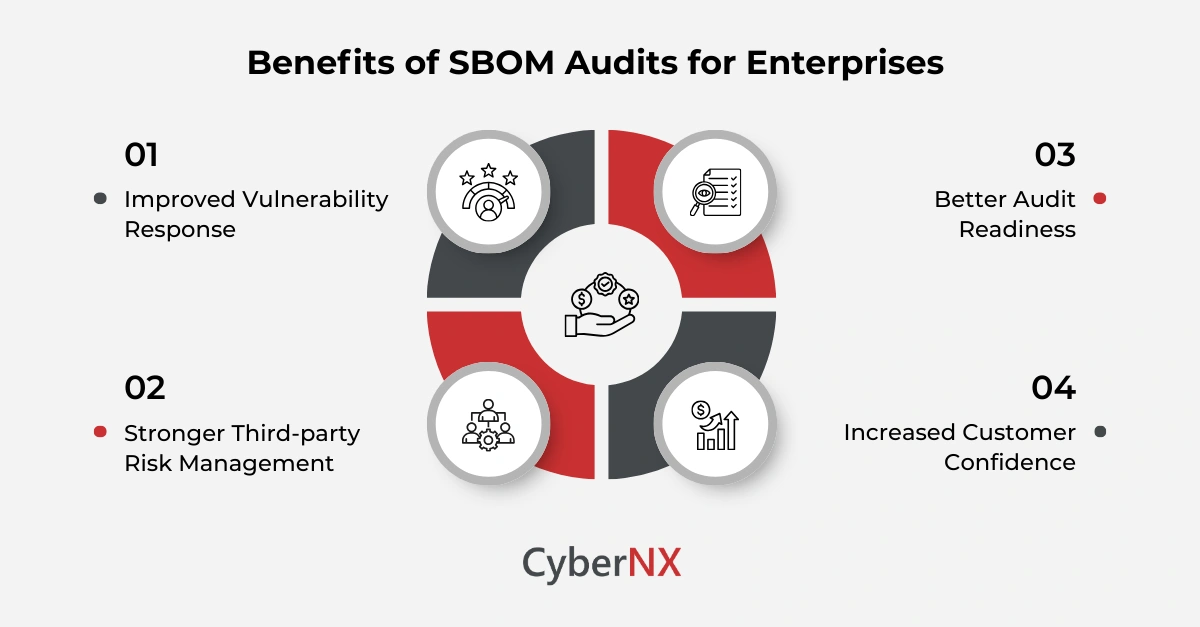
1. Improved vulnerability response
SBOM audits reveal whether vulnerability management is proactive or reactive. Organisations with mature SBOM practices respond faster during zero-day disclosures because they already know their exposure.
2. Stronger third-party risk management
Most enterprise applications rely heavily on third-party components. SBOM audits highlight:
- Hidden dependencies
- Unsupported or outdated libraries
- Licensing risks that may trigger legal exposure
This insight strengthens procurement and vendor governance.
3. Better audit readiness
SBOM audits reduce last-minute scrambling during regulatory reviews. When SBOMs are maintained continuously, audit evidence is readily available and credible.
4. Increased customer confidence
Customers, especially in regulated sectors, increasingly ask for proof of secure software practices. SBOM audit outcomes help answer those questions with confidence.
What an SBOM audit effectively reveals
SBOM audits are often eye-opening. They surface issues that traditional assessments miss.
- Dependency blind spots: Audits frequently uncover transitive dependencies that teams were unaware of. These hidden components often carry the highest risk.
- Gaps between policy and practice: Many organisations have secure development policies on paper. SBOM audits reveal whether those policies are actually enforced in build pipelines and release processes.
- Inconsistent ownership: SBOM audits highlight unclear accountability. Who owns SBOM accuracy? Who acts on vulnerability findings? Clarity here is essential for sustained improvement.
- Tooling and integration weaknesses: Audits often show that SBOM tools exist but are poorly integrated. SBOM data may not feed into vulnerability management, incident response, or reporting workflows.
How SBOM audits are typically conducted
Although approaches vary, most SBOM audits include:
- Review of SBOM generation tools and formats
- Validation of component completeness and accuracy
- Mapping of SBOM data to vulnerability databases
- Assessment of remediation and reporting processes
Formats such as SPDX and CycloneDX are commonly reviewed for consistency and interoperability.
Making SBOM audits sustainable
The most effective SBOM audits are not treated as annual events. They are embedded into ongoing governance.
This means:
- Automating SBOM generation within CI/CD pipelines
- Reviewing SBOM metrics regularly, not just during audits
- Aligning SBOM insights with risk and compliance reporting
Our experience shows that small, consistent improvements deliver far more value than large, one-off efforts.
Conclusion
SBOM audits are quickly becoming a cornerstone of software risk assurance in India. As regulators like RBI, SEBI, and CERT-In raise expectations, organisations need practical ways to demonstrate control over their software supply chains.
An effective SBOM audit does more than satisfy auditors. It reveals hidden risk, improves response capabilities, and builds long-term trust in software systems.
At CyberNX, we offer SBOM management tool, NXRadar. It help organisations prepare for SBOM audits by aligning technology, process, and governance. If you are assessing readiness or responding to regulatory pressure, a focused SBOM audit can turn uncertainty into clarity. Speak with our experts to strengthen your software assurance strategy.
SBOM Audits FAQs
Are SBOM audits mandatory in India today?
Mandates vary by sector, but regulatory expectations around software visibility are increasing rapidly.
How often should an SBOM audit be performed?
Most organisations align SBOM audits with annual risk assessments, with continuous monitoring in between.
Do SBOM audits apply only to custom-developed software?
No. They also cover third-party and vendor-supplied software used in critical systems.
Can SBOM audits reduce incident response time?
Yes. Accurate SBOMs significantly speed up impact analysis during vulnerability disclosures.