Security teams deal with evolving threats every day. Attackers use new tricks, tools and methods to slip past defences. So, leaders ask a simple question: How do we stay ahead?
Advanced red teaming techniques offer a powerful answer. These engagements go deeper than standard tests. They combine stealthy exploit techniques with intelligence-led planning. The goal is not to find a list of issues but to mirror real attackers with precision.
We have seen how useful this approach can be. It exposes blind spots that routine checks miss. Plus, it gives teams practical lessons they can act on. Moreover, it shapes long-term security decisions with confidence.
The strategic value of advanced red teaming techniques
Advanced red teaming techniques give organisations a deeper view of their real security posture. They blend technical attack methods with structured frameworks, creating a simulation that mirrors how genuine attackers operate.
This approach reveals hidden weaknesses, shows how defences respond under pressure and gives teams practical insight they can act on.
Here are five reasons these techniques make a meaningful difference:
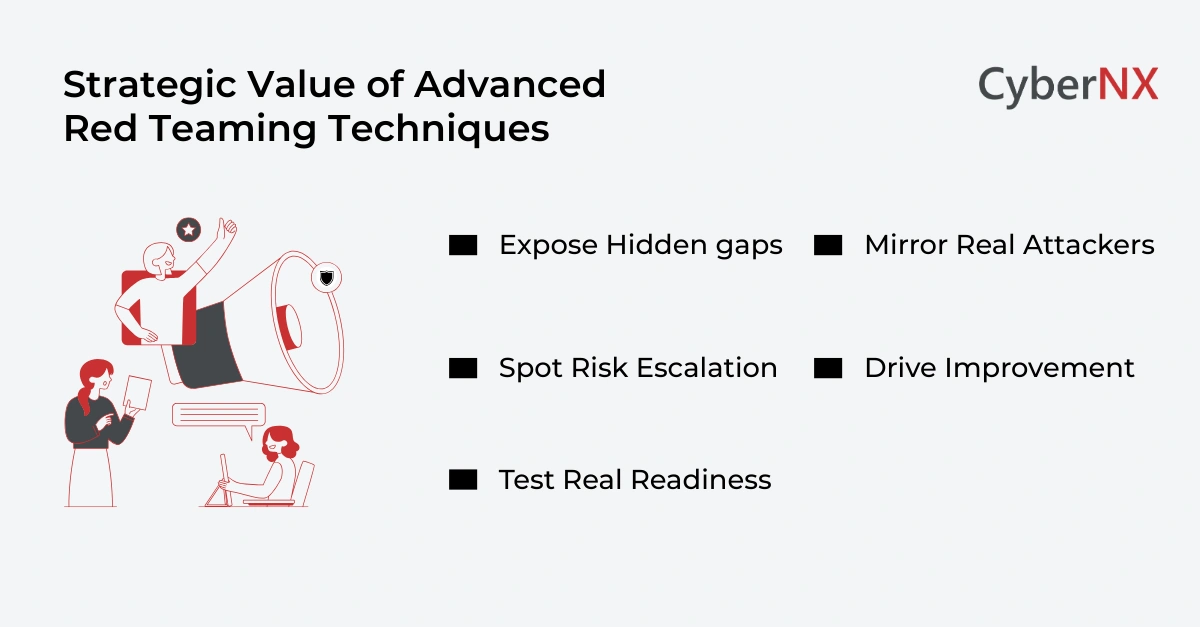
- Expose hidden gaps: They expose subtle gaps that traditional tests overlook and show how attackers move quietly through an environment.
- Spot risk escalation: They reveal how small misconfigurations escalate into major risks, helping teams prioritise fixes that matter most.
- Test real readiness: They test monitoring, detection and response together, giving a full picture of security readiness.
- Mirror real attackers: They provide a realistic view of attacker behaviour using both advanced technical tactics and intelligence-driven planning.
- Drive ongoing improvement: They make continuous improvement easier because teams understand the complete attack journey, not just isolated issues.
Before diving into the methodology, let’s unpack the technical side.
Advanced technical exploitation tactics
These techniques reflect what skilled threat actors attempt during real intrusions. Many target trusted systems. Others exploit design gaps, and some rely on stealth and patience.
Our work shows that even mature environments face risks in areas such as cloud authentication, Active Directory and browser credential storage.
- Exploiting cloud and authentication flows: Many organisations rely on Microsoft Azure, so attackers focus efforts there.
- Exploiting device code flow: Attackers send a crafted email urging the victim to authenticate using the Device Code Flow. Once the victim completes the step, the attacker obtains an authentication token. That token can often be renewed without prompting for credentials or MFA again. It becomes an easy foothold.
- Moving laterally through Microsoft Graph API: With a valid token, attackers query tenant data using tools like RoadRecon. They then interact with SharePoint and OneDrive through the Microsoft Graph API. This allows them to upload malicious files, create persistence or move sideways.
- Targeting exposed Azure components: Many components in Azure, including Microsoft Entra ID, expose interfaces by default. Without careful configuration, these pathways become prime attack surfaces.
Stealthy code execution and C2
Some red team operations revolve around staying invisible. Attackers aim to run code without setting off alerts.
1. Bypassing controls using .NET configuration files
The Microsoft .NET Framework loads configuration files during execution. When paired with a legitimate signed binary, a malicious configuration file can load attacker-controlled DLLs from a remote URL. The binary is clean. The config file does not raise suspicion. This allows code execution with minimal traces.
2. Establishing C2 without shellcode
Traditional shellcode triggers alarms because it needs memory permissions changed. Red teams avoid this by using reflective loading in C#. They load agents directly using Assembly.Load. No file is dropped. No shellcode is required. Detection becomes harder.
3. Key indicators worth monitoring
Long-running outbound HTTP requests, or a process loading an unsigned DLL from a browser temp folder, are signs worth investigating. These faint traces often reveal stealthy operations.
Leveraging AI in red teaming
AI enhances human capability. We see more teams using AI in red teaming to streamline steps.
1. AI-crafted phishing
Models learn how a target writes. They build natural, convincing messages. This increases the chance of engagement.
2. AI-assisted reconnaissance
Once attackers gain access to tools like Microsoft Copilot, they use natural language to locate sensitive files. Queries like “show password spreadsheets” can reveal critical data in seconds.
MITRE highlights that advanced adversaries combine cloud abuse, stealthy code execution and identity manipulation in complex attack chains.
The key here is to understand that a single technique rarely causes compromise. Attackers stack methods to avoid detection and escalate privileges.
The Advanced Red Teaming (ART) framework
There are many red teaming frameworks security teams utilize, depending on the objectives. Financial institutions use the ART framework to structure complex engagements.
We have seen how useful this model is for any large organisation. It aligns red team work with real threat intelligence and organisational learning.
ART has three phases: Preparation, Test and Closure. The framework is modular, so institutions choose the parts that match their goals.
- Threat Intelligence (TI) shapes the attack scenarios.
- Basic TI uses general threat landscape data and internal documents.
- Extended TI adds external research and expert insights.
- Full TI is delivered by a specialist provider. It includes Targeted Threat Intelligence (TTI) to map likely threat actors and their methods.
- Red Teaming (RT) TI feeds into the Red Team Test Plan, aligned with MITRE ATT&CK.
- Assumed compromise is the minimum version. The test begins with access already provided. It focuses on lateral movement and impact.
- End-to-end simulation makes the exercise realistic. Attackers simulate initial access, internal movement and goal execution.
- Scenario X is the version tests emerging threats. It helps institutions prepare for new techniques before attackers adopt them.
How CyberNX supports advanced red teaming
We work with organisations that want clarity and confidence. Our team uses advanced red teaming techniques grounded in real attacker behaviour. We follow structured frameworks like ART to ensure learning at every step.
We design exercises around your environment, keep the process safe, controlled and outcome focused. And we partner with your blue team, so improvements are practical and achievable.
If you want a deeper understanding of attacker behaviour in your environment, we can help.
Conclusion
Advanced red teaming techniques offer a deeper view into risk. They combine realistic attack strategies with structured testing methods. They expose gaps that traditional tests overlook. And they help leaders plan with more certainty.
If you want to strengthen your security with advanced red teaming, we are ready to support your journey. Reach out to us for red teaming services and a tailored assessment built around your organisation’s needs.
Red Teaming Techniques FAQs
How often should organisations run advanced red team exercises?
Many teams prefer an annual assessment to track progress. High-risk sectors run them more often because their environments change quickly. Smaller, scenario-based tests can fill gaps between major exercises.
Does advanced red teaming disrupt operations?
Exercises run on live systems but follow strict safety measures. Risky actions are simulated rather than performed to avoid downtime. The goal is realism without affecting business continuity.
What is the difference between red teaming and penetration testing?
Penetration testing checks for specific technical flaws. Red teaming simulates real attacker behaviour to test detection, response and resilience. It focuses on full attack paths rather than isolated issues.
Can smaller teams benefit from advanced red teaming?
Yes, because the scope is easy to scale. Even a targeted engagement reveals priority weaknesses and clear improvements. Smaller teams often gain faster, more focused insights.