Security teams work hard and yet gaps still slip through. We see this often. Controls look solid on paper, policies look complete, but threats move differently in real life. They chain small weaknesses, create pressure and distract teams. And finally, they strike when no one expects it.
This is where Red Teaming as a Service makes a real difference. It gives decision-makers a controlled way to see how attackers move, continuously. It tests systems, people and processes together and gives leadership a clear view of how resilient their organisation truly is.
In this guide, we share what Red Teaming as a Service means, how it works and why many organisations now choose RTaaS to strengthen their defences.
What is Red Teaming as a Service?
Red teaming is an offensive security exercise where ethical hackers take your permission and exploit vulnerabilities, exposing how far real-world attackers could harm your digital ecosystem. Now, red team engagements are sometimes one-off or done bi-annually, depending on the organisational objectives.
Red Teaming as a Service is an ongoing and structured security assessment delivered by an external team. These teams behave like real adversaries. They simulate targeted attacks, and they attempt to reach high-value assets without being detected.
RTaaS runs on a continuous or periodic model. It mirrors how real attackers operate over weeks or months.
It focuses on three areas.
- Weak controls
- Human behaviour
- Detection and response capability
Security leaders gain insights that are hard to uncover through routine assessments.
Why organisations choose a service model for red teaming
Many teams attempt one-off red team exercises, but these often lose momentum. This is because threats change, new assets appear and technology stacks also evolve. Plus, internal teams lack the time to run realistic simulations repeatedly.
A service model solves this. It supports long-term coverage, brings external expertise and helps internal teams grow without feeling overwhelmed.
1. Closer alignment with business priorities
Red Teaming as a Service builds campaigns around real business risks. These include:
- Financial fraud
- Identity compromise
- Sensitive data breaches
- Cloud misconfigurations
- Lateral movement paths
Every attack path connects back to business impact.
2. Better preparedness for evolving threats
Threat actors try fresh ideas every month. Some use simple tricks while others use advanced techniques. RTaaS mirrors both. So, teams gain a full picture of how different attackers might behave.
How Red Teaming as a Service works in practice
A strong RTaaS engagement follows a clear structure. Majority of the organisations follow similar red team testing methodology. Each phase helps your team learn from controlled and measurable simulations.
1. Scoping and discovery
We sit with your leadership and security teams. We understand what matters most. We map critical workflows. And we identify the risks that keep your team busy.
We then outline attack scenarios. These align with your environment, technology and threat exposure.
2. Reconnaissance
Our team studies your organisation just like an attacker would. We review open-source intelligence. We track exposed assets. We explore forgotten systems. And we identify employees who might be targeted with social engineering.
This phase builds the foundation for realistic attack chains.
3. Initial access attempts
Once we understand potential entry points, we attempt to gain a foothold.
Methods vary:
- Phishing simulations
- Credential attacks
- Cloud misconfigurations
- Web application weaknesses
- Physical access attempts (if in scope)
Each activity is designed to test how far an attacker could get.
4. Privilege escalation and lateral movement
This is the real test. We see how quickly systems respond. We study detection gaps. And we validate if your monitoring tools fire alerts at the right time.
We also look for indicators of weak policies, unmanaged assets or insecure configurations.
5. Persistence and data access
Attackers do not rush. They sit quietly. They learn how teams work. They wait for the best moment. Red Teaming as a Service examines this behaviour in detail. It tests how an attacker might maintain long-term access.
6. Reporting and improvement planning
Every RTaaS engagement ends with a clear improvement plan. We show attack paths, missed alerts, process failures and small weaknesses that created bigger risks.
We then work with your team to fix these gaps. This collaboration helps strengthen your security posture step by step.
The value Red Teaming as a Service offers
Security leaders choose this subscription security model for its practical and measurable benefits.
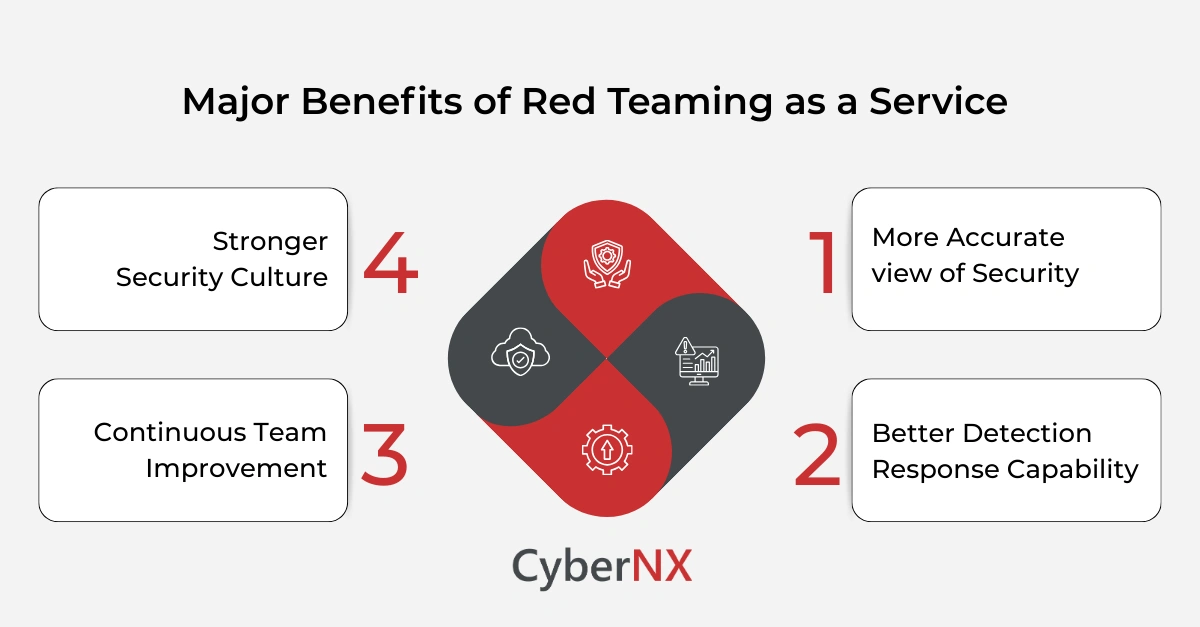
1. More accurate view of security
Internal testing often misses real-world behaviour. Red Teaming as a Service shows what attackers can actually achieve. It reveals vulnerabilities that other assessments overlook.
2. Better detection and response capability
Most teams want to shorten detection time. RTaaS helps with this. It shows how long attackers can stay hidden. It highlights the moments where the SOC could have acted faster.
3. Continuous improvement for teams
RTaaS is not a single event. It is a cycle. Teams learn. They fix gaps. They test again. And they build confidence in their defences.
4. Stronger security culture
Employees understand how attacks unfold. They become more aware. They make safer decisions. And they help the organisation grow stronger.
Future trajectory of Red Teaming as a Service
The Red Teaming as a Service landscape is changing quickly. New attack surfaces and emerging technologies shape how red teams operate.
1. More focus on cloud environments
Most enterprise workloads sit in cloud platforms today. Attackers know this. Red teams now simulate cloud-native attacks, misconfigured IAM roles and lateral movement across hybrid environments.
2. Attack simulations for SaaS applications
Tools like CRM systems, project management platforms and collaboration suites have become valuable targets. RTaaS now includes attacks on SaaS identity, access and configuration flaws.
3. Human-focused attack chains
Phishing remains the most common entry point. But attackers use more complex social engineering patterns. Red teams now test multi-step human attacks that combine emails, calls and spoofed messages.
4. Greater use of threat intelligence
Modern RTaaS teams model attacks based on active threat groups. This makes scenarios far more realistic for enterprises in finance, manufacturing, technology and retail.
5. AI Red Teaming
In red teaming, AI is playing a dual role. One, where AI capabilities are used to enhance the red teaming processes and activities. Secondly, there is an upsurge in the use of red teaming to secure growing use of AI systems across organisations. As you can see, AI red teaming is here to stay and gain more prevalence in the coming years.
Top operational challenges RTaaS helps solve
Security leaders often face similar issues. RTaaS helps address them step by step.
- Unclear security gaps: Many teams have tools. But they are unsure if these tools actually work when attacks unfold. RTaaS gives them clarity.
- Pressure on internal teams: Security teams handle many tasks. Realistic attack simulations require time and expertise. RTaaS removes this pressure.
- Limited visibility of attack paths: Networks grow quickly. Old systems remain connected. New SaaS platforms expand risk. RTaaS uncovers hidden pathways.
- Difficulty validating controls: Policies and controls do not always reflect day-to-day behaviour. RTaaS validates controls in a live environment.
How Red Teaming as a Service supports leadership
CISOs and CXOs need clear information. They must show progress. And they must justify investments.
RTaaS offers that clarity.
- It supports informed decision-making.
- It demonstrates maturity to auditors and regulators.
- It builds confidence among board members.
- It shows continuous improvement over time.
Leadership gains a structured way to measure resilience.
Critical considerations for prospective RTaaS partner
Selecting the right partner matters. Look for:
- Experience across different industries
- Strong understanding of cloud, identity and modern infrastructures
- Clear reporting style
- Collaborative engagement model
- Ability to support remediation
Your red team should feel like an extension of your internal team. They should guide, not judge. And they should help you grow stronger with every cycle.
Conclusion
Red Teaming as a Service gives organisations a practical and controlled way to test their resilience. It shows how attackers think, reveals gaps early and help teams build stronger habits. Every cycle creates improvement, insight strengthens operations and every step brings you closer to a resilient security posture.
At CyberNX, we work closely with your teams, build realistic attack scenarios and help you fix issues with clear and achievable guidance. If you want to explore Red Teaming as a Service, our experts are here to support you. Speak to our red teaming experts today.
Red Teaming as a Service FAQs
How often should an organisation run Red Teaming as a Service?
Red Teaming as a Service works as a continuous programme rather than a one-time exercise. Most organisations stay in an active cycle throughout the year. This includes regular attack simulations, ongoing reconnaissance and periodic reviews with the security team. Some organisations also run one major full-scope campaign annually to validate progress. The pace depends on business risk, industry regulations and how quickly new assets or threats appear.
Does RTaaS disrupt normal business operations?
No. RTaaS is designed to run quietly in the background. Activities are controlled, coordinated and planned to avoid operational impact. Only authorised stakeholders are aware during the engagement, unless the organisation chooses a purple team model. In that model, the defenders and red team work in closer alignment, but operations still run normally.
Is RTaaS suitable for cloud-native companies?
Yes. RTaaS fits cloud-native environments very well. Modern engagements include cloud-specific attack paths, identity and access risks, configuration weaknesses and lateral movement across cloud and hybrid systems. The approach helps teams understand how attackers move through IAM roles, misconfigured services and exposed APIs.
How is RTaaS different from penetration testing?
Penetration testing focuses on finding vulnerabilities in specific systems or applications. It has a fixed scope and checks for technical weaknesses. RTaaS goes much further. It simulates end-to-end attack chains across people, processes and technology. It tests detection, response and resilience under realistic conditions. While penetration testing gives a snapshot, RTaaS provides continuous insight into how attackers could operate across the entire environment. Find in-depth about their differences in our blog Red Teaming vs Penetration Testing.