
A red team assessment helps leaders see how well their organisation stands up to real threats. Many teams confuse it with red teaming, but there’s a difference. We wrote this guide to clear up the confusion and give you a sharper, more practical view.
Most leaders ask the same questions: Are we ready for a focused cyberattack? How long would it take us to detect one? Could we contain it quickly? A red team assessment answers those questions with evidence, not assumptions.
We researched the latest guidance from industry players, analyst reports and practitioner insights. Something stood out. Many blogs still explain red team security assessment in a generic way. They rarely show how it connects to everyday decisions that CISOs, IT heads and security managers make. This guide takes a more grounded angle. We look at where the exercise adds value, how it supports strategy and what you can do to extract meaningful learning from it.
The unexpected difference: red team assessment vs red teaming
Before anything else, we need to clear up the most common mix-up. Both activities sound similar, but they are not the same.
A red team assessment is a structured engagement with clear goals, timelines and scope. The aim is to test how your organisation responds to specific attack paths. It is evidence-driven and outcome-focused.
Red teaming, on the other hand, is an ongoing mindset and function. It supports your organisation throughout the year. A red team continuously tests assumptions, challenges blind spots and identifies areas that may mislead leaders. A red team assessment is a snapshot. Red teaming is a capability.
Many security leaders say this misunderstanding limits how they use both. When you treat a red team security assessment as a wider red teaming programme, you lose strategic value. When you expect ongoing red teaming insights from a one-time assessment, you get unrealistic expectations. Clear separation helps both efforts work better.
Why red team assessment is so important today
A red team assessment works like a rehearsal for the worst-day scenario. It reveals gaps that normal testing cannot reach. Penetration testing checks for weaknesses in pieces of technology. A red team security assessment checks the entire chain. It looks at people, processes and decision-making. This broader lens matters today because attackers mix techniques constantly.
Security teams also face stretched budgets and rising expectations. Leaders want clarity on where risk concentrates. A red team security assessment shows exactly where defences fail under pressure. Our experience shows that teams often discover misconfigurations, unpatched systems, false assumptions and slow detection workflows. These issues rarely appear in routine testing.
Inside the workings of a red team assessment
A red team assessment follows a cycle that mirrors a real intrusion. The goal is to measure resilience end to end. Before we expand on each stage, remember one thing: the exercise is not about passing or failing. It is about revealing the truth of how your defences behave.
1. Planning and scoping
Every strong assessment starts with a well-shaped scope. Leadership defines the critical assets, business processes and high-value targets. Teams agree on rules to ensure operations continue safely. When scope is rushed, the engagement suffers. When scope is thoughtful, the exercise becomes a powerful decision-making tool.
2. Reconnaissance and initial access
The assessment team gathers information to build an attack strategy. They study your external footprint, employee behaviour patterns and exposed services. They search for paths that provide quiet entry. This phase mirrors what real attackers do. It highlights how small details can expose big gaps.
3. Exploitation and privilege escalation
If the team gains a foothold, they move deeper. They attempt to escalate privileges and access sensitive areas. At this point, your monitoring capability faces its biggest test. Can it detect subtle movement? Can it spot unusual access patterns early?
4. Lateral movement and objective execution
The team tries to reach the defined objectives. They may attempt data access, service disruption or control-plane compromise. The goal is to understand how far an attacker could go before your team responds. We find this phase generates the most insight for CISOs.
5. Reporting, replay and learning
The final stage is where the value unfolds. A red team security assessment delivers a clear narrative, impact analysis and recommendations. Leaders use these insights to plan improvements. Many teams run tabletop sessions to replay the attack in slow motion. These sessions drive faster growth than the technical findings alone.
Key benefits that matter to decision-makers
Security leaders need more than technical output. They need context that helps them make better choices. A red team security assessment supports that in several ways.
1. It shows real adversary impact
Most organisations prioritise the wrong things. A red team assessment highlights what attackers would actually target. This helps you align your roadmap with real risk, not hypothetical scenarios.
2. Measures detection and response quality
The exercise exposes blind spots in monitoring. It also reveals delays in the investigation process. When your team sees the timeline of the attack, they learn where to tighten controls.
3. Validates your investment decisions
When you know how your defences behave under realistic pressure, you can allocate budget more effectively. Leaders often adjust their investment between endpoint controls, identity governance and network security after seeing the results.
4. Builds confidence across the organisation
Teams think more clearly about risk when they see live examples. A red team security assessment gives security teams confidence and clarity. Leaders gain assurance that decisions are based on real threat behaviour.
Busting key misconceptions
Many misconceptions still shape how organisations approach these assessments. Removing them strengthens the exercise and prevents wasted effort.
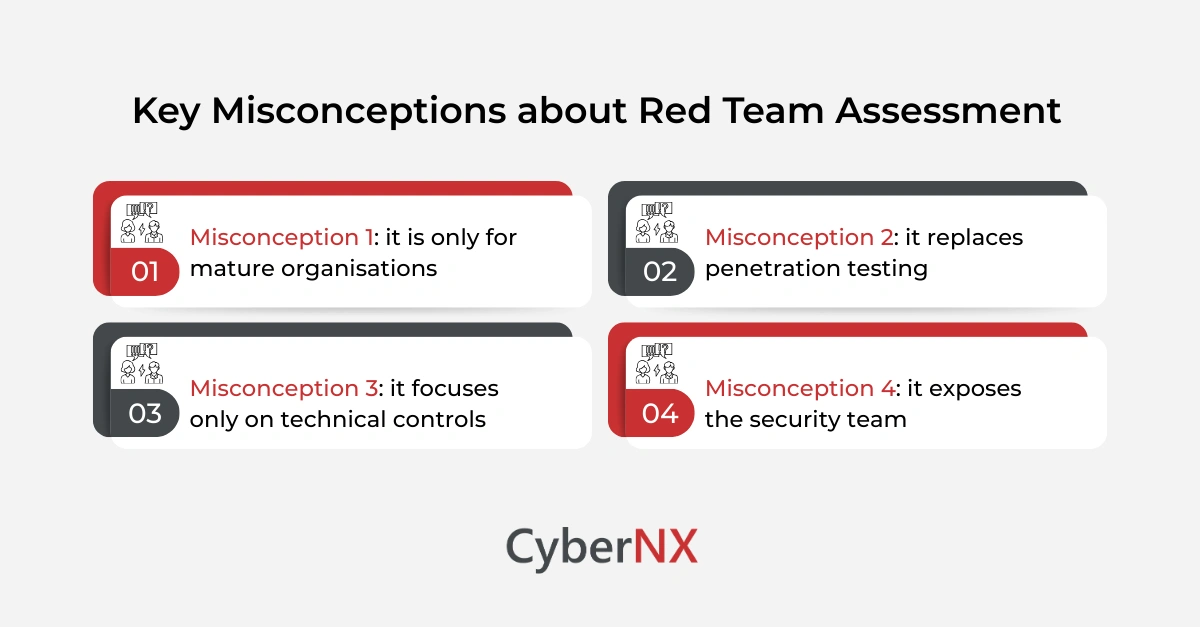
Misconception 1: it is only for mature organisations
Even mid-sized teams gain value from a red team assessment. The scope changes but the learning remains powerful. A well-designed assessment supports organisations at any maturity stage.
Misconception 2: it replaces penetration testing
It does not. Penetration testing checks systems. A red team security assessment checks resilience. They complement each other. Both provide different types of assurance.
Misconception 3: it focuses only on technical controls
Human behaviour plays a major role in outcomes. Many findings relate to incomplete processes, slow escalation paths or unclear decision patterns.
Misconception 4: it exposes the security team
A red team security assessment is not a performance test of individuals. It is a test of the system. The goal is open learning, not blame.
What’s next in red team assessment
Industry thinking continues to evolve. Several new trends now influence how organisations use these assessments.
1. Attack paths based on identity
Identity has become the new perimeter. Attackers target privilege chains to gain control. Many assessments now focus heavily on identity lifecycle, access paths and token misuse.
2. Blended threat scenarios
Real attackers combine phishing, cloud misconfigurations and on-prem gaps. Assessments now mirror this blended approach. It helps organisations understand how small cracks combine into major incidents.
3. Use of purple teaming follow-up
More organisations now run purple teaming sessions after the assessment. These sessions turn findings into improvements faster. They strengthen collaboration between offensive and defensive teams.
4. Testing resilience of cloud-first environments
As cloud estates grow, attackers target misconfigured permissions and shadow services. Cloud red teaming is now on the rise which includes deep evaluations of cloud identity, logging and monitoring.
How to prepare for a red team assessment
Preparing well ensures you gain strong value from the exercise. Leaders should consider a few steps.
- Align leadership expectations: Before the engagement starts, ensure the leadership team understands the purpose. Set measurable objectives. This avoids misinterpretation later.
- Validate incident response readiness: Make sure your team knows how to escalate issues. The goal is not to catch the red team instantly. The goal is to see how your organisation behaves when signs appear.
- Organise key documentation: Architecture diagrams, incident playbooks and monitoring inventories help shape clear scope. The assessment team uses this material to design realistic attack paths.
- Establish communication boundaries: Safe operation is key. Set the right boundaries. Clarify what systems, time windows and data categories require extra care.
Conclusion
A red team assessment helps leaders move from assumptions to clarity. It reveals how attackers could navigate through your environment and which controls need improvement. It also shows how your team detects, responds and adapts under pressure. Clear separation between red teaming and red team security assessment ensures you use both effectively. When you embrace the exercise as a learning tool, not a test, you gain insights that shape long-term security decisions.
If you want a structured, high-impact assessment tailored to your environment, we can help. Our red team experts will work alongside your team to strengthen your defences and build deeper resilience. Speak with us to know about our red teaming services and plan your next red team assessment.
Red team assessment FAQs
How often should organisations run a red team assessment?
Most large organisations run one every year. Companies facing major transformation, mergers, cloud expansion or new digital services often schedule them more frequently. The timing depends on how fast your environment changes and how much reassurance leadership needs.
Does a red team assessment disrupt operations?
A well-planned assessment minimises disruption. The engagement follows strict boundaries, and the red team works closely with leadership to stay within safe limits. Most organisations complete the exercise with no impact on customers or ongoing projects.
Can a red team assessment cover cloud-only setups?
Yes. Cloud-first and cloud-only organisations often gain stronger insights because identity, misconfigurations and API exposure create new attack paths. Assessments now focus on IAM drift, privilege chains, conditional access gaps and cross-tenant risks.
How long does a typical red team assessment take?
Four to six weeks is typical. Complex environments, large identity estates or hybrid infrastructures may need more time. If you add a purple team follow-up, expect an extended timeline to convert insights into measurable improvements.