For non-banking financial companies (NBFCs) the requirement to undergo RBI IT compliance audit is becoming more central. The regulatory focus on IT governance, risk management, controls and assurance means that gaps in your IT/IS framework can lead to regulatory scrutiny, reputational damage or operational loss.
In this blog, we explain why an RBI IT compliance audit matters for NBFCs, what the pain-points tend to be, and how you can organise your readiness efforts so your business is properly aligned.
What is an RBI IT Compliance Audit and why it matters
An “RBI IT compliance audit” for our purpose means the assurance and audit activity that confirms an NBFC’s alignment with the RBI’s Master Direction on Information Technology Governance, Risk, Controls and Assurance Practices.
1. Key regulatory triggers
The RBI’s Master Direction on IT Governance, Risk, Controls and Assurance Practices came into effect on 1 April 2024 and applies to NBFCs in the Top, Upper and Middle layers.
The audit covers aspects such as IT governance, information security, business continuity/disaster recovery, third-party arrangements and independent IS audit.
As NBFCs adopt digital systems, cloud, outsourcing, fintech partnerships and remote delivery channels, the RBI expects stronger assurance on technology-risk controls.
2. Why this is a business priority
Weak IT controls can lead to system outages, data breaches, operational losses or regulatory fines. Compliance with an RBI audit builds confidence among stakeholders (investors, board, partners). In addition, it supports resilience and enables growth rather than acting as a blocker. We’ve observed that even small changes deliver strong benefits.
A proactive audit posture positions your team as strategic enabler, not just “audit-surviving”.
Major challenges NBFCs face on the audit readiness path
Before diving into how to prepare, it helps to know what typically trips up NBFCs.
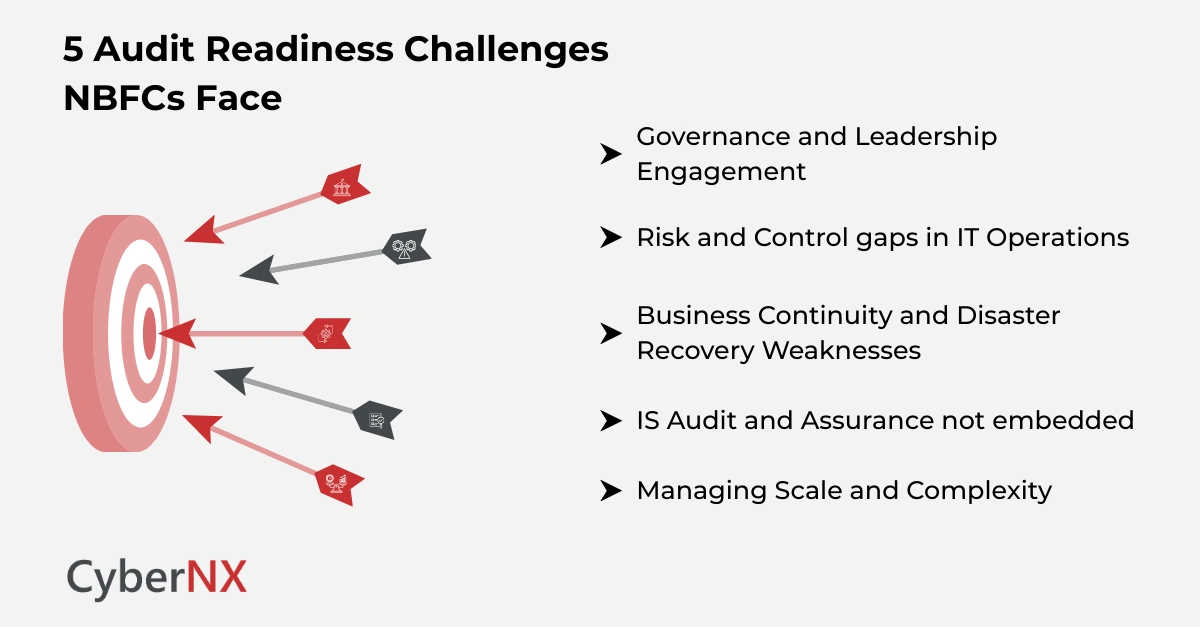
1. Governance and leadership engagement
Boards and senior management may not be fully engaged in IT governance. The direction mandates that the Board define roles and responsibilities around IT and that senior management lead the IT strategy.
The absence of a formal IT strategy committee, or unclear accountabilities, can weaken readiness.
2. Risk and control gaps in IT operations
Organisations often lack comprehensive asset-inventory, risk assessments, vulnerability management or penetration testing programmes. Outsourcing or third-party risk may not be fully covered: e.g., vendor audits, service level agreements, data-migration controls.
3. Business continuity and disaster recovery weaknesses
BCP/DR plans may exist but not be tested or updated. The audit will probe the plan’s design and whether drills are conducted.
4. IS audit and assurance not embedded
Some NBFCs treat IS audit as a tick-box rather than as independent, risk-based and continuous.
5. Managing scale and complexity
Under the RBI’s Scale-Based Regulation (SBR), NBFCs of different size and complexity face different expectations. The audit-readiness approach must be proportional.
A step-by-step readiness framework for NBFCs
We recommend a structured readiness journey broken into phases: gap assessment, remediation, monitoring & reporting.
Phase 1: Gap assessment
Before you can fix anything, you must follow a gap assessment checklist and measure where you stand. Key tasks:
- Map out applicable scope: What layer of NBFC you are (Top / Upper / Middle) and which portions of the Master Direction apply.
- Perform a baseline review: Review your current IT governance, information security, disaster recovery, third-party management and audit functions.
- Produce a risk-control matrix: Identify key IT/IS risk areas, map existing controls, identify gaps and rate severity.
- Engage Board & senior management: Present baseline findings and seek sponsorship for the remediation journey.
Phase 2: Remediation and implementation
Once gaps are identified you move into closure and strengthening. Key focal areas:
- IT governance: Institute or refresh an IT Strategy Committee (with Board representation) and IT Steering Committee. Define charters, meeting frequency, reporting lines. Appoint or confirm the Head of IT (or CISO) role with defined responsibilities. Embed regular Board reporting on IT risk, incidents, outsourcing and major projects.
- Controls and operations: Establish or refine information security policy, cyber-security policy, and ensure these are Board approved. Create or update a vendor risk management framework: vendor selection, SLA reviews, audit rights, exit/responsibility clauses. Conduct vulnerability assessments (VA) and penetration testing (PT) at least annually for critical systems. Maintain asset-inventory, review end-of-life hardware/software, ensure refresh plans for unsupported systems.
- Business continuity / disaster recovery: Develop a BCP and DR plan which covers IT services, data backups, failover arrangements, and test drills. Document DR drill outcomes, lessons learned, corrective actions. Ensure backups are stored securely, restore tests are logged, alternate site readiness is verified.
- IS audit and assurance: Define IS audit policy: scope, frequency, resources, independence of auditors. Perform risk-based IS audits: focus on highest risk systems and third-party services. Internal audit reports and external audit findings must feed into remediation tracking and Board oversight.
Phase 3: Monitoring, reporting & continuous improvement
Readiness is not a one-time exercise. Ongoing mechanisms keep you audit-fit.
- Dashboarding: Use key indicators (e.g., number of open findings, time-to-remediate, incidents by category) and report to senior management/Board.
- Periodic review: Reassess risks and controls at least annually or when significant change happens (e.g., digital roll-out, merger, vendor change).
- Training & awareness: Continuous education for staff on IT security, incident response, vendor controls.
- Change management: Ensure IT change / migration / project controls are in place – the Master Direction emphasises data-migration audits and vendor oversight.
Preparation payoff for NBFCs
When you invest in readiness for an RBI IT compliance audit you get more than just regulatory comfort.
- Enhanced operational resilience: By strengthening your IT controls you reduce risk of system failure, data loss or cyber-incident.
- Better stakeholder confidence: Boards, investors, partners and customers view you as a credible, well-governed entity.
- Efficient audit experience: With clear evidence, dashboards and remediation in place, the external audit and regulatory audit process becomes smoother.
- Competitive advantage: You may find that your readiness supports faster growth, digital partnerships and easier vendor on-boarding.
- Cost avoidance: Avoid the downstream cost and reputational impact of non-compliance findings, regulatory observations or enforced remediation.
New trends to keep in mind
The RBI’s Master Direction shifts supervisory focus squarely onto technology risk, demanding global best-practice governance and operational resilience beyond credit and liquidity assessments. This requires rigorously auditing and securing all third-party vendors and cloud usage while fully integrating cyber resilience into business continuity and disaster recovery plans.
- The RBI’s Master Direction reflects global best-practice: governance, third-party risk, business continuity, independent assurance.
- Supervisory focus is shifting more to technology risk – not just credit and liquidity. IT audit findings will be increasingly scrutinised.
- Outsourcing and cloud usage pose new risk vectors: vendors, data-rights, contract terms, data-migration audits.
- Integration of cyber resilience with BCP/DR is paramount. Systems need to restore as well as protect.
- Third-party assurance, vendor audits and supply-chain cyber resilience are becoming board-level topics.
Conclusion
As NBFCs navigate growth, digital transformation and competitive pressures, the requirement for an effective RBI IT compliance audit should be viewed not as a hurdle. Rather, it should be seen as an enabler of stronger, more trusted operations.
We’ve seen that by taking a structured readiness approach, starting with gap assessment, implementing controls and embedding continuous monitoring, organisations can pass audits and build IT resilience that supports growth.
At CyberNX we work alongside your team to strengthen your defences and align you with regulatory expectations while keeping operational efficiency in view. Contact us today for RBI Master Directions related consultation and let’s begin your audit-readiness journey.
RBI IT Compliance Audit FAQs
What types of NBFCs must comply with the RBI IT compliance audit requirements?
The Master Direction applies to NBFCs in the Top, Upper and Middle layers under the RBI’s Scale-Based Regulation (SBR) framework.
How often should an NBFC conduct an IS audit for IT compliance readiness?
The IS audit should be risk-based and periodic. For critical systems, at least annually; for others according to your risk profile and audit plan.
What role does vendor risk management play in the RBI IT compliance audit?
A significant one. The RBI direction mandates controls over outsourcing/third-party arrangements, migration, data ownership, audit rights and vendor monitoring.
Can smaller NBFCs (with lower asset size) adopt a simplified approach to audit readiness?
Yes, proportionality applies. The risk, complexity and size of controls should align with the NBFC’s scale, but core governance and control frameworks must still be in place.