Security leaders often tell us they want clearer alignment between defence and offence. They invest in red team exercises and strengthen blue team operations. Yet gaps still remain. Teams work hard but do not always work together. That is why the purple team framework has gained so much traction. It improves communication, provides structure and brings both teams into the same room to learn from one another.
Worldwide, security professionals rely on different purple team frameworks to standardise collaboration and measure improvement. Each model offers a unique lens for learning, testing and sharpening defence. Understanding these frameworks helps leaders choose what fits their environment.
Purple team framework for security synergy
Purple teaming is an exercise that creates a shared method for offensive and defensive teams to collaborate. Red teams simulate attacks. Blue teams respond. Purple teaming framework is focused on bringing them together with planned exercises, knowledge exchange and structured improvements.
Security leaders use this approach to eliminate guesswork. They want to see how controls behave during real attack simulations. They want clearer visibility into blind spots. Most of all, they want measurable progress.
Purple team framework in cybersecurity
The purple team framework in cybersecurity refers to a structured process where offensive tactics and defensive responses are mapped together. The focus shifts from scoring red versus blue to lifting the entire organisation’s maturity.
Today, purple teaming helps enterprises fine-tune detection engineering, verify visibility, stress-test security processes and improve cyber readiness.
Global purple team frameworks security teams rely on
Before diving into the details, it helps to know that purple team frameworks vary in approach. Some focus on attack simulation. Others emphasise detection quality. Some give step-by-step methods. Others offer flexible building blocks. Together, they give organisations powerful ways to raise their defence.
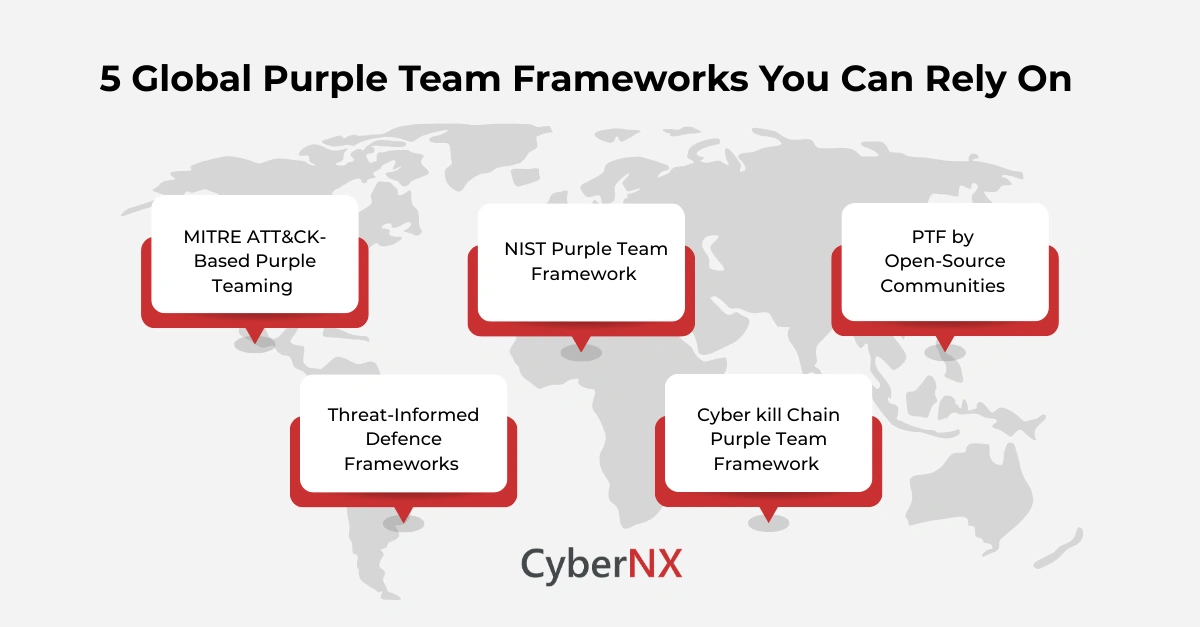
1. MITRE ATT&CK-Based purple teaming
MITRE ATT&CK is the most widely used model for purple team operations. It gives teams a structured map of adversary tactics and techniques.
Why security teams use it
- Offers full visibility of attacker behaviour
- Helps validate detection coverage
- Provides a shared language for red and blue teams
How it works
Red teams select ATT&CK techniques to simulate. Blue teams monitor how controls perform. Both teams document detection gaps and track improvements.
This method is popular because it offers consistency and global recognition.
2. NIST purple team framework
NIST provides guidance on collaborative security testing through its SP 800-series publications. While not a single “purple team” document, NIST’s approach supports joint exercises through structured test planning and reporting workflows.
Why leaders trust it
- Follows a controls-based view
- Aligns well with compliance frameworks
- Helps teams understand whether processes work under pressure
Security leaders in regulated industries prefer the NIST approach for its clarity and audit readiness.
3. PTF (Purple Team Framework) by Open-Source Communities
Several open-source groups have developed lightweight purple teaming frameworks used across global teams.
Examples include:
- Scythe’s Purple Team Exercise Framework
- C2Matrix-based purple teaming
- Atomic Red Team purple testing workflows
Why these frameworks are popular
- Easy to adopt
- Highly flexible
- Ideal for fast-growing teams
They provide practical, modular steps for running purple team simulations without heavy documentation.
4. Threat-Informed defence frameworks
Threat-informed defence frameworks combine threat intelligence with structured purple team activities.
Characteristics
- Use real-world threat intel to choose relevant attack scenarios
- Map adversary behaviour against organisation-specific systems
- Enable targeted improvement rather than broad, general testing
This approach is widely used in banking, fintech, telecom and public-sector defence units.
5. Cyber kill chain purple team framework
Based on Lockheed Martin’s Cyber Kill Chain, this framework focuses on mapping offensive actions to each stage of an attack.
Why professionals use it
- Simple and intuitive
- Great for training and awareness
- Helps teams validate each defensive layer
Red teams simulate an attacker’s progress from reconnaissance to impact. Blue teams observe how far the attacker can go and what alerts triggered along the way.
Some organisations use maturity-based frameworks that measure how well red and blue teams collaborate.
These models typically include:
- Level 1: Basic coordinated testing
- Level 2: Structured collaboration with shared metrics
- Level 3: Continuous purple teaming integrated with detection engineering
- Level 4: Automated simulations and feedback loops
They help leaders track progress and justify investment.
Benefits of purple team frameworks
Purple teaming frameworks provide structure and repeatability. They help both offensive and defensive units speak the same language.
Leaders gain measurable outcomes and predictable improvements.
Key benefits
- Better alignment between security teams
- Improved detection and response quality
- Faster identification of blind spots
- Stronger resilience against advanced attacks
- Clearer metrics for executives
These outcomes drive adoption worldwide.
Challenges before purple teaming begins
Even capable teams face hurdles that slow down progress.
Common issues:
- Limited visibility of assets
- Incomplete logging
- Over-reliance on automated tools
- No shared understanding of attack behaviours
- Lack of prioritisation during remediation
A proper purple team framework addresses each of these issues with structure and teamwork.
How CyberNX supports purple team exercises
CyberNX helps organisations choose and operationalise the right purple team framework for their environment. Our experts work closely with internal teams to test, detect and improve defences with clarity.
Why organisations choose CyberNX
- Experience across BFSI, telecom, manufacturing and SaaS
- Ability to run ATT&CK-driven purple team engagements
- Clear, actionable reporting that supports detection engineering
- Guidance on strengthening SIEM, SOAR and EDR visibility
- Tailored exercises for cloud, hybrid and legacy environments
We help teams uncover gaps, fix issues and build a culture of collaboration.
Conclusion
Purple team frameworks bring offensive and defensive teams together with purpose. They give leaders confidence that controls are tested and improvements are measurable. As threats grow more sophisticated, these frameworks help organisations stay resilient and aware. At CyberNX, we support enterprises with structured, collaborative purple team exercises that lift capability across teams and across systems. Ready to strengthen your defence? Connect with us to know about our purple team services and to plan your next purple team engagement.
Purple team frameworks FAQs
How often should organisations conduct purple team exercises?
Most teams run purple team exercises quarterly or biannually, depending on their environment’s complexity and threat exposure. Frequent exercises help refine detection rules, improve visibility and ensure both teams stay aligned as systems evolve.
Are purple teaming frameworks only for large enterprises?
Not at all. Even smaller teams benefit from structure and shared workflows. Purple teaming scales well because organisations can start small, focus on a few ATT&CK techniques and expand as their maturity grows.
Which framework is best for cloud environments?
MITRE ATT&CK Cloud Matrix, threat-informed defence models and open-source purple testing toolkits are widely used for cloud ecosystems. These frameworks map cloud-native threats clearly, making them ideal for organisations with hybrid or multi-cloud setups.
Can purple teaming replace red or blue team activities?
Purple teaming does not replace either function. Red teams still challenge defences. Blue teams still respond and harden. Purple frameworks simply bring both teams together to speed up learning, reduce friction and tighten controls across the board.