Security teams carry a heavy load. Threats move fast. Tools generate noise. Gaps appear in places no one expects. A purple team exercise gives organisations a safe space to test assumptions and sharpen capability. It blends offensive and defensive skills. It creates clarity. It turns scattered efforts into coordinated action. This guide explains what this security practice is, how teams use it today and why it has become a pillar of modern security programmes.
How purple teams revolutionize offence and defence
Purple teaming is an umbrella term that acts as a collaborative function bringing together red teamers and blue teamers. A purple team exercise, on the other hand, is the specific security practice where this collaboration event takes place. It brings red teams and blue teams together. Both sides work in the same loop. The aim is simple. Improve detection and response without friction.
The red team simulates realistic attack paths. The blue team responds in real time. Together, they test controls, refine alerts, improve playbooks and close gaps.
This approach shifts the focus from competition to cooperation. It helps security teams learn faster. It builds a repeatable process that improves the organisation’s overall resilience.
Walking through a purple team exercise
A typical exercise unfolds in phases. These phases are consistent across industries because they mirror real attack behaviour.
1. Planning and scoping
Teams define the scope. They select tactics and objectives. They choose techniques mapped to MITRE ATT CK. They identify systems or processes to test.
The aim is clarity. Everyone understands the goals before the exercise begins.
2. Attack simulation
The red team executes selected attack techniques. The actions are deliberate. The pace is controlled. This makes it easier for defensive teams to observe the events.
3. Detection and response review
The blue team monitors logs, alerts and endpoints. They validate whether tools triggered signals. They check if analysts saw the right information at the right time.
4. Joint analysis
Both teams review outcomes. They compare what happened with what should have happened. They discuss missed alerts, noisy alerts and blind spots.
This step is the heart of a purple team exercise. It builds shared understanding.
5. Refinement and re-testing
Teams adjust controls. They tune rules. They update use cases. Then they repeat the attack. This creates measurable progress.
Why enterprises can’t afford to skip purple teaming
Security leaders value purple team exercises for the gains they offer. The improvements appear quickly and compound over time.
1. Better alignment between people, tools and processes
Security technology delivers value only when teams use it effectively. A purple team exercise helps analysts understand real attack behaviour.
It also helps red teams understand defensive realities. This alignment reduces noise. It creates clearer detection paths.
2. Stronger detection and response
Purple team insights go straight into SIEM rules, EDR policies and SOC playbooks. Small adjustments often lead to faster detection.
These exercises give teams confidence in their controls.
3. Lower operational risk
Most incidents escalate because early signals go unnoticed. A purple team exercise exposes those weak points. Teams fix them before an attacker finds them.
4. Clear, measurable improvements
Every cycle generates data. Teams see what improved. Leaders gain evidence that investments produce value. This makes reporting easier.
Practical purple team exercise examples
Many organisations use purple teaming to test scenarios that mirror attacks seen in the wild. Here are common examples that security teams perform today.
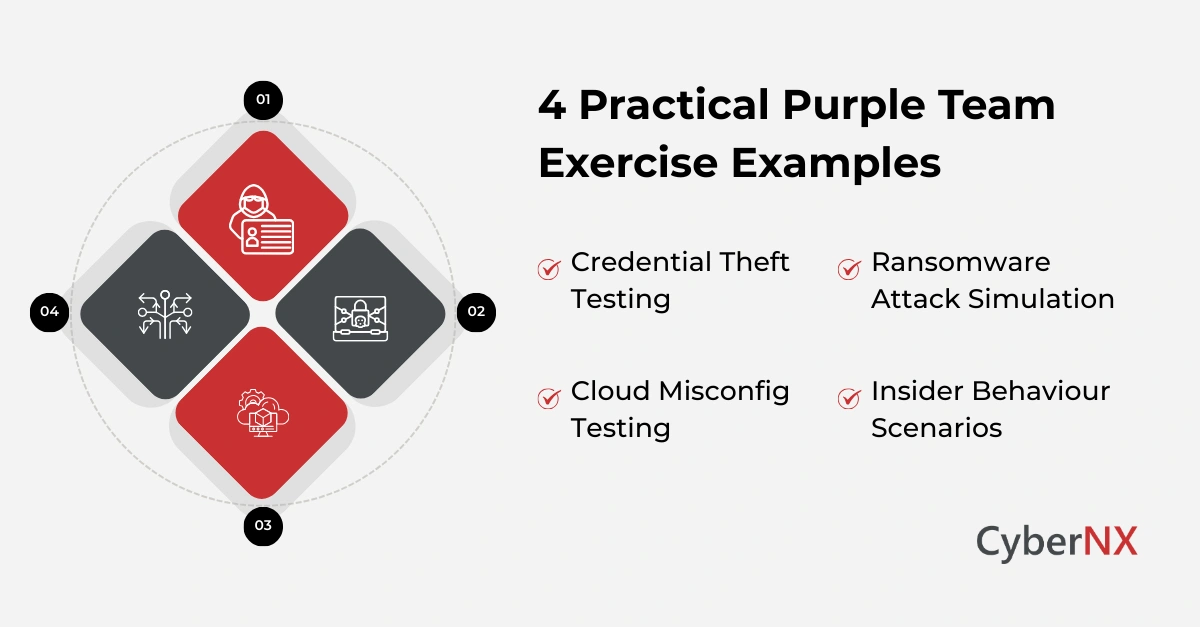
1. Credential theft testing
The red team uses:
- Credential dumping
- Pass the hash
- Password spraying
The blue team checks:
- EDR alerts
- Authentication logs
- Lateral movement detection
2. Ransomware attack chain simulation
The red team deploys initial access methods. They escalate privileges. They attempt encryption steps.
The blue team monitors for early signals like suspicious privilege escalation or unusual file access.
3. Cloud misconfiguration testing
Teams test identity roles, IAM policies and exposed services.
The aim is to spot weak privilege pathways that attackers exploit in cloud platforms.
4. Insider behaviour scenarios
These exercises replicate actions like data exfiltration or unusual access spikes.
Analysts check whether monitoring tools detect the out-of-pattern behaviour.
How security professionals use purple team exercises today
Security teams now use purple team exercises in more structured ways. Organisations run them quarterly or semi-annually. Some run them continuously.
- Continuous control validation: Security tools change often. Cloud environments shift daily. Purple team exercises help teams validate that current configurations match expected outcomes.
- Building MITRE ATT CK mapped use cases: Enterprises map purple team findings to specific ATT CK techniques. This helps SOC teams prioritise high-value use cases and reduce gaps.
- Improving threat hunting capabilities: Hunters use exercise data to build new queries. They base hunting paths on real events instead of assumptions.
- Testing incident response readiness: Purple team exercises reveal how teams communicate under pressure. This uncovers gaps in escalation, ownership and timing.
- Supporting compliance and audit requirements: Some frameworks require evidence of regular testing. Purple team exercises produce structured reports that help meet these expectations.
The new trends reshaping purple team exercises
Purple teaming continues to evolve. New tools and threats push teams to adapt.
- AI-driven attack simulation: Tools now automate parts of red teaming. This helps teams test a wider range of tactics in less time. Defensive teams use AI-assisted analytics to identify behaviours faster.
- Cloud-native purple teaming: Organisations now test multi-cloud environments. They also test identity federation paths. These scenarios reflect the shift from traditional networks to identity-first security.
- Expanded focus on identity attacks: Attackers rely on identity attacks more than ever. Purple team exercises now include token theft, impersonation and session hijacking scenarios.
- Integration with breach and attack simulation tools: Teams use BAS platforms to complement manual purple teaming. This creates a hybrid approach. It keeps the exercise realistic but scalable.
Conclusion
A purple team exercise gives organisations a powerful way to strengthen detection, response and security strategy. It connects teams. It uncovers blind spots. It creates measurable improvements that leaders can rely on.
We support enterprises in designing and executing structured purple team exercises that align with real-world threats and business needs. Reach out to explore our purple teaming services and how these exercises can strengthen your security programme.
Purple team exercise FAQs
How often should organisations run a purple team exercise?
Teams benefit from running them quarterly. Some run specific scenarios monthly if their environment changes often. Regular cycles help teams spot new gaps early. They also help security leaders maintain consistent performance across tools and processes.
Is a purple team exercise suitable for small teams?
Yes. Smaller teams benefit because collaboration reduces workload and improves shared understanding. Even limited-resource teams gain clearer visibility into what matters most. The structured format also reduces guesswork in day-to-day operations.
What tools help during a purple team exercise?
Teams use SIEM, EDR, identity logs, packet capture tools and MITRE ATT CK mapping platforms. Most organisations also integrate automation to replay attack sequences. This speeds up validation and removes manual overhead from routine testing.
How long does a typical purple team exercise last?
Most exercises run for one to two weeks depending on scope and number of attack techniques. Shorter engagements focus on single attack chains. Larger programmes span multiple use cases and produce more detailed insights for leadership.