From assessment scorecards and algorithm scanning platforms to migration advisors and Q-Day estimators, the market has responded to the quantum security moment with a wave of new options.
The problem is not access but knowing which tools will hold up when your auditor asks for evidence, your board asks for a status report or your team needs to track migration progress across innumerable applications.
Post-quantum cryptography (PQC) readiness is not a one-time exercise. It is a continuous programme and the tools you choose to support that programme will either give you real visibility or create the illusion of it.
Here is what Indian BFSI security and compliance teams should evaluate before committing to any PQC readiness tool – and why integrated platforms deserve a closer look than standalone scanners.
What PQC readiness tools are trying to do
Before evaluating tools, it helps to be clear about what the job is. PQC readiness tools broadly serve three functions.
1. Discovery
Identifies where your organisation is using cryptographic algorithms that are vulnerable to quantum attack – specifically RSA, ECC and Diffie-Hellman. This requires scanning code repositories, network traffic, configuration files, libraries and certificates across your environment.
2. Assessment
Interprets what discovery found. Which vulnerabilities are high priority? Which systems protect data that must remain confidential for more than five years? Which third-party integrations introduce exposure you cannot directly control?
3. Planning and tracking
Turns assessment findings into a migration roadmap and tracks progress as your organisation moves from quantum-vulnerable to quantum-safe configurations. A tool that only does one of these three things is a starting point, not a solution. Evaluating tools means asking which functions each one covers – and how well.
Six criteria that should drive your evaluation
The market is full of tools that perform well in demos but create problems in production. These are the criteria that matter for Indian regulated entities.
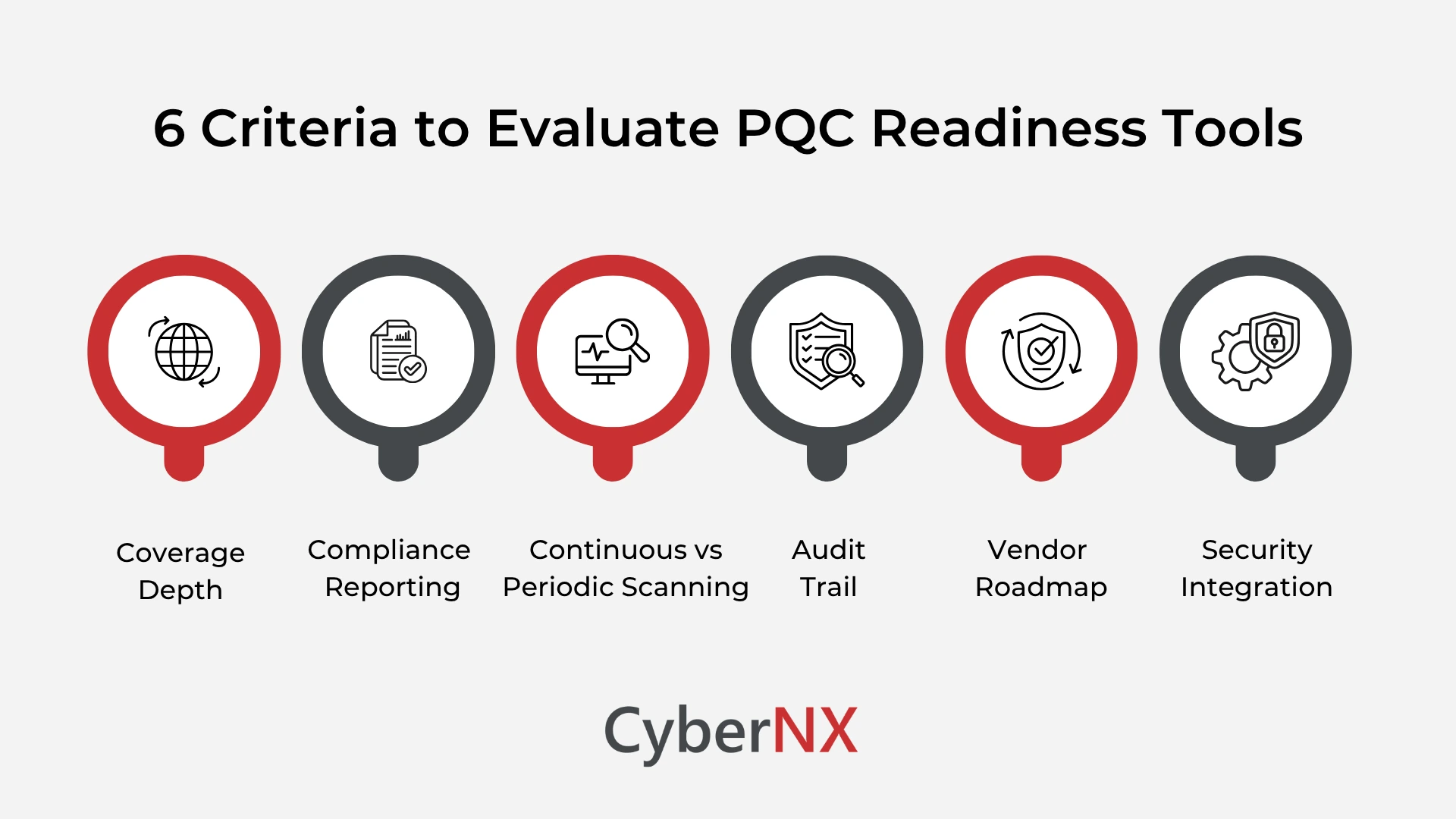
1. Coverage depth
It refers to how thoroughly the tool can discover cryptographic usage.
- Does it scan only network traffic or also application code?
- Can it identify hard-coded algorithms in legacy systems?
- Does it process certificate stores, HSM configurations and third-party libraries?
A tool with shallow coverage will give you a clean report that is simply incomplete.
2. Compliance reporting output
This is critical for BFSI. CERT-In’s CBOM guidelines, RBI’s cryptographic risk advisory and SEBI’s CSCRF PQC planning requirements all demand documented evidence. Your tool must produce reports that map findings to these regulatory frameworks – not just technical outputs that your compliance team then has to manually translate into audit evidence.
3. Ongoing monitoring versus point-in-time scanning
This difference separates serious platforms from convenience tools. Your cryptographic environment changes every time an application is updated, a new service is deployed or a vendor integration changes. A tool that runs a scan once a quarter and produces a static report will always be behind reality. Continuous monitoring is the standard that regulated environments require.
4. Audit trail and access controls
This matters in regulated environments. Every change, every finding, every resolution needs a timestamp and an owner. If your tool does not maintain this record natively, you will be maintaining it manually – which creates its own compliance risk.
5. Vendor roadmap and NIST alignment
It is a forward-looking criterion. NIST’s post-quantum cryptography standards are now finalised. The tools you use should support scanning for compliance against ML-KEM (Kyber), ML-DSA (Dilithium) and SLH-DSA (SPHINCS+) – the algorithms your organisation will be migrating toward. If a tool’s roadmap does not reference NIST standardisation, its usefulness will decline as migration begins.
6. Integration with existing security infrastructure
Determines whether the tool becomes part of your operational workflow or a standalone project. Tools that connect with your SIEM, vulnerability management platform or CBOM pipeline produce actionable intelligence. Tools that sit in isolation produce PDF reports.
Why standalone PQC tools often fall short
Most standalone PQC readiness tools were built for a specific moment – the initial discovery phase when organisations first needed to understand their quantum exposure. They are valuable for that moment. They are not sufficient for the ongoing programme that follows.
The gap shows up in three places.
- First, standalone tools typically lack the business context layer. They identify that a system uses RSA-2048 but cannot tell you whether that system handles data that needs to remain confidential for 15 years. That risk contextualisation – which determines priority – requires connecting technical findings to data classification, retention policies and business function.
- Second, standalone tools rarely support third-party assessment. Your organisation’s cryptographic exposure extends to every vendor and cloud platform that handles your data. Standalone scanning tools scan what you control. They cannot reach into your vendors’ environments or flag gaps in their quantum roadmaps.
- Third, standalone tools generate a report. They do not generate a programme. The output requires significant manual interpretation before it becomes a migration plan – and even more effort before it becomes audit evidence.
What an integrated CBOM platform changes
A Cryptographic Bill of Materials (CBOM) platform approaches PQC readiness differently. Rather than running a one-time scan, it builds and maintains a living inventory of every cryptographic asset across your environment – updated continuously as your systems change.
For Indian BFSI entities, this matters because it directly produces the CBOM that CERT-In requires. It creates the cryptographic inventory that RBI expects. And it generates the continuous monitoring evidence that demonstrates to auditors that your organisation is managing cryptographic risk on an ongoing basis.
An integrated platform also enables per-application migration tracking. As your team upgrades systems to NIST-approved PQC algorithms, the platform records what changed, when and who authorised it. That audit trail is exactly what a SEBI CSCRF audit or RBI inspection will look for.
Questions to ask any PQC tool vendor
Before committing to any tool, ask these five questions directly.
- Does the tool produce output that maps to CERT-In CBOM fields, RBI cryptographic risk categories or SEBI CSCRF PQC planning requirements? If the vendor cannot answer this specifically, the compliance reporting burden falls on your team.
- Does the tool monitor continuously or scan periodically? If it is periodic, what is the minimum scan frequency and what happens to new assets deployed between scans?
- How does the tool handle third-party and SaaS environments where you do not control the underlying infrastructure?
- What is the vendor’s own NIST PQC alignment roadmap? When will the tool support scanning for ML-KEM and ML-DSA adoption?
- Can the tool integrate with your existing CBOM or SBOM pipeline, or does it operate as a standalone data silo?
Conclusion
Choosing a PQC readiness tool is not a technology decision – it is a programme decision. The right tool needs to support discovery, risk assessment, compliance reporting, ongoing monitoring and migration tracking in a single workflow.
CyberNX’s PQC solutions give Indian regulated entities the continuous cryptographic visibility that underpins both PQC readiness and regulatory compliance. If you are evaluating PQC readiness tools, speak with our team to understand what the right platform looks like for your specific environment and regulatory obligations.
PQC readiness tools FAQs
Are open-source PQC tools sufficient for regulated Indian entities?
Open-source tools can be useful for initial discovery in non-production environments or for technical teams that want to understand the tool’s methodology. For production environments in regulated sectors, they rarely meet compliance reporting, audit trail and ongoing monitoring requirements without significant customisation. The total cost of that customisation often exceeds the cost of an enterprise platform.
How do PQC readiness tools relate to CBOM?
A CBOM platform is a superset of a PQC readiness tool. It does everything a PQC tool does – discovering cryptographic assets and flagging quantum-vulnerable algorithms – but also maintains the continuous, structured inventory that regulatory compliance requires. For BFSI entities under CERT-In, RBI and SEBI mandates, a CBOM platform is the more appropriate foundation.