Every BFSI security team approaching PQC migration planning tools faces the same early fork in the road. Do you build your own cryptographic discovery process using open-source tools, internal scripts and engineering effort or do you buy a purpose-built commercial platform that handles discovery, risk scoring and compliance output out of the box?
Those organisations classified as Critical Information Infrastructure (CII) – which includes BFSI under the Government of India’s May 2026 quantum-safe roadmap – the foundations deadline is December 2027. That changes the calculus significantly.
This blog lays out both sides honestly, so your team can make the right call.
What “building” means
Building does not mean writing a cryptographic scanner from scratch. In practice, it means assembling a discovery process using open-source Cryptographic Asset Discovery and Inventorisation (CADI) tools, configuring them for your environment, interpreting their output manually and maintaining the inventory over time.
The open-source toolkit
Several credible open-source tools exist for this purpose. IBM’s CBOMkit scans Java codebases and generates CycloneDX-format Cryptographic Bill of Materials (CBOM) output – the format referenced in CERT-In CBOM guidelines. Network-layer tools like Zeek with PQC extensions capture TLS cipher suite data from live traffic. Certificate discovery tools pull X.509 data from infrastructure endpoints. For organisations with a well-defined, single-language codebase and dedicated engineering resource, these tools can produce a useful starting inventory.
What open-source tools do well
Open-source CADI tools are genuinely capable within their designed scope. They are free to use, auditable, and in the case of IBM CBOMkit, produce standards-compliant CycloneDX output. For organisations running proof-of-concept discovery on a single application or a bounded environment, they provide real value without licensing cost. An academic analysis presented at ARES 2026 confirmed that open-source tools perform well within their designed domains – the limitation is breadth, not quality.
Where the build path breaks down
The problem is coverage. Cryptographic assets do not sit neatly in source code. They appear across five distinct layers:
- Code and dependency scanning – algorithm usage in source, libraries and containers
- Network-layer inspection – TLS configurations and cipher suites in live traffic
- Certificate discovery – X.509 certificates across distributed infrastructure
- Binary scanning – cryptographic usage in compiled binaries and firmware
- Configuration scanning – HSM settings, key management configurations and infrastructure configs
Most open-source tools cover one or two of these layers well. Covering all five requires multiple tools, custom integration work and ongoing engineering effort to reconcile outputs into a single inventory.
The same ARES 2026 study found that cross-domain coverage and interoperability across open-source tools remain significantly underexplored. For a BFSI organisation with a heterogeneous environment – core banking, payment gateways, cloud infrastructure, third-party APIs – that gap is not a minor inconvenience but a compliance risk.
What “buying” means
Buying means deploying a purpose-built commercial platform that handles cryptographic discovery across all five layers in a single integrated workflow, produces quantum-risk-scored CBOM output in compliance-ready formats and maintains a continuous, current inventory rather than a point-in-time snapshot.
What a commercial platform covers
Commercial PQC migration planning tools are designed around the full discovery scope that regulatory compliance requires. Across code, network, certificates, binaries and configuration – in one platform, with one output format. They classify each asset by quantum vulnerability: quantum-broken (RSA, ECC, Diffie-Hellman), quantum-weakened (AES-128) or quantum-safe.
They assign migration priority based on both algorithm type and data shelf life – because a long-lived customer record protected by RSA-2048 is a higher priority than a session token using the same algorithm. Output is in CycloneDX format, audit-ready for CERT-In CBOM guidelines and SEBI CSCRF requirements.
The continuous monitoring difference
This is the capability that the build path struggles most to replicate. A commercial platform monitors your cryptographic estate continuously – alerting on new quantum-vulnerable assets introduced through software updates, certificate renewals or infrastructure changes. An internal tool produces a snapshot. A snapshot goes stale. For organisations maintaining CBOM automation as a compliance practice across SEBI CSCRF audit cycles, continuous monitoring is not optional.
The cost honest organisations account for
Commercial platforms carry licensing costs. That is real. But the honest cost comparison includes the engineering time to build and maintain a multi-tool open-source stack, the manual effort to reconcile outputs across discovery layers, the compliance risk of submitting an incomplete CBOM to a regulator and the opportunity cost of delaying migration planning while the inventory is still incomplete. For most BFSI security teams, those costs exceed the licensing fee before year one is done.
Putting both sides against the 2027 deadline
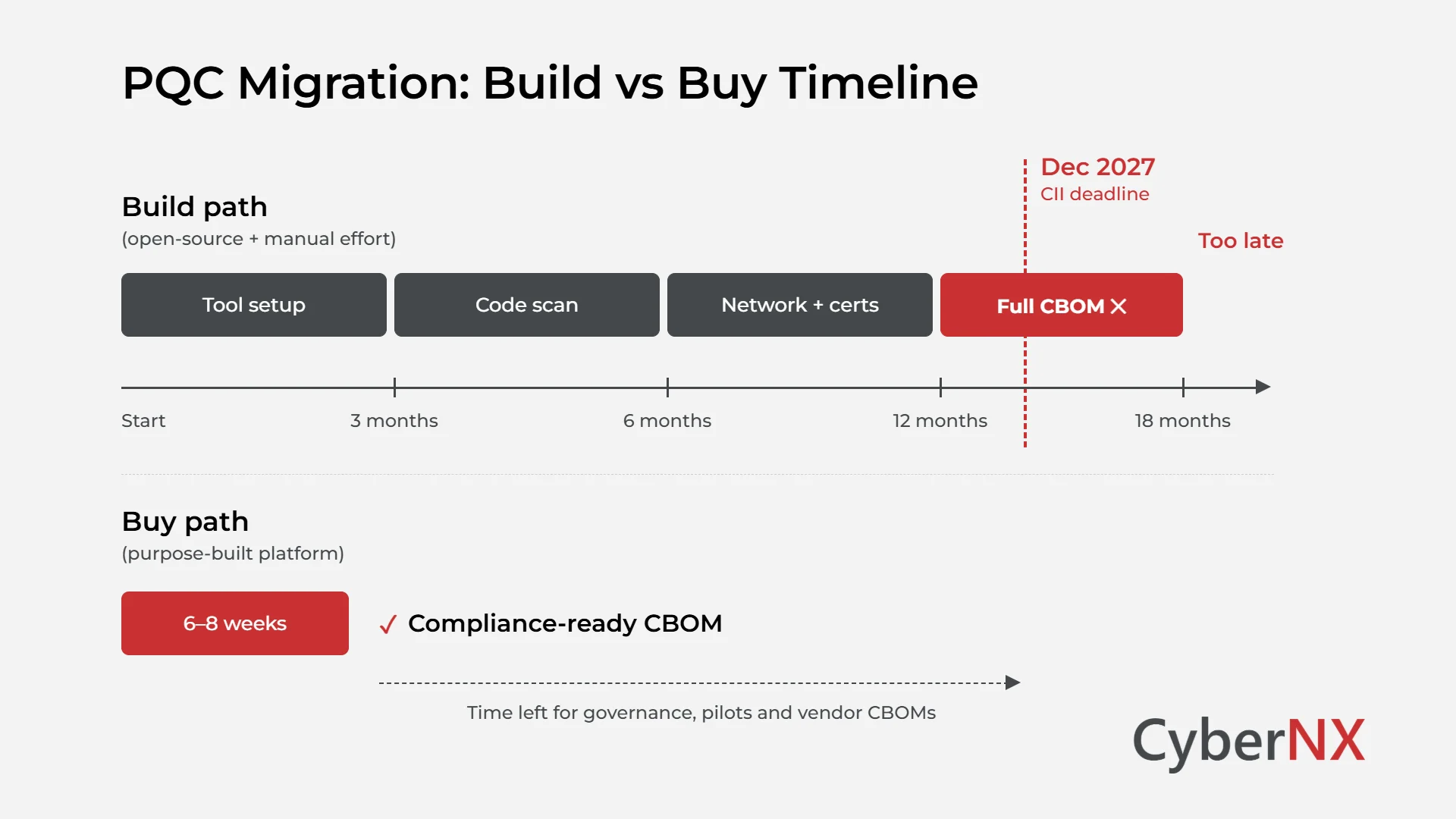
The Government of India Task Force roadmap requires CII organisations – which includes BFSI – to complete foundations by December 2027. And foundations include establishing governance, running pilots, introducing PQC readiness in procurement and preparing for mandatory CBOM submissions from vendors starting FY 2027–28.
All of that depends on having a complete, quantum-risk-scored, continuously maintained cryptographic inventory. Not a partial one built from two open-source tools and a spreadsheet.
The build path is viable for organisations with ample time, dedicated engineering resource and a bounded, well-understood environment. It has a legitimate place in security programmes with those characteristics.
But for a BFSI organisation facing a 2027 CII deadline, a heterogeneous cryptographic estate spanning core banking, third-party platforms and cloud infrastructure – and a security team already stretched across SEBI CSCRF, RBI master directions and DPDPA compliance – the build path does not fit inside the available window.
The CBOM maturity model makes this sequencing clear: discovery is the foundation everything else builds on. A slow, partial discovery phase compresses every subsequent milestone. As outlined in our PQC migration guide, cryptographic inventory is the mandatory first step – and it needs to be complete before migration sequencing can begin.
Making the call for your organisation
Open-source PQC migration planning tools have genuine value. For a well-scoped pilot on a single application, they are often the right starting point. For building cryptographic awareness in a contained environment, they produce real results.
But for a BFSI organisation that needs a complete, audit-ready, continuously maintained cryptographic inventory before December 2027 – one that covers all five discovery layers, scores quantum risk, maps to India’s regulatory frameworks and keeps pace with a changing estate – a purpose-built commercial platform is the only path that fits the timeline.
CyberNX’s PQC readiness solutions are built for exactly this programme. We handle multi-layer cryptographic discovery, generates CycloneDX CBOM output aligned to CERT-In and SEBI CSCRF requirements, scores each asset against NIST PQC standards and provides continuous monitoring to keep your inventory current as your estate evolves.
If your team is at the build-vs-buy decision point, talk to us. We will help you understand what your current environment requires, and what the right approach looks like for your organisation’s timeline and complexity.
PQC migration planning tools FAQs
Can open-source tools produce a CERT-In compliant CBOM?
Yes, partially. IBM CBOMkit generates CycloneDX output for Java codebases, which aligns with CERT-In CBOM format requirements. The issue is not output format – it is coverage scope. A CBOM built from a single code-scanning tool misses network-layer cryptography, certificate data, binary-level usage and configuration-level assets. CERT-In expects a comprehensive cryptographic inventory. A single-layer open-source tool does not produce one.
Is building more appropriate for smaller BFSI organisations?
Smaller organisations with a simpler, more bounded environment may find open-source tools sufficient for an initial proof-of-concept. But even smaller BFSI entities classified as CII face the same 2027 deadline and the same regulatory output requirements. The question is less about organisational size and more about how much of your cryptographic estate is visible to a code-level scanner – and how much sits in network traffic, certificates, third-party platforms and compiled binaries that it cannot reach.