
Post-quantum cryptography (PQC) refers to encryption methods designed to withstand attacks from quantum computers. Banking, financial services and insurance (BFSI) firms rely on encryption for everything from online banking sessions to SWIFT transfers, which makes this transition a direct business priority rather than a distant research topic.
Quantum computers powerful enough to break RSA and ECC, the algorithms behind most of today’s encryption, are estimated to be five to ten years away. Regulators including NIST, the G7 Cyber Expert Group and India’s Department of Science and Technology have already published migration timelines targeting 2030 to 2035 for critical systems. This guide covers what PQC readiness involves, how a cryptographic inventory supports it, the steps BFSI firms can take to build a migration roadmap, and where migrations commonly go wrong.
What is Q-Day and why does it matter for BFSI?
Q-Day is the point at which a quantum computer becomes capable of breaking current public-key encryption. Once that happens, any RSA or ECC-protected data becomes readable, regardless of how old it is.
This creates a specific risk called harvest now, decrypt later. Attackers can copy encrypted data today, such as TLS traffic or archived customer records, and store it until a capable quantum computer exists. Financial data has an unusually long shelf life. KYC files, custody agreements and transaction logs are built to stay confidential for decades, which means data encrypted today could still be exposed well after Q-Day arrives.
Not every algorithm is equally exposed. RSA and ECC, which rely on factoring and discrete logarithm problems, are the ones quantum computers threaten directly. Symmetric algorithms such as AES are less affected. Grover’s algorithm only halves their effective security, so AES-256 still offers meaningful protection. This distinction matters for planning, since it means the priority list starts with anything using RSA or ECC key exchange and signatures, not with every encrypted system across the estate.
The impact spans four areas:
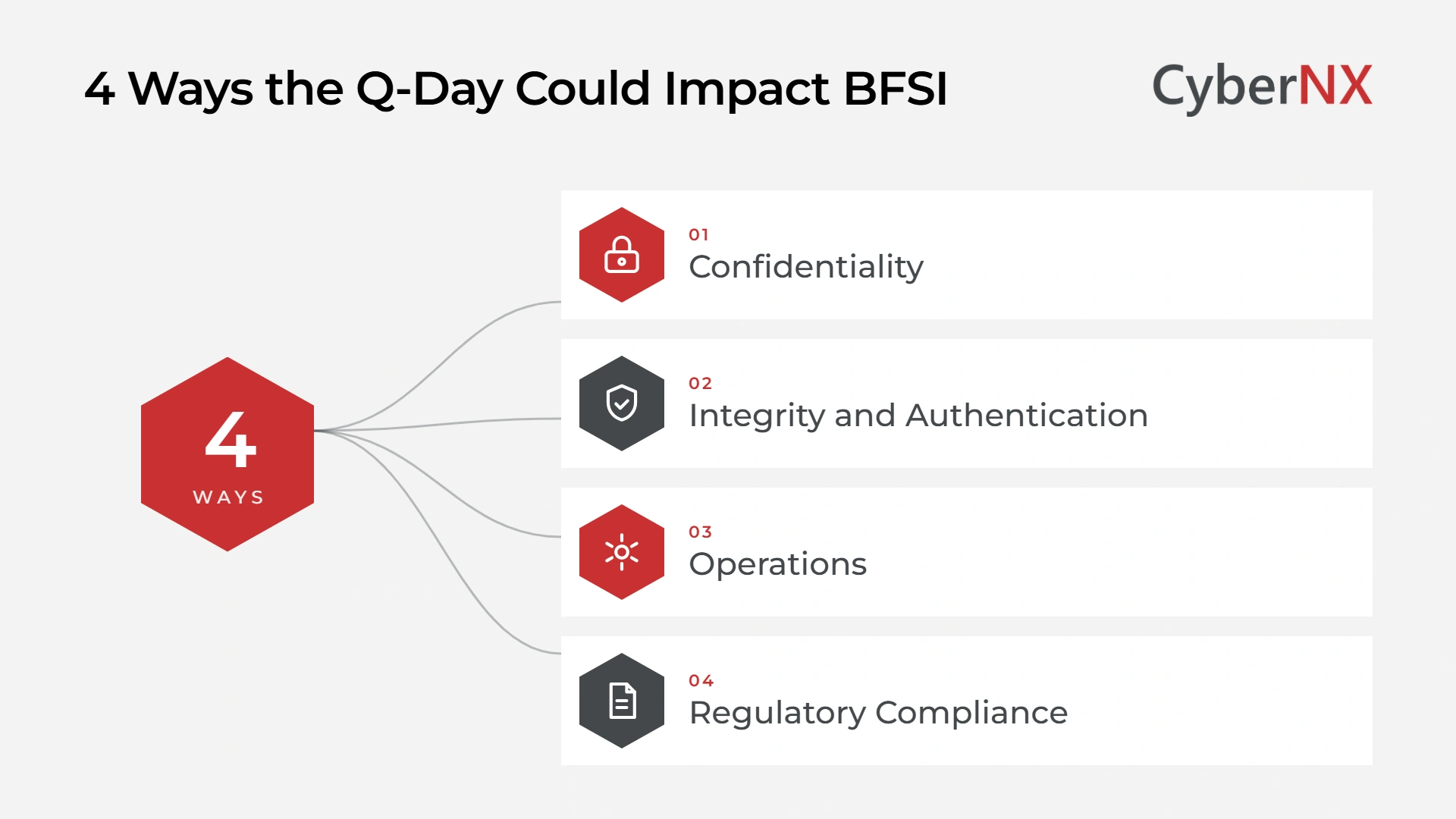
- Confidentiality: customer records and archived transactions become readable retroactively.
- Integrity and authentication: digital signatures on contracts and payment instructions become forgeable, so a fraudulent instruction becomes indistinguishable from a genuine one.
- Operations: TLS, VPNs and interbank channels relying on RSA or ECC would need emergency replacement mid-incident rather than on a planned schedule.
- Regulatory compliance: regulatory frameworks and guidance already treat cryptographic resilience as part of operational risk, not a future consideration.
How a cryptographic inventory supports PQC readiness
Before any migration can start, an organisation needs a complete inventory of where RSA and ECC are in use. Most security teams cannot produce this list from memory or outdated architecture diagrams alone, which makes prioritisation guesswork without it.
This inventory, often called a cryptographic bill of materials, typically records systems and channels, algorithm and key strength, certificate details, and ownership for each asset. For a deeper look at what this involves and how it is built, see our complete guide to CBOM.
What matters for PQC planning specifically is treating the inventory as a live risk register rather than a one-time audit. Each entry should carry a criticality score based on the sensitivity of the data it protects and how long that data needs to stay confidential. An RSA-2048 certificate protecting a customer database, for example, ranks well above the same algorithm protecting an internal test environment.
Building a PQC migration roadmap
Migrating to post-quantum cryptography works best as a phased programme rather than a single cutover. NIST guidance and the G7 roadmap both point to a similar sequence:
- Discover: build the cryptographic inventory and establish governance, including an accountable owner such as a CISO or PQC lead.
- Prioritise: rank systems by data sensitivity and business impact, starting with payment gateways, HSMs and PKI infrastructure.
- Pilot hybrid solutions: test combined classical and post-quantum algorithms, such as X25519 paired with CRYSTALS-Kyber, in a controlled environment before wider rollout.
- Migrate: reissue certificates with post-quantum signatures and update key management infrastructure, including HSM firmware.
- Sustain: monitor deployed systems, retrain staff and reassess algorithms as standards evolve.
Each phase depends on the one before it. Skipping discovery to migrate directly often means redoing work later on systems that were not accounted for initially.
Hybrid testing deserves particular attention. Running classical and post-quantum algorithms side by side means security never depends entirely on either one during the transition. It also surfaces practical issues early, since post-quantum algorithms tend to produce larger keys and signatures than RSA or ECC.
That size difference can add measurable latency to high-volume systems such as payment gateways or SSH-based infrastructure, which is why performance testing belongs in the pilot phase rather than after full deployment.
Cost is a fair concern at this stage. One documented pilot at a global bank identified 47,000 cryptographic objects across 1,200 critical systems, with a migration budget close to 12 million dollars. That figure looks smaller next to the potential cost of a single incident involving customer financial data, including regulatory penalties and lasting reputational damage.
Tracking progress against a small set of KPIs, such as the percentage of critical systems inventoried and the percentage running hybrid cryptography, keeps the programme measurable rather than open-ended.
Common pitfalls in PQC migration
A handful of issues come up repeatedly in early PQC migrations, and most are avoidable with planning rather than additional technology.
1. Incomplete discovery
Legacy devices, embedded systems and vendor appliances are the most commonly missed assets, since automated scanning tools often cannot reach them. Manual review of architecture diagrams and vendor documentation fills this gap.
2. Vendor readiness gaps
Some hardware, particularly older HSMs and network appliances, cannot support post-quantum algorithms without a firmware update, and a small number cannot be updated at all. Confirming vendor roadmaps early avoids late-stage surprises.
3. Implementation errors
New cryptographic code introduces new opportunities for mistakes, such as weak random number generation. Rigorous testing, including regression and fuzz testing, catches these before production rollout.
4. Treating migration as a single event
institutions that plan for one cutover date, rather than a phased rollout with monitoring, tend to face avoidable disruption when something does not behave as expected.
Regulatory expectations shaping PQC timelines
Regulatory guidance on PQC is becoming more specific each year.
- NIST published its first PQC standards, covering Kyber, Dilithium and SPHINCS, in 2024, alongside a draft timeline that deprecates weaker algorithms by 2030 and disallows them entirely by 2035.
- The EU’s Digital Operational Resilience Act requires financial entities to stay current with developments in cryptanalysis, including quantum computing.
- Singapore’s Monetary Authority has issued its own advisory urging financial institutions to inventory cryptography and engage vendors on quantum resilience.
- India’s Department of Science and Technology released a national quantum-safe roadmap in February 2026, setting 2027 for Critical Information Infrastructure and 2028 for the banking and finance sector to complete PQC pilots. The report also directs SEBI, RBI and CERC to issue sector-specific PQC guidance aligned with that timeline, alongside a National PQC Testing and Certification Programme due by December 2026.
Across these frameworks, the common expectation is the same: financial institutions should maintain a cryptographic inventory, demonstrate a migration plan and show measurable progress well before their sector’s deadline arrives.
Conclusion
Post-quantum cryptography readiness starts with a clear inventory of where RSA and ECC currently protect your data. From there, a phased migration roadmap, built around discovery, prioritisation and hybrid testing, keeps the transition manageable rather than reactive.
Watching for the common pitfalls, incomplete discovery, vendor readiness gaps and implementation errors, early on saves rework later. Regulatory timelines from NIST, DORA and India’s DST task force all point toward the same window for action.
If your organisation needs help building a cryptographic bill of materials or planning a PQC migration roadmap, CyberNX can help you assess your current exposure and map a realistic path forward. Get in touch to schedule a consultation.
FAQs
What is Q-Day and when is it expected to happen?
Q-Day refers to the point when quantum computers become capable of breaking RSA and ECC encryption. Estimates place this five to ten years away, with regulators targeting 2030 to 2035 for critical systems to be quantum safe.
How is post-quantum cryptography different from encryption used today?
Post-quantum cryptography uses mathematical problems that remain hard for quantum computers to solve, unlike RSA and ECC, which quantum algorithms can break efficiently once sufficiently powerful hardware exists.
Do BFSI firms need to migrate all systems at once?
No. A phased approach works better. Migration typically starts with the highest risk systems, such as payment gateways and HSMs, before extending to lower priority channels.
What is the difference between CBOM and SBOM?
A software bill of materials (SBOM) catalogues software components and dependencies. A cryptographic bill of materials (CBOM) catalogues cryptographic assets specifically, including algorithms, keys and certificates.