
Mobile apps drive daily business today. They help teams move fast, keep customers close and support critical operations. But attackers follow the same shift. They search for weak spots that slip past routine testing. Many security leaders, therefore wonder how to safeguard mobile ecosystem and feel the pressure to keep their businesses running. They want safe apps, fast releases, but balancing both can be tricky.
Mobile application red teaming gives clear insight to key stakeholders. It mirrors attacker thinking, reveals blind spots that routine assessments miss. Plus, it shows how one overlooked weakness in an iOS or Android app can expose the entire ecosystem. At CyberNX, we view red teaming as practical defence. One focused assessment at a time and one informed improvement at a time boosts your security posture.
Decoding the scope and principles of mobile app red teaming
Red teaming, in general, is a controlled attack simulation. The offensive security exercise mirrors a determined adversary and reveals loopholes in your entire IT infrastructure. Mobile app red teaming is the evaluation that spans the full mobile environment. This includes iOS and Android app code, user flows, APIs, backend systems, device behaviour and business logic.
This approach goes beyond known vulnerability checks. Leaders gain a clear picture of how attackers behave in real scenarios which helps them see how small gaps expand under pressure.
Key areas assessed during mobile red teaming
Red team assessments examine a broad set of technical and behavioural risks across both iOS and Android ecosystems. The goal is to understand the complete attack surface.
- Application logic and user flows: We inspect how users move through the app. Logic flaws often create opportunities for misuse.
- Authentication and session handling: Weak identity flows can allow unauthorised access. We examine session management and flow consistency across iOS and Android.
- API and server-side integrations: Most severe mobile breaches occur at the API layer. We analyse how backends respond to manipulated requests.
- Device-level risks: Each platform handles permissions and storage differently. We inspect how the app behaves on real and emulated devices.
- Data exposure and storage: Sensitive data may leak through logs, caches or insecure containers. This area needs close attention on both operating systems.
- Reverse engineering and tampering: Attackers decompile apps to understand logic. Android apps face higher tampering risk due to their open ecosystem, but iOS apps are not immune. We validate the strength of obfuscation and anti-tamper controls.
- Network communication: We inspect how requests move across networks. Manipulation and replay attacks often begin here.
From app store to data breach: why mobile security can’t wait
Mobile apps hold payments, personal data and core business logic. Attackers know this. Their tools continue to evolve. Red teaming helps leaders understand how their iOS and Android apps behave when pushed by a real adversary. It shifts discussions from assumptions to evidence.
A recent Check Point Cyber Security Report highlighted increased mobile-focused malware activity, especially around credential theft and app impersonation attacks. This trend mirrors user behaviour because mobile-first usage continues to rise across industries.
Challenges mobile red teaming helps solve
Many organisations invest in routine tests. Yet critical gaps still surface. Red teaming highlights hidden risks across iOS and Android that ordinary checks often overlook.
1. Design assumptions that do not hold in real use
Teams may trust internal APIs. They may assume users cannot manipulate logic. Attackers test every boundary. They reverse engineer apps. They intercept traffic. They push edge cases. Red teaming reveals weak assumptions early.
2. Gaps across mobile, API and backend systems
A mobile app connects many components. One weak point can compromise everything. Red teaming shows how attackers pivot across systems.
3. Limited visibility into abuse paths
Not all attacks appear as classic hacks. Some look like misuse. Examples include:
- Manipulating payment flows.
- Triggering reward or discount logic.
- Harvesting data through repeated requests.
- Bypassing verification steps.
Red teaming uncovers these abuse paths before attackers discover them.
4. Over-reliance on compliance controls
Compliance reviews follow fixed rules. Attackers do not. Red teaming highlights real behaviour instead of checklists.
Multi-layered approach of mobile app red teaming
Red teaming should feel structured, predictable and easy for teams to follow. Every phase delivers specific outcomes.
- Planning and scoping: We understand the app’s purpose, user roles and dependencies. This shapes a precise scope.
- Reconnaissance: We examine file structures, permissions, resources and metadata. This applies to both iOS IPA packages and Android APKs.
- Threat modelling: We identify high-value targets and possible attack routes. This includes identity flows, financial actions and privileged operations.
- Exploitation: We attempt controlled tests across logic paths, APIs, storage patterns and device-level interactions. This includes safe tampering attempts on both iOS and Android builds.
- Post-exploitation: We assess how far a real attacker could move. This shows leaders the real impact of each weakness.
- Reporting and guidance: We share clear, actionable steps without jargon. The focus stays on practical improvements.
The business case for mobile app red teaming
Mobile red teaming strengthens teams, platforms and decision-making. It supports security without slowing product delivery.
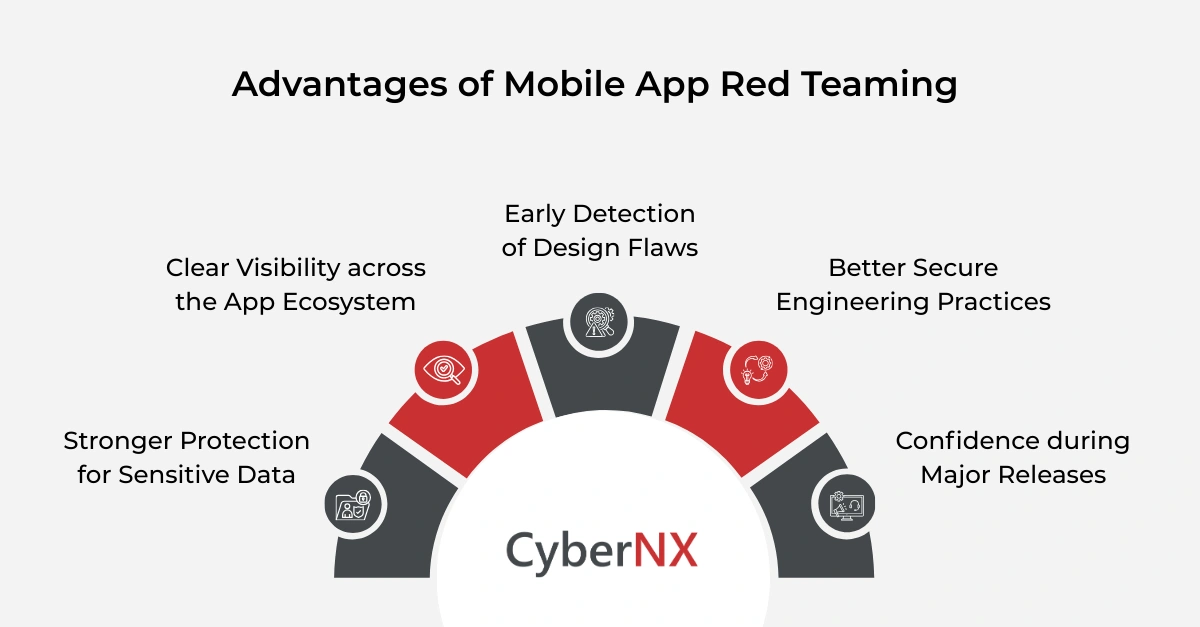
- Stronger protection for sensitive data: The exercise reveals hidden data exposure. Fixing these areas protects user trust.
- Clear visibility across the app ecosystem: Leaders see how attackers move from the mobile app to backend systems. This supports sharper risk decisions.
- Early detection of design flaws: Developers gain insight into issues that normal testing misses. This leads to better engineering outcomes.
- Better secure engineering practices: Red teaming supports long-term improvement. It enhances design reviews and coding habits.
- Confidence during major releases: Teams gain assurance before entering new markets or scaling user bases.
Trends shaping mobile security today
Mobile environments change quickly. Security leaders need to track shifts that influence iOS and Android risk.
1. Growth in automated mobile fraud
Automation now supports credential stuffing, session abuse and behavioural manipulation. Detection becomes harder.
2. Increasing supply chain exposure
Apps depend on external SDKs. Weak SDKs create exposure across both iOS and Android environments. Red teaming validates these dependencies.
3. Expansion of mobile-first identity
More organisations use mobile-first verification. Attackers often target these flows first.
How CyberNX supports your mobile security goals
CyberNX works with your team to simplify mobile security. Our experience across iOS and Android ecosystems helps organisations strengthen their defences without slowing delivery. We focus on clear insights, practical remediation and continuous improvement.
With CyberNX, you receive:
- Skilled red team specialists
- Clear, actionable reporting
- Guidance for developers and architects
- Support for long-term improvement
Each step contributes to stronger and more resilient mobile applications.
Conclusion
Mobile apps carry trust. They store sensitive data and support business-critical actions. Leaders need confidence that their iOS and Android applications can withstand real threats. Mobile application red teaming provides that confidence. It reveals hidden risks. It strengthens the full ecosystem and helps teams grow stronger with every release.
If you want to uncover real-world risks early and improve your mobile security posture, our team is ready to support your next steps. Book a red teaming consultation with us today.
Mobile application red teaming FAQs
How often should organisations conduct mobile application red teaming?
Most organisations run yearly assessments, while high-risk or rapidly evolving apps may require more frequent reviews. Continuous monitoring of major feature releases can also help maintain a strong security posture.
Will red teaming disrupt our iOS or Android environment?
Tests are conducted in a controlled, pre-approved manner, and high-impact checks are carefully coordinated to prevent disruption. Teams often use isolated builds or staging environments to ensure business continuity during the exercise.
Which types of mobile apps gain the most value?
Apps handling payments, identity flows, personal data, or regulated information benefit the most. Any application that processes financial transactions or integrates with third-party services gains deeper insights from adversarial testing.
How is mobile red teaming different from penetration testing?
Penetration testing focus on identifying known issues and technical vulnerabilities. Red teaming examines real attacker behaviour across the entire ecosystem – mobile app, APIs, cloud backend, authentication flows, and user interaction – to reveal systemic weaknesses and exploit paths that traditional testing may miss.