Log data grows quietly at first. Then suddenly, it becomes overwhelming.
Security teams tell us the same story. Storage costs rise faster than budgets. Performance drops as data ages. Compliance teams ask for year-old logs that take hours, sometimes days, to retrieve. Meanwhile, analysts still need fast access to recent data for investigations.
A long-term log storage strategy is no longer just an infrastructure concern. It directly affects detection quality, investigation speed, and regulatory confidence. This is why many organisations now look at log storage strategy using Elastic ELK stack as a foundation for modern security and observability.
In this blog, we break down how to design a sustainable, searchable, and cost-aware log storage approach using Elastic. One that supports growth, audits, and real-world security operations without unnecessary complexity.
Why long-term log storage needs a rethink
Before diving into architecture, it helps to understand why traditional approaches struggle.
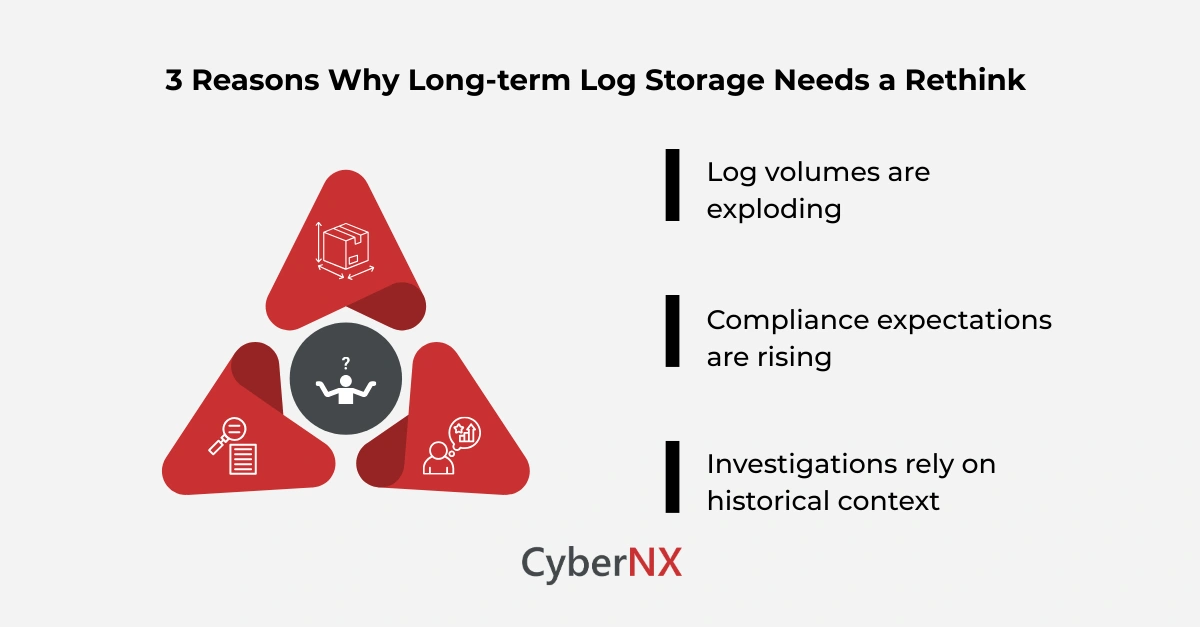
1. Log volumes are exploding
Cloud adoption, SaaS tools, endpoints, APIs, and identity platforms generate logs continuously. Retaining everything in high-performance storage is neither realistic nor necessary.
2. Compliance expectations are rising
Regulations increasingly require 180 to 365 days of log retention. Some sectors demand even longer. The challenge is not just storing logs but being able to search them during audits or incidents.
3. Investigations rely on historical context
Threat actors often move slowly. Without historical data, security teams lose visibility into early indicators of compromise. A modern strategy balances cost, performance, and searchability. Elastic ELK stack is well suited for this balance when designed thoughtfully.
Understanding the Elastic ELK stack for log storage
Elastic ELK stack consists of three core components.
- Elasticsearch: Elasticsearch is the core data store and search engine. It indexes log data and enables fast queries, even at massive scale.
- Logstash and Beats: Logstash and Beats handle data ingestion. They normalise, enrich, and route logs into Elasticsearch.
- Kibana: Kibana provides dashboards, searches, and visual analytics for security, operations, and compliance teams.
Together, they create a flexible platform where storage decisions can evolve over time without re-architecting everything.
Designing log retention by data value, not age alone
A common mistake is treating all logs the same. Classify logs by usage. Not all data needs the same performance.
High-value logs include authentication events, security alerts, cloud control plane activity, and endpoint telemetry. These require fast search and correlation. Lower-value logs may include verbose application debug logs or network flow records rarely queried after a few weeks.
Elastic allows you to design retention based on how data is used, not just how long it exists.
Elastic data tiers: the backbone of long-term storage
Elastic uses a tiered storage model that aligns cost with access patterns.
- Hot tier: This tier stores recent data. It uses high-performance storage optimised for indexing and frequent queries. Analysts and SOC teams primarily work here.
- Warm tier: Warm data is queried less frequently but still needs reasonable performance. Storage costs drop while search remains effective.
- Cold tier: Cold tier supports large volumes of older data at significantly lower cost. Searches may be slower, but data remains available.
- Frozen tier with searchable snapshots: This is where Elastic becomes particularly effective for long-term retention. Searchable snapshots store data in low-cost object storage while keeping it queryable.
Instead of rehydrating archives, teams can search years of data directly. This dramatically reduces storage costs without sacrificing audit readiness.
Building a practical long-term log storage workflow
A good strategy is not just about tiers. It is about lifecycle.
Step one: define retention policies
Decide how long each log category remains in hot, warm, cold, and frozen tiers. Security logs may stay searchable for a year. Application logs may move to frozen storage after 30 days.
Step two: automate lifecycle management
Elastic Index Lifecycle Management automates data movement between tiers. Once defined, it runs quietly in the background.
This reduces manual effort and prevents storage surprises.
Step three: validate search performance
Regularly test searches on older data. Make sure audit queries and incident investigations work as expected.
Long-term storage is only useful if it remains accessible when needed.
Cost optimisation without losing visibility
Storage cost is often the biggest concern for leadership. Elastic addresses this in several ways.
Searchable snapshots reduce reliance on expensive disks. Compression and efficient indexing lower footprint. Tiering ensures premium storage is reserved for data that truly needs it. From our experience, organisations often reduce log storage costs by 40 to 60 percent after moving to a tiered Elastic design.
Compliance and audit readiness with Elastic
Compliance teams care about two things. Retention and retrievability. Elastic supports both, but it requires planning.
- Meeting retention requirements: Searchable snapshots enable multi-year retention without ballooning costs. This aligns well with frameworks that require long-term evidence.
- Supporting audits: While Elastic does not ship with as many prebuilt compliance templates as some traditional tools, it excels in flexibility. Dashboards can be tailored to regulatory language and internal audit workflows.
For organisations with complex or evolving compliance needs, this adaptability becomes an advantage.
Security investigations across long time ranges
Threat hunting often requires historical context. Elastic’s federated search capabilities allow analysts to query across clusters and tiers without moving data. Investigations remain consistent whether data is days or months old. This continuity improves detection confidence and reduces blind spots.
When Elastic ELK stack fits best
Elastic is particularly effective for organisations that:
- Handle large and growing log volumes
- Operate across hybrid or multi-cloud environments
- Need flexible retention without rigid licensing
- Value transparency and customisation
For teams willing to invest in good design upfront, Elastic scales smoothly over time.
This is why many organisations now anchor their observability and security roadmap around log storage strategy using Elastic ELK stack rather than static, archive-heavy models.
Conclusion
Long-term log storage is no longer about keeping data somewhere safe. It is about keeping it useful.
Elastic ELK stack provides the tools to balance cost, performance, and compliance through tiered storage, searchable snapshots, and lifecycle automation. When designed well, it supports investigations, audits, and growth without constant rework.
At CyberNX, we help teams design Elastic architectures that match real operational needs, not just reference diagrams. If you are planning to scale log retention or reduce storage cost, we are happy to help.
Talk to our experts for a Elastic Stack Consulting and we will create a roadmap built for the long term.
Log storage strategy using Elastic ELK Stack FAQs
How long can logs be retained in Elastic?
With searchable snapshots, logs can be retained for multiple years on low-cost object storage while remaining searchable.
Does long-term storage impact search speed?
Older data may be slower to query, but it remains usable for audits and investigations without rehydration.
Is Elastic suitable for regulated industries?
Yes. With proper design, Elastic supports regulatory retention and audit needs across finance, healthcare, and public sector.
Can Elastic replace separate log archiving tools?
In many cases, yes. Searchable snapshots reduce the need for standalone archive platforms.