
Modern security operations need to reach a certain level of maturity to be truly effective. To pursue this objective, indicators alone do not help SOC leaders anymore. Threat intelligence has emerged as a key distinction which adds context and meaning to suspicious activity. It links alerts to known attackers, campaigns, and techniques.
This is why integrating threat intelligence into CrowdStrike NG-SIEM changes the game. By doing this, your Security Operations Centre gains stronger visibility. In addition, analysts move faster, investigations become clearer and decisions become more confident.
Our experience working with enterprise security teams shows that the right intelligence integration helps analysts focus on what truly matters. Let’s explore how this integration works and why it matters.
Why threat intelligence matters in modern SIEM platforms
First thing first, businesses are utilizing plethora of digital technologies in the increasingly digitized society. As a result, security tools generate massive telemetry. SOC teams keeping getting logs from endpoints, cloud services, identity platforms, and applications – all of which flow into SIEM platforms. But without context, these logs often appear as isolated events.
This is where threat intelligence transforms these raw signals into meaningful insights. It connects suspicious behaviour with known adversaries, malicious infrastructure, and emerging attack techniques. Instead of reacting to isolated alerts, security teams gain a clearer view of attacker intent.
When threat intelligence feeds directly into CrowdStrike NG-SIEM, detection becomes far more precise. Analysts no longer ask, “Is this suspicious?” They ask, “Which threat actor could be behind this?” That shift dramatically improves security operations.
How threat intelligence integrates with CrowdStrike NG-SIEM
CrowdStrike NG-SIEM is designed for high-speed analytics and unified visibility. Integrating threat intelligence expands its detection capability.
1. Threat intelligence feeds
External and internal threat intelligence feeds provide Indicators of Compromise such as malicious IP addresses, domains, file hashes, and attacker infrastructure.
Once integrated, these indicators are continuously compared against incoming telemetry in CrowdStrike NG-SIEM.
If a match appears, the system immediately flags the activity for investigation.
2. Real time enrichment
Threat intelligence also enriches security alerts. Instead of showing a basic indicator, alerts include context such as associated threat actors, known campaigns, and attack techniques.
This enrichment allows analysts to understand the potential severity of an event within seconds.
3. Automated correlation
Modern SIEM platforms thrive on correlation. When threat intelligence integrates with CrowdStrike NG-SIEM, events can be correlated with behavioural patterns and known adversary tactics.
This allows the SOC to detect multistage attacks that might otherwise go unnoticed.
Key benefits of integrating threat intelligence
Security leaders often ask whether intelligence integration truly improves operational efficiency. In practice, the benefits are immediate and measurable.
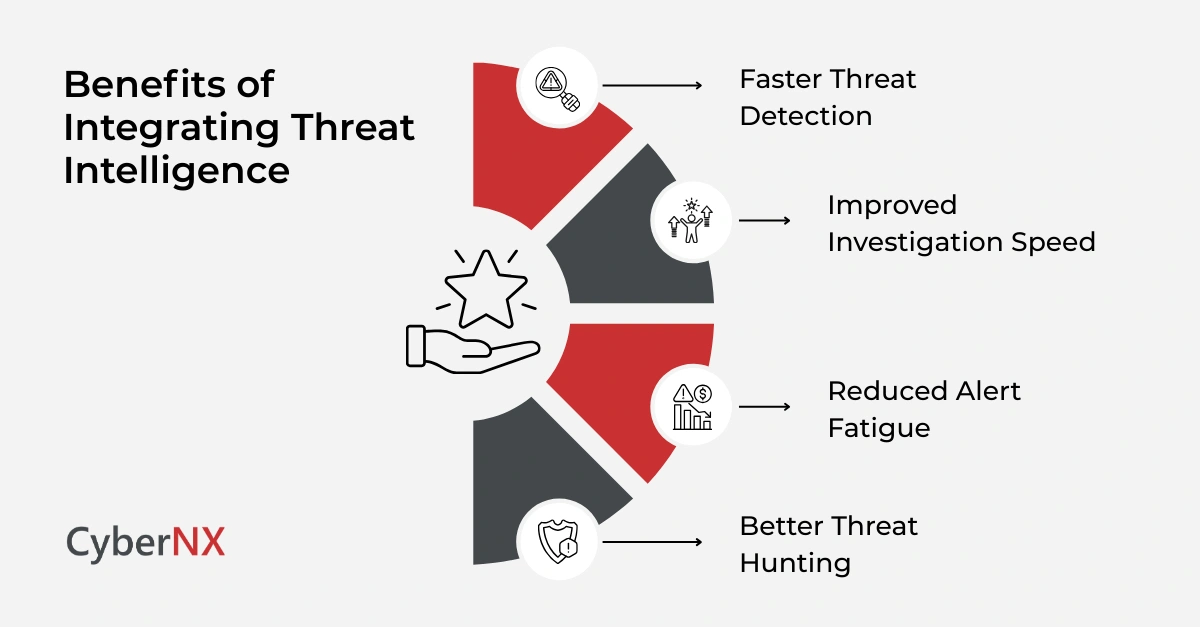
1. Faster threat detection
Threat intelligence accelerates detection by identifying known malicious infrastructure the moment it appears within network activity. Analysts spend less time validating indicators and more time investigating real threats.
2. Improved investigation speed
Investigations move quickly when alerts contain rich intelligence context. Instead of manually researching IP addresses or domains, analysts see threat reputation and attacker links directly within CrowdStrike NG-SIEM dashboards. This shortens investigation timelines and improves SOC productivity.
3. Reduced alert fatigue
SOC teams regularly struggle with alert overload. Threat intelligence helps prioritise alerts based on known malicious activity. When integrated properly, CrowdStrike NG-SIEM surfaces alerts tied to credible threats first. This reduces noise and allows teams to focus on meaningful incidents.
4. Better threat hunting
Threat hunters benefit greatly from intelligence driven insights. They can search historical logs for indicators linked to active threat campaigns. This often reveals attacker activity that occurred before detection rules were triggered. The result is deeper visibility across the enterprise environment.
Emerging trends in intelligence driven SIEM operations
Security operations are shifting toward intelligence driven detection models. Several trends are shaping this shift.
- AI assisted intelligence analysis: Machine learning models now analyse threat data to identify patterns across campaigns and infrastructure. This helps security teams identify emerging threats earlier.
- Intelligence sharing communities: Many organisations participate in intelligence sharing networks where threat indicators and attack insights are shared securely. This collaboration strengthens collective defence.
- Unified detection platforms: Platforms such as CrowdStrike NG-SIEM increasingly combine endpoint telemetry, threat intelligence, and analytics into a single ecosystem. This integration simplifies investigations and strengthens visibility across the entire attack surface.
Conclusion
Security operations depend on speed, clarity, and context. Raw telemetry alone cannot provide those advantages.
Integrating threat intelligence into CrowdStrike NG-SIEM equips SOC teams with deeper insights into attacker behaviour. Alerts gain context. Investigations move faster. Detection becomes more accurate. When implemented thoughtfully, intelligence integration turns a SIEM platform into a proactive detection engine rather than a reactive monitoring tool.
Are you looking to maximise the effectiveness of your SIEM platform? We help organisations optimise CrowdStrike deployments, integrate actionable threat intelligence, and improve SOC efficiency. Speak with our cybersecurity specialists for a CrowdStrike consultation and to explore how we can strengthen your security operations.
Integrating threat intelligence into CrowdStrike NG-SIEM FAQs
What types of threat intelligence can be integrated into CrowdStrike NG-SIEM?
Threat intelligence can include Indicators of Compromise, threat actor profiles, campaign data, malware signatures, and attacker infrastructure intelligence.
How often should threat intelligence feeds be updated?
High quality feeds typically update in near real time. Security teams should review feed relevance regularly and remove outdated indicators.
Can threat intelligence help with proactive threat hunting?
Yes. Analysts can search historical telemetry for indicators linked to known campaigns, helping uncover hidden attacker activity.
Does integrating threat intelligence increase SIEM complexity?
When implemented properly, it actually simplifies investigations. Alerts become richer and analysts spend less time performing manual research.