Artificial intelligence (AI), for too long, have been on the corridors of mystery. Everyone knew AI is coming but didn’t know when and how to use it. In the past six odd months, every business vertical on this blue planet have got their hands on the AI. From automating workflows to accelerating decision-making, AI is offering significant advantages.
But here’s some food for thought: are you adopting AI faster than you can govern it? If yes, new risks, unknown assets and expanding attack surfaces could get you in trouble.
Traditional security controls were designed for predictable applications and infrastructure. AI systems behave differently. They evolve, learn from data, interact autonomously and often rely on complex third-party ecosystems. This creates challenges that conventional security approaches cannot fully address.
To build trust in AI and reduce risk, you need a lifecycle-based AI security strategy that protects systems from development through deployment and ongoing operations.
Why AI security requires a new approach
You may have already invested in perimeter security, endpoint protection and identity controls. They are indeed important. But do they provide complete protection for AI environments? Not necessarily.
AI introduces risks across multiple stages of its lifecycle. That’s why you must understand where AI exists, how it behaves and what actions it is authorised to perform. Without visibility, organisations cannot effectively manage risk.
A lifecycle-based approach helps businesses secure AI throughout four critical phases:
- AI sourcing and procurement
- AI development and testing
- AI deployment and operations
- User interaction and governance
This broader perspective enables organisations to identify vulnerabilities before they become business problems.
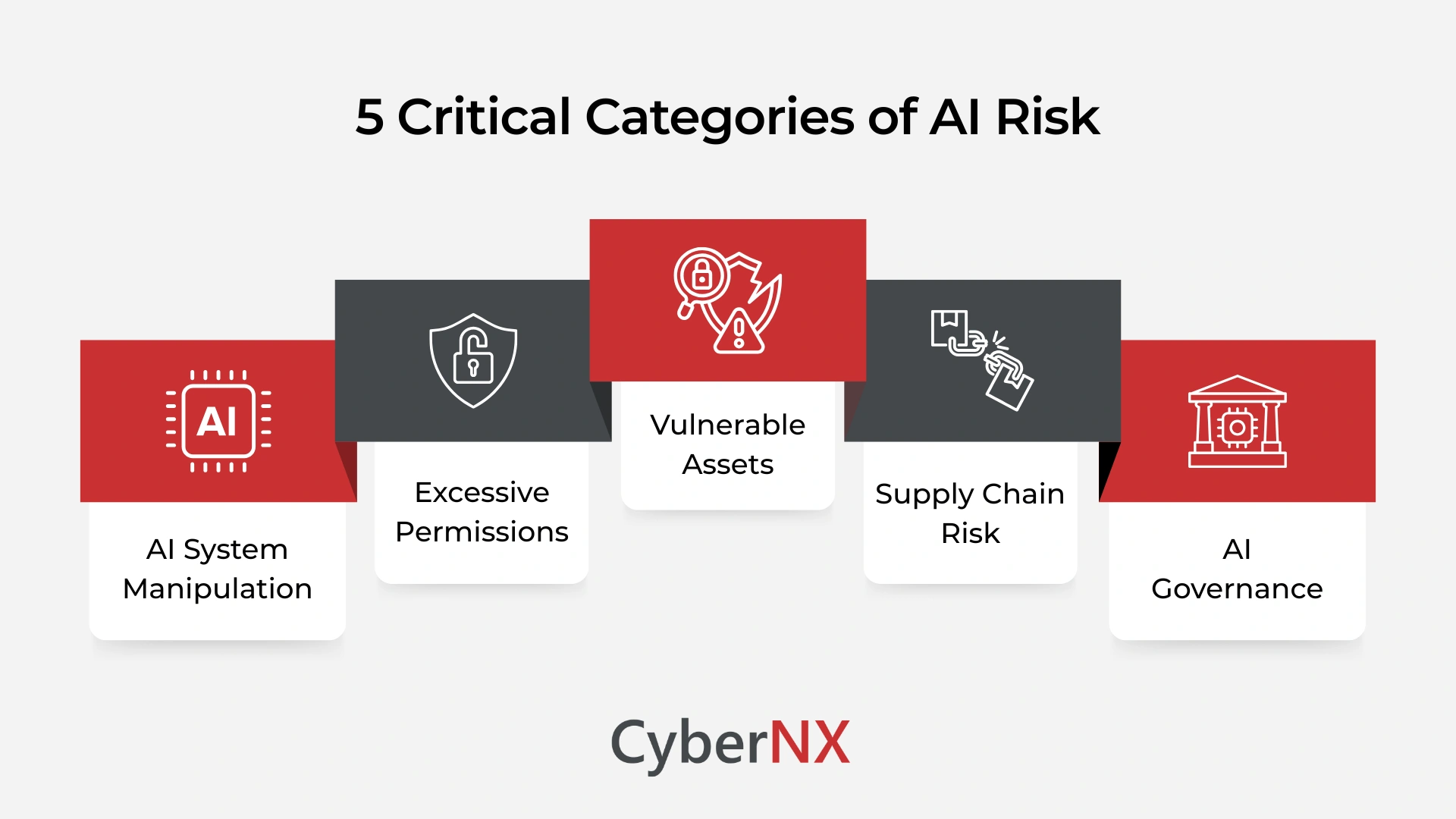
The five critical categories of AI risk
Effective AI security starts with understanding the primary threats organisations face today.
1. Defending against AI misuse
AI systems can be manipulated through techniques such as prompt injection, jailbreak attacks and malicious inputs designed to influence model behaviour. Attackers may attempt to:
- Extract sensitive information
- Bypass safety controls
- Generate harmful or misleading outputs
Security teams should continuously test AI systems against these attack methods and establish guardrails to limit unauthorised behaviour.
2. Monitoring autonomous AI agents
Many organisations are deploying AI agents that can take actions, interact with applications and make decisions with limited human involvement. While these capabilities improve efficiency, they also increase risk. An autonomous agent with excessive permissions can access sensitive systems, modify data or trigger unintended actions.
Continuous monitoring is essential to ensure AI agents operate within approved boundaries.
3. Protecting AI development infrastructure
AI development environments often contain valuable intellectual property, training datasets and model configurations. Threat actors increasingly target:
- Source code repositories
- Model training environments
- Development pipelines
- Cloud infrastructure
Securing these assets requires strong access controls, vulnerability management and ongoing monitoring throughout the development process.
4. Securing the AI supply chain
AI systems rarely operate in isolation. They depend on external models, datasets, APIs and open-source components. Each dependency introduces potential risk. Without proper oversight, organisations may unknowingly incorporate vulnerable or compromised components into production environments. Supply chain visibility is therefore a fundamental requirement for AI security.
5. Strengthening governance and oversight
Technology alone cannot solve AI security challenges. Organisations need governance frameworks that establish accountability, define acceptable use and ensure compliance with regulatory requirements. Strong governance creates consistency across departments and reduces the likelihood of unmanaged AI adoption.
The growing challenge of shadow AI
One of the biggest risks facing organisations today is Shadow AI. Employees are increasingly using public AI tools without approval from IT or security teams. Research shows that approximately 78% of users bring their own AI tools into the workplace. While often well-intentioned, these activities can expose:
- Customer information
- Financial records
- Intellectual property
- Proprietary source code
Many employees do not fully understand how data submitted to public AI platforms may be stored, processed or reused. This makes governance policies critical.
Detecting unsanctioned tools is only the first step. Organizations also need a way to enforce controls at the point of use. Solutions that focus on securing AI usage across the workforce give teams visibility into prompts and uploads while blocking sensitive data from leaving the organization.
Building Effective AI Governance Policies
Successful AI adoption starts with clear organisational policies. Every organisation should establish an approved list of AI applications and services. Employees must understand which tools are authorised and which are prohibited. A comprehensive AI usage policy should include:
1. Data classification requirements
Teams need clear guidance on what information can and cannot be shared with AI systems. Organisations should explicitly prohibit the submission of:
- Personally identifiable information (PII)
- Customer records
- Authentication credentials
- Restricted source code
- Confidential business information
2. Employee usage guidelines
Employees should understand acceptable use cases, approval processes and reporting procedures for AI-related incidents. Clear guidance reduces confusion and encourages responsible adoption.
3. Accountability and ownership
Business leaders, security teams and technology stakeholders must share responsibility for AI governance. Cross-functional collaboration improves decision-making and accelerates risk management.
AI security best practices to follow
Organisations seeking secure AI adoption should focus on the following practices.
1. Adopt a cross-functional security model
AI security is not solely a security team responsibility. SecOps, DevOps, engineering, legal and governance teams should work together throughout the AI lifecycle.
2. Create an AI Bill of Materials (AI-BOM)
An AI-BOM provides a complete inventory of AI components, models, datasets, frameworks and dependencies. This visibility helps security teams identify vulnerabilities and manage supply chain risk more effectively.
3. Implement continuous monitoring
AI systems can generate harmful outcomes even when they have not been directly compromised. Continuous monitoring helps organisations identify unexpected behaviour, policy violations and performance anomalies.
4. Automate security testing
Manual assessments alone are insufficient for modern AI environments. Automated testing enables organisations to detect vulnerabilities, configuration issues and security weaknesses before deployment.
5. Identify attack paths early
Security teams should evaluate how attackers might move through AI environments and supporting infrastructure. Finding attack paths before production significantly reduces risk exposure.
6. Extend security beyond the model
AI security must include the broader ecosystem. Applications, APIs, databases and infrastructure supporting AI systems require the same level of protection as the models themselves.
7. Strengthen identity and access management
Least privilege access remains one of the most effective security controls. AI systems, developers and autonomous agents should only receive permissions necessary for their specific roles.
8. Deploy data loss prevention controls
Data Loss Prevention (DLP) solutions help prevent sensitive information from being exposed through prompts, integrations and API interactions. DLP provides an additional layer of protection against accidental or intentional data leakage.
Infrastructure security still matters
The excitement surrounding AI can sometimes distract organisations from basic security fundamentals. However, many AI-related breaches originate from weaknesses in underlying infrastructure rather than the models themselves. Businesses should maintain strong security hygiene across:
- Virtual machines
- Containers
- Cloud environments
- Databases
- Network infrastructure
Consistent patching, configuration management and vulnerability scanning remain essential for reducing overall risk.
Conclusion
AI presents enormous opportunities for innovation, efficiency and business growth. However, rapid adoption without proper governance introduces significant security risks. Organisations must move beyond traditional security models and adopt a lifecycle-based AI security framework that covers development, deployment, operations and user interactions.
By combining strong governance, continuous monitoring, AI supply chain visibility, identity controls and employee awareness, businesses can confidently embrace AI while maintaining security and accountability. At CyberNX, we help organisations build practical AI security strategies that support innovation without compromising trust, compliance or resilience. Planning to scale AI across your organisation? Speak with our experts to assess your AI security posture, identify hidden risks and build a governance framework that enables secure and responsible AI adoption.
FAQs
What is an AI Bill of Materials (AI-BOM)?
An AI-BOM is a documented inventory of all components that make up an AI system, including models, datasets, APIs, frameworks and third-party dependencies. It helps organisations improve visibility and manage supply chain risk.
How does prompt injection affect AI security?
Prompt injection is an attack technique that manipulates AI inputs to bypass controls, expose sensitive information or alter model behaviour. It is one of the most common threats affecting generative AI systems.
What is Shadow AI and why is it dangerous?
Shadow AI refers to employees using unapproved AI tools without organisational oversight. This can lead to data leakage, compliance violations and exposure of confidential business information.
How does the NIST AI Risk Management Framework support AI security?
The NIST AI Risk Management Framework provides guidance for identifying, assessing and managing AI-related risks. It helps organisations establish governance processes and improve trust in AI systems.