A digital risk monitoring program continually scans the entire digital footprint – from on-premises systems to cloud, supply chain, and social media – to detect and respond to emerging threats. In the increasing hybrid environments, risks extend beyond traditional perimeters, and continuous monitoring is essential.
The program’s objectives include early detection of cyberattacks, fraud, data leaks, and compliance violations, minimizing business impact, and aligning with risk frameworks. Key elements are a well-defined risk taxonomy, prioritized use cases (e.g. credential leaks, phishing, cloud misconfig), diverse data sources (endpoints, logs, APIs, threat feeds, dark web), and layered detection methods (rules, ML/UEBA, threat intelligence).
Learning how to build a digital risk monitoring program from scratch will help you shift from reactive defence to continuous awareness. A well-designed programme gives early signals of threats like credential leaks, phishing attempts, or cloud misconfigurations.
Set program objectives and scope
Before you start building the strategy, set clear objectives and scope and make sure everyone inside the firm are on the same page.
Objectives
Some of the objectives can be:
- Identify and mitigate digital risks proactively
- Protect assets, data, and reputation
- Minimize incident impact
- Improve security posture over time
In addition, the objective should align with risk appetite and compliance needs.
Scope
Scope should be to monitor your entire digital footprint. This includes on-prem systems, cloud environments, SaaS, mobile apps, and third-party vendor assets. Coverage spans:
- Cybersecurity threats like malware and intrusions
- Fraud (payment/identity)
- Third-party breaches
- Brand impersonation
- Data privacy violations
- Supply-chain disruptions
- Cloud misconfigurations
- Shadow IT
- Social engineering (phishing, BEC)
- Regulatory compliance gaps
Taxonomy of digital risks
Digital risks fall into distinct categories (with examples):
- Cybersecurity Threats: Malware infections, network intrusions, zero-day exploits, insider threats.
- Fraud: Financial fraud (e.g. fake transactions), phishing-based credential theft, account takeovers.
- Third-Party/Vendor Risk: Compromises or misconfigurations in suppliers or partners that impact the organization.
- Brand/Reputation: Online impersonation or hijacking of company domains, logos, or social media accounts; negative social media campaigns.
- Data Privacy: Unsecured sensitive data (PII, IP) exposed via breaches, leaks, or cloud misconfigurations, violating privacy laws.
- Supply Chain Risk: Attacks on products/services supply chain (e.g. malicious code in software updates, supplier outages).
- Cloud/Configuration: Misconfigured cloud storage/services (e.g. open S3 buckets), excessive privileges, or weak cloud controls.
- Shadow IT: Use of unauthorized hardware/software (e.g. employee-run cloud instances) that evade official controls.
- Social Engineering: Phishing, spear-phishing, vishing, or impersonation targeting employees or executives.
- Regulatory/Compliance: Non-compliance with laws/regulations (e.g. GDPR, PCI DSS) due to discovered weaknesses or incidents (e.g. failing to encrypt customer data).
These categories overlap (e.g. an insider exfiltrating data might be both a cybersecurity and privacy risk). Monitoring should catch credential compromises, brand impersonations, data leaks, executive targeting, vendor vulnerabilities, and fraud. The program registers and tracks risks across all these categories, enabling a unified view of organizational exposure.
Digital risk monitoring deployment models
Digital risk monitoring can be deployed using different models, each suited to specific business needs and constraints.
1. On-Premises
SIEM and analytics run within the organisation’s data centre. This offers full control and customisation, ideal for regulated sectors. However, it involves high infrastructure costs, ongoing maintenance, and limited scalability.
2. Cloud-Based
Delivered as SaaS, cloud solutions enable rapid deployment, scalability, and reduced operational effort. They integrate easily with cloud platforms but come with recurring costs and vendor dependency.
3. Hybrid
A balanced approach where sensitive data stays on-prem while analytics leverage the cloud. It combines control with scalability and is widely adopted by modern enterprises.
Governance, roles, and operations
A robust governance structure ensures the program’s success:
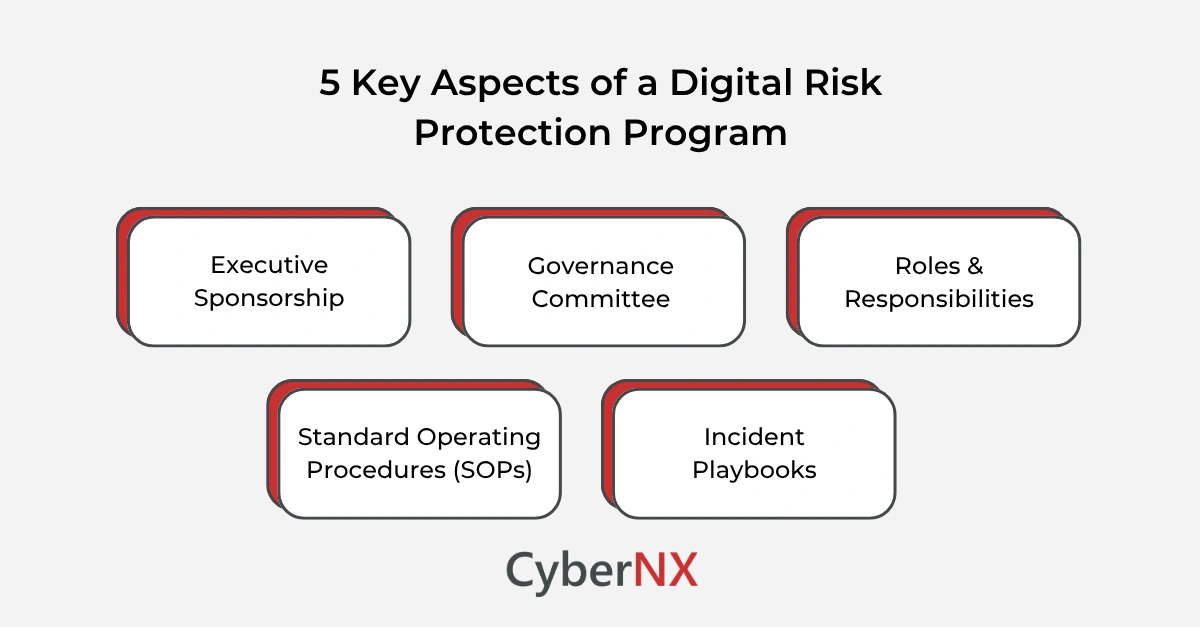
1. Executive sponsorship
A senior leader (often the CISO or Head of Risk) sponsors the program. The board or C-suite should receive regular briefings with business-focused metrics (see KPIs below).
2. Governance committee
A steering committee or Risk Steering Group (CISO, IT, Legal, Privacy, HR, Compliance, and key business reps) oversees policy, budget, and risk tolerance. They define program charter, scope, and priorities.
3. Roles & Responsibilities
Key roles include a Program Manager, SOC Lead, Incident Response Lead, Third-Party Risk Manager, Privacy/Legal, DevOps engineers, and business liaisons. Each ensures monitoring, response, compliance, and integration. A RACI matrix defines ownership, while governance establishes policies, incident definitions, and change control for adding new monitoring capabilities.
4. Standard Operating Procedures (SOPs)
Document how alerts are handled. Define SLAs for response (e.g. critical incidents triaged within 1 hour) and escalation paths (e.g. when legal or PR must be involved).
5. Incident Playbooks
Pre-defined, step-by-step guides for common scenarios (ransomware attack, data breach, fraud attempt, brand spoofing, etc.) that outline detection cues, communication plans, containment steps, and responsibilities. Playbooks are living documents that incorporate lessons learned.
Prioritized monitoring use cases
Key monitoring use cases are chosen based on likely impact and feasibility. Examples include:
- Credential Leak Detection: Scan dark web forums and paste sites for stolen corporate credentials or personal data.
- Phishing/Domain Abuse: Detect look-alike domains, phishing kits, or apps mimicking company brands on web and app stores.
- Malware/Infrastructure Compromise: Monitor network/IDS logs for malware behaviour, ransomware indicators, or unexpected external communications.
- Data Exfiltration: Use DLP and database logs to spot large data transfers or queries of sensitive data.
- Privilege Misuse: Analyse identity/authentication logs (SSO, VPN, cloud identities) for anomalous access patterns (e.g. impossible travel or high-risk login times).
- Cloud Misconfiguration: Regularly audit cloud configurations (S3 buckets, security groups, IAM roles) to find overly permissive settings.
- Shadow IT Discovery: Network traffic analysis and proxy logs to identify unauthorized SaaS or unmanaged devices/VMs on the network.
- Social Media & OSINT Monitoring: Watch public social media and forums for leaked product info, disgruntled employee posts, or malware strain chatter.
- Third-Party Breach Alerts: Track threat intelligence feeds for incidents involving key vendors/suppliers.
- Fraudulent Transactions: For e-commerce or finance, monitor transactions against anomaly patterns (e.g. duplicate accounts, rapid card changes).
Use cases are prioritized by risk level, business impact, and regulatory focus.
Phased implementation roadmap
Implement the program in stages, each with clear milestones and resources. Each phase has resource needs:
- Phase 1: Project leads, risk analysts, budgeting (costs still “unspecified” until vendor quotes are available).
- Phase 2: Security architects, engineers (for deployments), vendor support.
- Phase 3: SOC analysts and test users to validate coverage.
- Phase 4: All relevant staff trained; expand monitoring to all business units.
- Phase 5: Ongoing. Budget depends on chosen tools (e.g. SIEM licensing by data volume, XDR by endpoints).
If budget estimates aren’t yet defined, denote as TBD during initial planning; ROI can be justified by reduced incident costs.
Conclusion
Building a digital risk monitoring program requires clear objectives, structured governance, and continuous improvement. When done right, the programme becomes a central layer of defence. It connects visibility, detection, and response across the organisation.
Looking to build or enhance your digital risk monitoring capabilities? Connect with CyberNX for a tailored consultation and take a confident step towards stronger, continuous security.
How to build a digital risk monitoring program from scratch FAQs
How long does it take to build a digital risk monitoring program?
It depends on scope and maturity. A basic programme can take a few months, while enterprise-wide implementations may take longer.
What is the difference between SIEM and digital risk monitoring?
SIEM focuses on internal logs and events. Digital risk monitoring extends beyond to include external threats, third-party risks, and brand exposure.
How do you prioritise risks in digital monitoring?
Risks are prioritised based on business impact, likelihood, and regulatory requirements.
Can small organisations implement digital risk monitoring?
Yes. Starting with focused use cases and scalable tools allows smaller organisations to build effective programmes over time.