

For a long time, digital risk protection was considered necessary only by sectors like BFSI and healthcare. Primarily because of the sensitive data they captured for effective operations.
However, as the digital adoption accelerates across sectors, attack surfaces have also expanded in tandem. As a result, the gap between detection and exploitation has narrowed to hours, sometimes minutes. This creates a clear challenge. Digital risk protection must now become a core function rather than an isolated layer. It should now be tightly connected with identity, threat intelligence, and incident response.
In this guide, find key trends in digital risk protection shaping up in 2026 and what they mean for your security strategy.
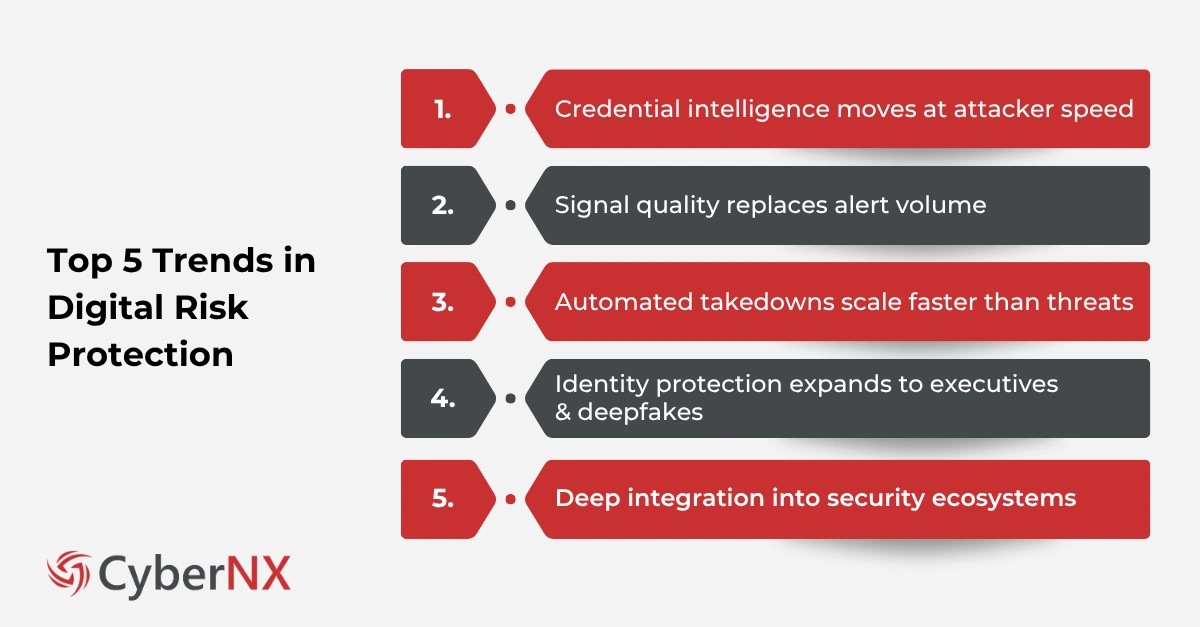
Credential intelligence moves at attacker speed
Credential theft is not new. What has changed is the speed at which stolen data becomes usable. Security researchers observed that stealer malware campaigns were leaking millions of credentials daily. According to one industry report, over 24 billion credentials are circulating across underground markets, with fresh data appearing in near real time. This has pushed trends in digital risk protection towards rapid credential intelligence.
1. Real-time ingestion and response
Modern DRP platforms now ingest credential dumps within minutes of exposure. They correlate this data with enterprise identity systems and trigger immediate actions. This means compromised accounts can be:
- Disabled within hours
- Forced into password resets instantly
- Protected with step-up authentication
We have seen organisations reduce account takeover incidents simply by shrinking response time from days to hours. That alone changes the game.
Why this matters for enterprises
Attackers rarely wait. Once credentials are exposed, they are tested quickly across multiple services. If your response takes longer than theirs, the breach is almost guaranteed. This is why credential intelligence is now a leading driver in trends in digital risk protection. It aligns detection speed with attacker behaviour, not internal processes.
Signal quality replaces alert volume
Security teams are overwhelmed. That is not new. But what has changed is how DRP solutions approach the problem. Earlier, more alerts meant better visibility. In practice, it meant fatigue. Now, one of the most important trends in digital risk protection is the shift towards signal quality.
1. AI-assisted validation
Modern DRP platforms use AI to validate threats based on business relevance. Instead of flagging everything, they prioritise risks that matter most. These include:
- Exposure of privileged credentials
- Threats targeting critical infrastructure
- Brand impersonation impacting customers
This approach reduces noise significantly.
2. Context over quantity
The focus is no longer on how many alerts you receive. Today, it has shifted toward how actionable those alerts are. We often advise teams to ask a simple question: “Does this alert require action within the next 24 hours?” If the answer is no, it should not interrupt your team. This shift is redefining how trends in digital risk protection are implemented across mature security programmes.
Automated takedowns scale faster than threats
Phishing sites, fake domains, and impersonation accounts continue to grow. In 2025 alone, phishing attacks have increased globally, driven by automation and AI-generated content. Manual takedown processes simply cannot keep up. That is why automated takedowns are now a core part of trends in digital risk protection.
1. Direct platform integrations
Modern DRP solutions integrate directly with domain registrars, hosting providers and social media platforms. This allows fraudulent assets to be removed quickly, often within hours instead of days.
2. Scale and consistency
Automation brings consistency. Every identified threat follows the same validated takedown process. In our experience, you can reduce phishing site lifetimes by more than 70% using automated takedowns. That directly lowers customer risk and brand damage.
Identity protection expands to executives and deepfakes
Identity is no longer limited to usernames and passwords. It now includes voice, video, and behavioural patterns. With deepfake technology becoming more accessible, attackers are targeting executives directly. This has made identity protection one of the fastest-growing trends in digital risk protection.
1. Rise of deepfake-enabled attacks
In 2025, multiple reported incidents involved attackers using AI-generated voice clones to impersonate CEOs and authorise fraudulent transactions. Losses from such attacks crossed millions per incident in some cases. These attacks are convincing because they mimic real individuals.
2. Executive protection strategies
DRP now includes monitoring for:
- Deepfake videos and audio
- Social media impersonation
- Leaked personal data of leadership teams
We encourage organisations to treat executive identity as a critical asset. Because attackers already do.
3. A shift in mindset
Security leaders must expand their definition of identity risk. It is no longer just about login credentials. It is about protecting digital presence across all channels. This broader view is shaping DRP trends in 2026.
Deep integration into security ecosystems
Digital risk protection used to operate in isolation. Alerts were generated externally and handled manually. That model no longer works. One of the most impactful trends in digital risk protection is deep integration into existing security systems.
1. Connected workflows
Modern DRP platforms integrate with SOC tools, identity and access management systems and SOAR platforms. This allows external threat intelligence to trigger internal controls automatically. For example, if stolen credentials are detected, access can be revoked instantly, MFA can be enforced and sessions can be terminated – all without manual intervention.
2. Faster response, lower risk
This integration reduces response time dramatically. It also ensures consistency in how threats are handled. We have seen organisations cut incident response times by more than half after integrating DRP into their SOC workflows.
3. From visibility to action
Visibility is useful. But action is what reduces risk. This shift from passive monitoring to active defence is central to trends in digital risk protection today.
Conclusion
Trends in digital risk protection in 2026 show a clear direction. Speed, intelligence, and integration are no longer optional elements but expected.
From real-time credential intelligence to AI-driven signal quality, and from automated takedowns to executive identity protection, the focus has shifted towards measurable impact.
We believe organisations that align DRP with their core security strategy will be better positioned to reduce risk and respond faster.
At CyberNX, we help security teams to operationalise digital risk protection in a way that fits their environment. If you are looking to strengthen your external threat visibility and response, we are here to help you take that next step with confidence. Contact us today.
Trends in digital risk protection FAQs
How is digital risk protection different from threat intelligence?
Digital risk protection focuses on external threats targeting your organisation, such as leaked credentials or phishing domains. Threat intelligence is broader and includes general attacker behaviour and tactics.
What industries benefit most from digital risk protection?
Financial services, healthcare, e-commerce, and technology companies see strong benefits due to high exposure to credential theft and brand impersonation.
How quickly should organisations respond to exposed credentials?
Ideally within hours. Delayed response increases the risk of account takeover and lateral movement within systems.
Can digital risk protection prevent phishing attacks completely?
It cannot eliminate phishing entirely, but it can significantly reduce impact by detecting and taking down malicious assets quickly.