Just like a regular health check-up is essential for your well-being, regular security assessments are important for the health of your IT systems. Vulnerability Assessment and Penetration Testing (VAPT) is your comprehensive health check for your digital infrastructure.
Cyberattacks have grown sharply in frequency and cost. Vulnerability exploitation as an initial access path grew 34% year-over-year and now drives 20% of all breaches, according to Verizon’s 2025 Data Breach Investigations Report – with Mandiant’s M-Trends 2025 confirming exploits as the single top initial infection vector at 33%. Against this backdrop, VAPT has become a business necessity.
This guide examines the types of VAPT tests available today, including emerging areas like AI and cloud-native systems – and explains the methodologies used to diagnose and fix flaws before attackers misuse them.
Types of VAPT Testing
Think of your IT infrastructure as a city. You have thriving commercial districts (web applications), residential neighbourhoods (internal networks), and vital infrastructure (cloud services). Each area requires a different kind of security. Here are the VAPT “security patrols” designed for each:
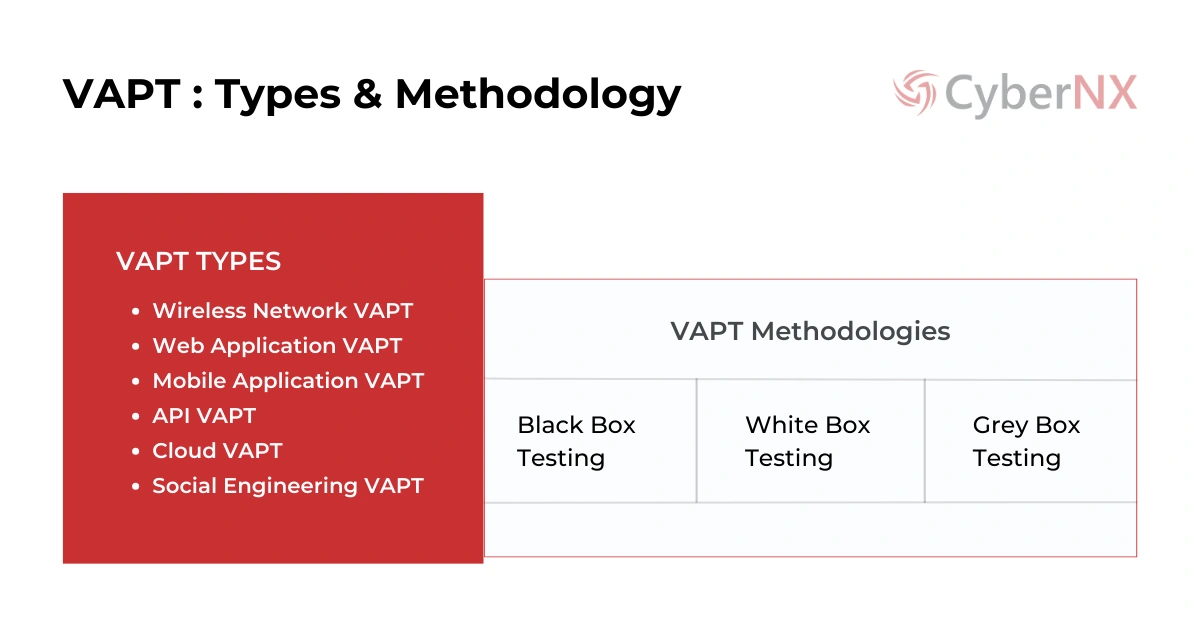
- Wireless network VAPT: Identifies vulnerabilities in Wi-Fi access points, encryption protocols, and wireless components to block unauthorized access. Modern assessments also cover WPA3 weaknesses and rogue access point detection, as wireless attacks remain a leading initial access vector.
- Web application VAPT: Assesses web apps for SQL injection, cross-site scripting (XSS), and authentication flaws. The OWASP Top 10 for Web Applications was updated in 2025 – broken access control retains its position as the #1 risk, with injection attacks and security misconfiguration also in the top tier.
- Mobile application VAPT: Tests iOS and Android apps for vulnerabilities in code, data storage, and server communication. The OWASP Mobile Top 10 (updated 2024) now focuses on inadequate supply chain security and insufficient binary protections.
- API VAPT: Focuses on the security of APIs – the backbone of modern software. Identifies flaws that could expose sensitive data or disrupt services. Broken object-level authorization (BOLA) remains the #1 API risk per the OWASP API Security Top 10.
- Cloud VAPT: Assesses cloud environments – infrastructure, platforms, and applications, for misconfigurations and compliance gaps. Misconfiguration remains the top cloud risk. Tenable’s 2025 Cloud Risk Report found that 38% of organisations have cloud workloads that are critically exposed.
- Social engineering VAPT: Simulates phishing and other human-manipulation attacks to check employee susceptibility. The 2024 Verizon DBIR found that 68% of breaches involved a human element, thus reinforcing why this remains a critical testing area.
- AI/LLM application VAPT: Tests AI chatbots, agents, and RAG-powered systems for prompt injection, insecure output handling, and data leakage. OWASP launched a dedicated LLM Top 10 list (2025 edition) as AI-specific attack surfaces have become a mainstream enterprise risk.
Curious about the tools behind VAPT? Explore our comprehensive VAPT Tools guide here!
What is VAPT Methodology? What are the Common Testing Methodologies?
Continuing with our city analogy, the type of VAPT determines which “district” we’re patrolling, but the VAPT methodology dictates how we conduct that patrol. Are we doing a quick drive-by (black box), a thorough inspection of every building (white box), or a balanced approach (grey box)?
In 2026, AI is also shaping how these methodologies are executed – with AI-powered VAPT tools now performing dynamic asset discovery, behavior-based attack emulation, and real-time risk scoring across hybrid and cloud-native environments, going well beyond what static rule-based scanners could achieve.
Here’s a breakdown of the common VAPT methodologies, each representing a different tactical approach to security assessment:
- Black Box Testing: In this VAPT methodology, the testers have no prior knowledge of the target system’s internal workings. They simulate real-world attacks, relying on their skills and tools to discover vulnerabilities. This approach is valuable for mimicking external attackers.
- White Box Testing: Testers have full access to the target system’s source code, architecture, and configurations. This allows for a more in-depth analysis and can uncover vulnerabilities that might be missed in black box testing. This VAPT methodology ideal for developers and internal security teams.
- Grey Box Testing: This is a hybrid VAPT methodology where testers have partial knowledge of the target system. They might have access to documentation or some high-level information. This approach provides a balance between the realism of black box testing and the thoroughness of white box testing.
Want to know which testing method fits your security needs best? Read our in-depth comparison of Black Box vs White Box Penetration Testing.
Choosing the Right VAPT Methodology: A Strategic Decision
Selecting the appropriate VAPT methodology is a strategic decision that depends on several factors:
- Type of Application or Network: Some systems are better suited for certain methodologies. For example, web applications often benefit from a combination of black box and white box testing.
- Level of Access and Engagement: If you’re working with an external security firm, black box testing might be the most appropriate, while internal teams can leverage white box or grey box approaches.
- Industry standards and regulatory compliance: Certain industries have specific requirements for VAPT methodologies. Make sure your chosen approach aligns with these standards.
Importance and Benefits of VAPT Testing
Every organization today, no matter how big or small, runs on digital systems. And every system – whether it’s a website, a payment gateway, or a cloud setup – has weak spots waiting to be found.
Vulnerability Assessment and Penetration Testing (VAPT) helps you find those weak spots before someone else (cybercriminals) does. It’s not about ticking a compliance box; it’s about knowing how secure your business truly is.
Here’s why VAPT testing matters:
- Finds what others miss: It digs deeper than automated scanners, revealing real-world attack paths that could put your data or reputation at risk.
- Gives you clarity, not chaos: Instead of a long list of technical flaws, VAPT testing prioritizes what actually needs fixing – saving time and resources.
- Protects what drives your business: Whether that’s customer information or proprietary data, VAPT ensures your core assets stay out of harm’s way.
- Builds confidence: When clients know you invest in regular VAPT testing, they see a partner who takes security seriously.
Simply put, VAPT testing helps you stay informed, stay secure, and stay in control – because the cost of not knowing your weaknesses is always higher.
Strengthening Your Security Posture with Strategic VAPT
VAPT is an indispensable component of a robust cybersecurity strategy. By understanding the different types of VAPT testing and methodologies used, you can tailor your security assessments to your specific needs and maximize their effectiveness. Choosing the right approach, combined with regular testing and prompt remediation, will significantly strengthen your security posture and protect your organization from evolving cyber threats.
CyberNX Technologies is a CERT-In empanelled VAPT provider covering the full spectrum – from traditional network, web application, API, cloud, and mobile testing to AI system VAPT for LLMs, agents, RAG pipelines and MCP integrations. Findings are mapped to OWASP standards and MITRE ATLAS, with compliance evidence generated for DPDPA, EU AI Act, and NIST AI RMF where applicable. Contact us today to discuss your VAPT requirements.
FAQS
Which type of VAPT is right for my organization?
The best type depends on your specific systems and applications. Web application VAPT is crucial for online businesses, while network VAPT is essential for organizations with complex network infrastructures. Cloud VAPT is a must for cloud-based environments, and so on. A comprehensive strategy often involves a combination of types.
What are the advantages and disadvantages of Black Box, White Box, and Grey Box testing?
Black Box testing simulates real-world attacks but may miss internal vulnerabilities. White Box testing offers in-depth analysis but can be time-consuming. Grey Box testing provides a balance, leveraging some knowledge of the system for efficient testing.
How do I choose the right VAPT methodology?
The right methodology depends on factors like your budget, the level of access you can provide, and the type of system being tested. A combination of methodologies is often the most effective approach.
What is Social Engineering VAPT, and why is it important?
Social Engineering VAPT assesses the human element of security by simulating attacks like phishing. It’s crucial because employees can be the weakest link in your security chain. This type of testing helps identify areas where security awareness training is needed.