You would perhaps agree that the future of digital risk protection is taking shape right in front of our eyes. AI is changing every aspect of how businesses operate, communicate, and innovate.
At the same time, it is also changing how cyber threats emerge and spread. Attackers are using AI to scale campaigns, personalise attacks, and bypass traditional controls. To counter this, security teams are responding faster with the help of AI.
This creates a clear tension. AI introduces new risks, yet it also offers powerful ways to manage them. The organisations that succeed will be the ones that understand both sides of this shift and act early.
Digital risk protection: decoding future
Digital risk protection once focused on monitoring exposed assets, detecting impersonation, and managing brand abuse. That scope has expanded and will continue to expand in the future.
Today, digital risk protection includes tracking risks across social media, dark web forums and third-party ecosystems. It is no longer just about visibility but about context and speed.
Security leaders now need to anticipate risks before they escalate with the advent of AI. AI in general and AI-driven threats will be the biggest challenge. And that will require combining threat intelligence with automation and continuous monitoring.
How AI is creating new digital risks
AI has emerged as a technology layer that is fundamentally changing how cyber threats are created and executed.
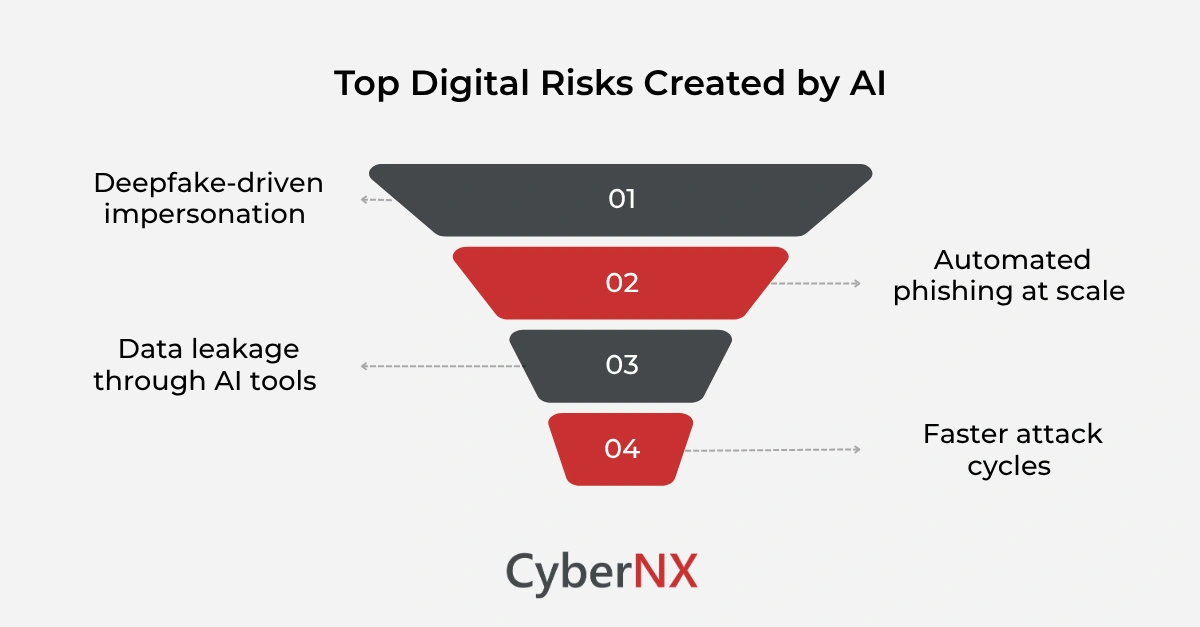
Deepfake-driven impersonation
AI-generated audio and video are making impersonation attacks far more convincing. Senior executives are being mimicked in real-time calls. Fraudsters are using these techniques to authorise payments or extract sensitive data. The risk here is not just technical. It is psychological. Employees trust what they see and hear. AI exploits that trust.
Automated phishing at scale
Phishing emails used to be easy to detect. Poor grammar and generic messaging were clear warning signs. Now, AI tools generate highly personalised messages. They analyse social media activity and craft emails that feel authentic. These campaigns scale rapidly and adapt in real time. This raises the baseline risk for every organisation.
Data leakage through AI tools
Employees are increasingly using AI tools to improve productivity. However, sensitive data is often shared with these platforms without proper controls. This creates a new category of exposure. Information that was once internal can unintentionally become part of external training datasets or logs.
Faster attack cycles
AI enables attackers to automate reconnaissance, vulnerability scanning, and exploitation. What once took days can now happen in minutes. This compresses response time and increases the pressure on security teams to act instantly.
While AI is creating novel risks, it is equipping the defenders to counter the discussed risks too. Find out how in the next section.
How AI is enhancing digital risk protection
While AI introduces new threats, it also plays a crucial role in shaping the future of digital risk protection.
Real-time threat detection
AI systems can analyse vast volumes of data across multiple sources. They identify patterns that humans might miss. This allows organisations to detect threats earlier. For example, unusual domain registrations or brand impersonation attempts can be flagged instantly.
Predictive risk intelligence
AI helps move security from reactive to predictive. By analysing historical data and threat trends, it can forecast potential attack vectors. This gives teams a chance to act before damage occurs. It also improves prioritisation, which is critical when resources are limited.
Automated response mechanisms
Responding to threats quickly is just as important as detecting them. AI-driven automation enables faster containment. For instance, phishing domains can be taken down faster. Suspicious accounts can be flagged and investigated without delay. This reduces dwell time and limits impact.
Enhanced brand and identity protection
AI tools can continuously scan digital channels for misuse of brand assets. They identify fake websites, rogue mobile apps, and social media impersonations. This helps organisations protect their reputation and maintain customer trust.
Digital risk protection: changes expected
The future of digital risk protection will be shaped by how well organisations integrate AI into their security strategy.
Converged security platforms
We expect to see platforms that combine threat intelligence, digital risk monitoring, and AI analytics into a single ecosystem. This reduces fragmentation and improves visibility.
Continuous monitoring across ecosystems
Digital risk is no longer confined to internal systems. It extends to partners, vendors, and public platforms. Future solutions will provide continuous monitoring across this entire ecosystem.
Proactive defence strategies
Organisations will shift towards proactive defence. Instead of waiting for incidents, they will actively hunt for potential risks. This mindset will define mature security programmes.
Conclusion
The future of digital risk protection is being shaped by AI in ways that are both challenging and promising. Attackers are becoming more sophisticated, but so are the tools designed to stop them.
Organisations that adapt early will gain a clear advantage. They will detect threats faster, respond more effectively, and protect their brand with confidence.
Our digital risk protection services help teams to strengthen visibility, improve response, and reduce digital risk across your ecosystem. If you are looking to build a forward-looking strategy, now is a good time to start the conversation. Contact today.
Future of digital risk protection FAQs
How does AI impact digital risk protection strategies?
AI introduces advanced threats like deepfakes and automated phishing, but also enhances detection, prediction, and response capabilities in digital risk protection.
What industries benefit most from digital risk protection?
Industries like banking, healthcare, retail, and technology benefit significantly due to high exposure to digital assets and customer data.
Is digital risk protection only about external threats?
No. It also includes internal risks such as data leakage, employee behaviour, and misuse of digital platforms.
How can organisations measure the effectiveness of digital risk protection?
Effectiveness can be measured through metrics like threat detection time, response time, incident reduction, and brand abuse mitigation.