A brand is more than a well-designed logo. It encompasses business reputation, customer trust, and many times holds a competitive edge. However, sometimes organisations end up focusing solely on legal rights, while others chase threats across digital channels without a clear structure.
This is where stakeholders can get confused in the brand risk monitoring vs trademark protection debate. The truth is both are critical, and they serve different purposes. Missing one can leave dangerous gaps.
Understanding how these two approaches work together can make a measurable difference in how well your organisation defends its identity and customer trust. Let’s understand both the concepts and move on to know how they differ.
Defining brand risk monitoring
Brand risk monitoring focuses on identifying and responding to threats that can harm your brand’s reputation, revenue, or customer trust. It is continuous, proactive, and largely digital-first. It tracks how your brand is being used across online environments. This includes social media, domains, marketplaces, and even dark web forums.
1. What does brand risk monitoring cover?
Brand risk monitoring extends far beyond simple mentions or sentiment tracking. It dives deeper into misuse and malicious activity.
- Detection of fake domains and phishing websites
- Monitoring counterfeit products on e-commerce platforms
- Identifying impersonation accounts on social media
- Tracking data leaks and credential exposure
- Spotting unauthorised use of brand assets
Each of these risks can directly impact customer trust. Even a single phishing attack using your brand name can damage years of credibility.
2. Why it matters for enterprises
Modern attackers target brands because customers trust them. That trust becomes the entry point. Organisations lose customers not due to internal failure, but because attackers misused their brand externally. Brand risk monitoring helps you detect these threats early and respond quickly. It also provides visibility. Without it, most threats remain invisible until damage is done.
3. Key benefits
Brand risk monitoring delivers both security and business value.
- Early detection of threats before they escalate
- Protection of customer trust and brand reputation
- Reduced financial loss from fraud and impersonation
- Improved visibility across digital ecosystems
Small improvements in detection speed can significantly reduce impact.
What is trademark protection?
Trademark protection is a legal framework that safeguards your brand’s identity. It gives you exclusive rights to use your brand name, logo, or slogan within specific jurisdictions. Unlike monitoring, this approach is rooted in intellectual property law.
1. What does trademark protection involve?
Trademark protection ensures your brand is legally recognised and defendable.
- Trademark registration with authorities
- Legal ownership of brand identifiers
- Enforcement through cease-and-desist actions
- Litigation against infringement
- Renewal and maintenance of trademark rights
It creates a formal structure for ownership and enforcement.
2. Why it matters for organisations
Without trademark protection, you do not legally own your brand identity. That means limited ability to act against misuse. We often advise organisations to treat trademarks as foundational. They give you the legal backing needed to take action when infringement occurs. However, legal processes can be slow. That is why relying only on trademarks creates gaps.
3. Key benefits
Trademark protection offers long-term strategic advantages such as:
- Legal ownership of brand identity
- Ability to take enforceable action against misuse
- Stronger market positioning and credibility
- Protection against competitors using similar branding
It builds a strong legal shield around your brand.
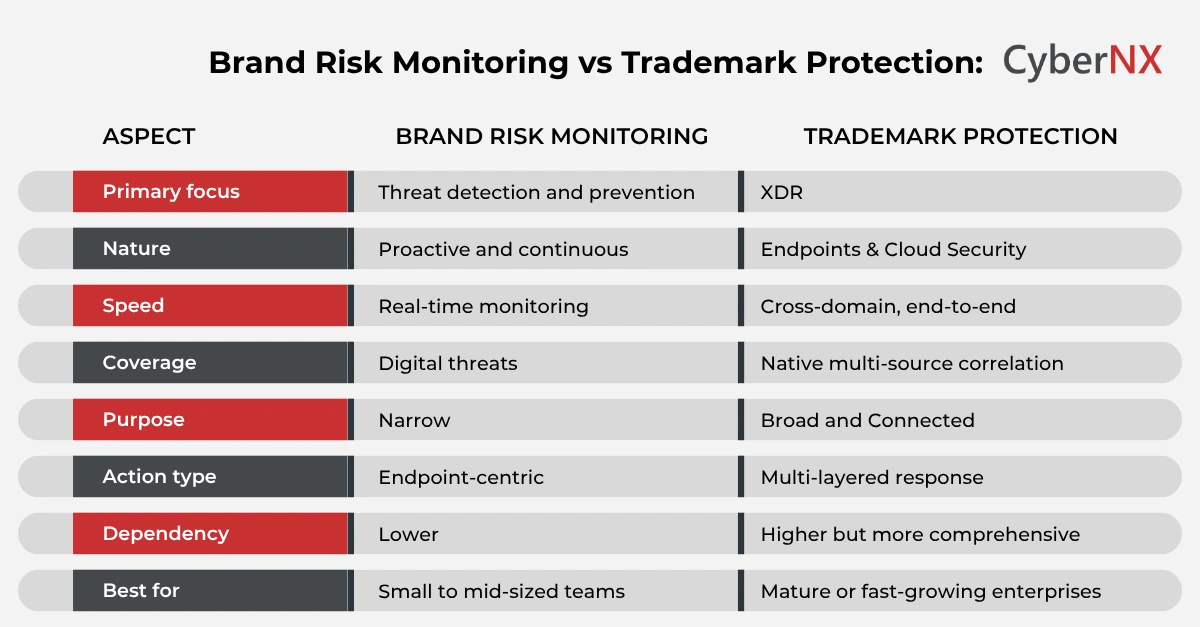
Brand risk monitoring vs trademark protection: key differences
Now that both concepts are clear, the distinction becomes easier to understand. One focuses on detection and response. The other focuses on legal ownership and enforcement.
1. Core difference in approach
Brand risk monitoring is proactive and continuous. Trademark protection is legal and reactive in many cases. Monitoring identifies threats as they emerge. Trademark protection helps you act on those threats within a legal framework.
2. Speed vs authority
Monitoring operates in real time. It can detect threats instantly. Trademark protection, on the other hand, provides authority. It allows you to take legal action, but often with longer timelines.
3. Scope of protection
Brand risk monitoring covers digital risks, impersonation, and fraud. Trademark protection focuses on ownership of brand elements such as names and logos.
Key differences at a glance
Why businesses need both approaches
Relying on only one approach creates blind spots.
If you only invest in trademark protection, you may not even know when your brand is being abused online. By the time legal action begins, the damage may already be done. On the other hand, if you only monitor risks without legal backing, your ability to act is limited. You can detect threats, but enforcement becomes difficult.
We recommend combining both strategies. Monitoring acts as your early warning system. Trademark protection gives you the authority to respond effectively. Together, they create a layered defence. One that protects both your reputation and your rights.
Conclusion
Understanding the difference between brand risk monitoring and trademark protection is not just a legal or technical exercise. It is a strategic decision.
One helps you see threats as they emerge. The other gives you the power to act. When combined, they form a strong defence that protects your brand from both immediate risks and long-term misuse. At CyberNX, help organisations to strengthen their brand protection strategies. From identifying threats early to supporting enforcement actions, we help you build a resilient and trusted brand presence.
If you are looking to strengthen your brand, connect with our experts today for a brand risk monitoring consultation. Let us help you identify risks early and protect what your business has built with confidence.
Brand risk monitoring vs Trademark protection FAQs
Can brand risk monitoring replace trademark protection?
No. Monitoring helps detect threats, but it does not provide legal ownership or enforcement rights. Both are needed for complete protection.
How often should brand risk monitoring be performed?
It should be continuous. Threats evolve quickly, and periodic checks are not enough to detect real-time risks.
Is trademark protection valid globally?
Trademark protection is usually jurisdiction-specific. You need to register trademarks in each region where you operate or plan to expand.
What industries benefit most from brand risk monitoring?
Industries with strong customer interaction such as banking, e-commerce, healthcare, and technology benefit the most due to higher risk of impersonation and fraud.