Picture your last board review: the ISO 27001 certificate is renewed and the audit closed without a major non-conformity. But then a director asks a simple question. Does this mean we are ready for the DPDP Act? The honest answer is no.
DPDPA and ISO 27001 both deal with protecting data, so they get treated as one job with two labels. They are not interchangeable. One is a law with financial penalties attached. The other is a voluntary certification proving your security management system works as designed. For Indian firms working towards the May 2027 date, that distinction decides how much work is still left.
This blog breaks down the difference between DPDPA and ISO 27001, where they overlap, the obligations your certificate leaves untouched and how to run both as one programme.
What DPDPA and ISO 27001 are built to do
DPDPA is India’s personal data protection law. It governs how organisations collect, use, store and erase the digital personal data of people in India. It gives individuals, called Data Principals, enforceable rights. It makes organisations, called Data Fiduciaries, answerable for honouring them.
ISO 27001 is the international standard for an Information Security Management System (ISMS). It tells you how to identify information risks, apply controls and keep improving them. It covers every information asset, not just personal data.
One protects the person. The other protects the asset. That single line is the foundation of most of the difference between DPDPA and ISO 27001.
Difference between DPDPA and ISO 27001
Here is how the two compare on the points that matter to a compliance owner.
| Parameter | DPDPA | ISO 27001 |
| Nature | Law, mandatory | Standard, voluntary |
| Scope | Digital personal data of people in India | All information assets in scope |
| Core focus | Lawful processing and individual rights | Risk based security controls |
| Oversight | Data Protection Board of India | Accredited certification bodies |
| Evidence | Consent records, notices, breach reports | Certificate, audit reports, risk register |
| Cost of failure | Monetary penalty | Non-conformity or withdrawn certificate |
Under the Schedule to the Digital Personal Data Protection Act, 2023, failure to take reasonable security safeguards attracts a penalty of up to ₹250 crore. A missed breach notification carries up to ₹200 crore. For a certified company, ISO 27001 nonconformities can affect certification status. Only the Board can issue a penalty order.
Where ISO 27001 already does the heavy lifting
Rule 6 of the DPDP Rules, 2025 sets a floor for reasonable security safeguards. As explained in the government’s FAQs on reasonable security safeguards, that floor includes:
- Encryption, masking or tokenisation of personal data
- Access control over the systems that process it
- Logs and monitoring to detect unauthorised access
- Log retention for a minimum of one year
- Backup and recovery so processing continues after an incident
- Contractual safeguards binding every data processor to the same standard
Read that list against ISO 27001 Annex A and the overlap is obvious. Cryptography, access management, logging, backup and supplier security are controls a certified ISMS already operates and evidences.
If your ISMS scope covers the systems that process personal data, ISO 27001 can provide proper supporting evidence for several Rule 6 safeguards. But the overlap should be validated through a control-by-control gap assessment, and not assumed.
5 DPDPA gaps ISO 27001 does not close
Security controls answer how data is protected. DPDPA asks whether you should hold that data at all. These five obligations sit outside a standard ISMS.
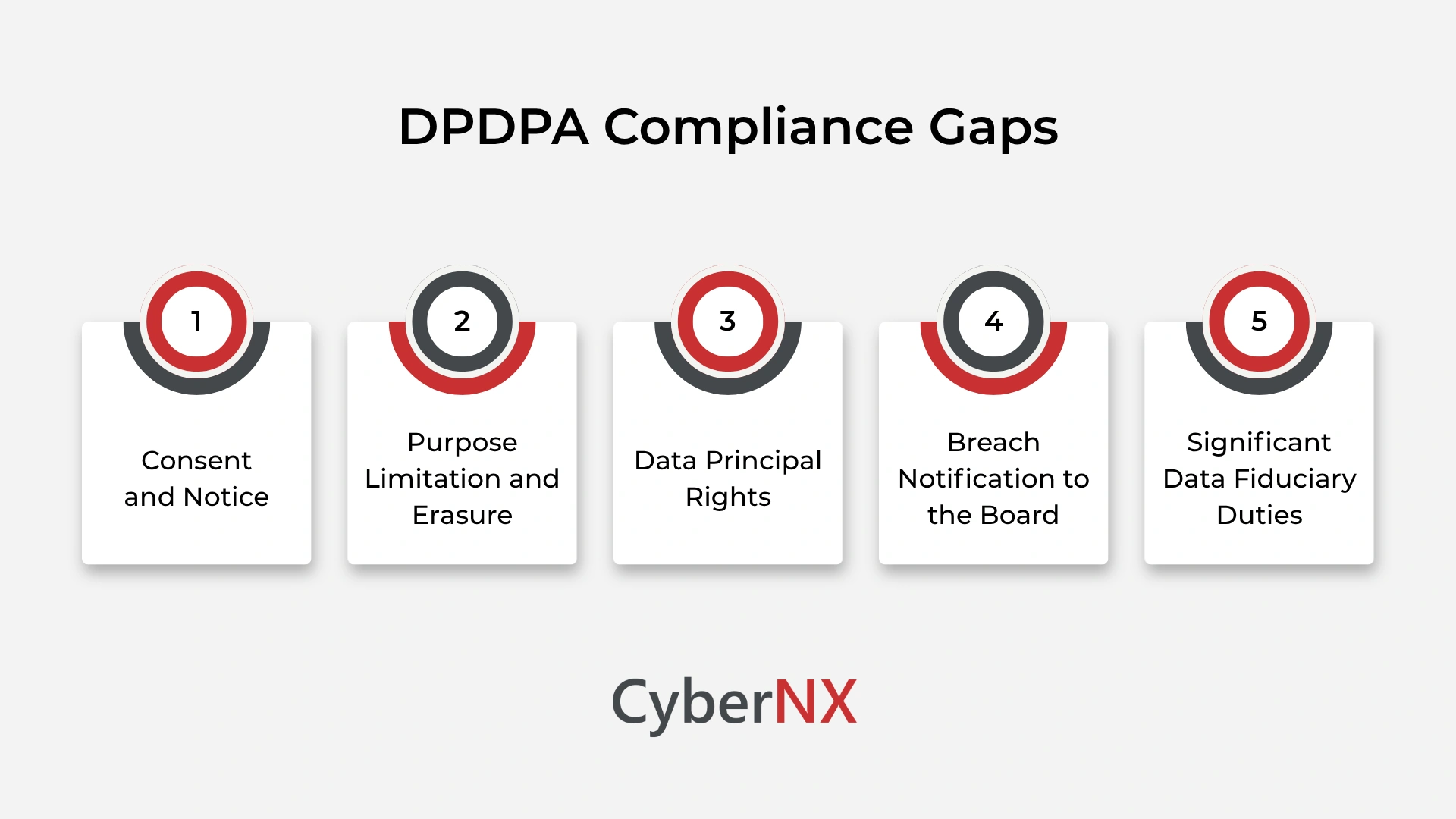
1. Consent and notice
DPDPA requires free, informed and specific consent, plus a standalone notice in plain language listing the data collected and the purpose. ISO 27001 never asks why you collected the data.
2. Purpose limitation and erasure
An ISMS is comfortable retaining data securely for years. DPDPA establishes storage-limitation and erasure obligations, which is subject to applicable legal retention requirements and the specific retention provisions in the Rules. Firms should maintain documented proof of their retention and deletion decisions.
3. Data Principal rights
Access, correction, erasure, grievance redressal and nomination all need working request workflows with defined turnaround times. Annex A has no control for this.
4. Breach notification to the Board
DPDPA notification duties run to the Data Protection Board and to every affected individual, with no minimum breach size. ISO 27001 asks for an incident process, not a regulatory filing.
5. Significant Data Fiduciary duties
Entities notified as Significant Data Fiduciaries carry extra duties, including a Data Protection Officer based in India, periodic Data Protection Impact Assessments and independent audits.
How to run DPDPA and ISO 27001 as one programme
Sequencing matters more than the frameworks. A practical order for most BFSI teams looks like this:
- Start with a personal data inventory: Your ISMS asset register lists systems. Map which of those hold personal data, for what purpose and for how long.
- Reuse your ISMS evidence: Access reviews, encryption standards, log retention and vendor contracts already exist. Point them at Rule 6 rather than rebuilding.
- Build the privacy layer separately: Consent, notices, rights workflows and erasure need owners, systems and timelines of their own.
- Consider a privacy management system: ISO/IEC 27701 was revised in October 2025 and is now a standalone privacy information management standard, so certification no longer depends on holding ISO 27001 first.
- Work back from the deadline: The DPDP Rules notified in November 2025 set an eighteen-month phased runway, with many core operational provisions taking effect 18 months after publication, in May 2027, under the Rules’ phased framework.
Consent redesign and data mapping take quarters, not sprints. Teams starting from a certified ISMS finish faster because the security half is already audit ready.
Conclusion
ISO 27001 proves your controls work. DPDPA asks whether your data practices are lawful. A certified ISMS carries you a long way into Rule 6 and almost nowhere on consent, rights and erasure. Treating the certificate as proof of privacy compliance is the gap you should consider closing this year.
At CyberNX, our DPDP Act consulting and ISO 27001 consulting teams work together so your security and privacy programmes share one set of evidence instead of two. If you are looking for DPDPA and ISO consulting services, talk to our experts and map your DPDPA and ISO 27001 gaps before the deadline arrives.
DPDPA and ISO 27001 FAQs
What is the difference between DPDPA and ISO 27001?
The difference between DPDPA and ISO 27001 is one of intent. DPDPA is an Indian law governing how personal data is collected, used and erased, enforced by the Data Protection Board of India. ISO 27001 is a voluntary international standard for managing information security risk. DPDPA protects the individual. ISO 27001 protects the asset.
Does ISO 27001 certification make an organisation DPDPA compliant?
No. Certification supports the security safeguards expected under Rule 6, such as encryption, access control and logging. It does not cover consent, privacy notices, purpose limitation, Data Principal rights or breach notification to the Board. Those need a separate privacy workstream.
Should you implement DPDPA and ISO 27001 together?
Yes, and integrating the programmes can reduce duplicate work and allow existing ISMS evidence to be reused. An ISMS gives you the asset register, risk process and control evidence a privacy programme can reuse. Adding the privacy layer on top avoids duplicate audits and duplicate documentation.
Where does ISO 27701 fit alongside DPDPA and ISO 27001?
ISO 27701 adds the privacy layer, covering consent, notices and rights handling. Since its October 2025 revision it is a standalone standard, so you can certify a privacy management system without holding ISO 27001. It supports DPDPA readiness but does not replace legal compliance.