Organisations often believe they have a clear view of their digital footprint. Yet shadow IT, forgotten domains and exposed credentials quietly expand the attack surface every day. A single overlooked asset can become the entry point for a major breach.
A well-structured digital risk monitoring checklist helps security leaders uncover what is truly exposed. It moves the conversation from reactive incident response to proactive visibility. In this guide, we break down the assets many enterprises overlook and how to monitor them with confidence.
Why hidden digital assets create real enterprise risk
Digital transformation has accelerated faster than governance. Cloud adoption, remote work and third-party integrations have multiplied the number of digital assets outside traditional security controls.
Attackers look for weak signals. It could be an expired domain, a public S3 bucket or an exposed test server. These gaps often sit beyond firewall protection and endpoint monitoring. Digital risk monitoring forces teams to look outward. It asks one simple question. What can an attacker see that we cannot?
When we work with CISOs and IT Heads, we often find that visibility, not tooling, is the root challenge. Once assets are mapped, risk becomes manageable.
The digital risk monitoring checklist every security leader needs
Before diving into specific categories, remember this. A checklist is not a one-time audit. It is an ongoing discipline because digital assets change daily. Below are the areas most enterprises underestimate.
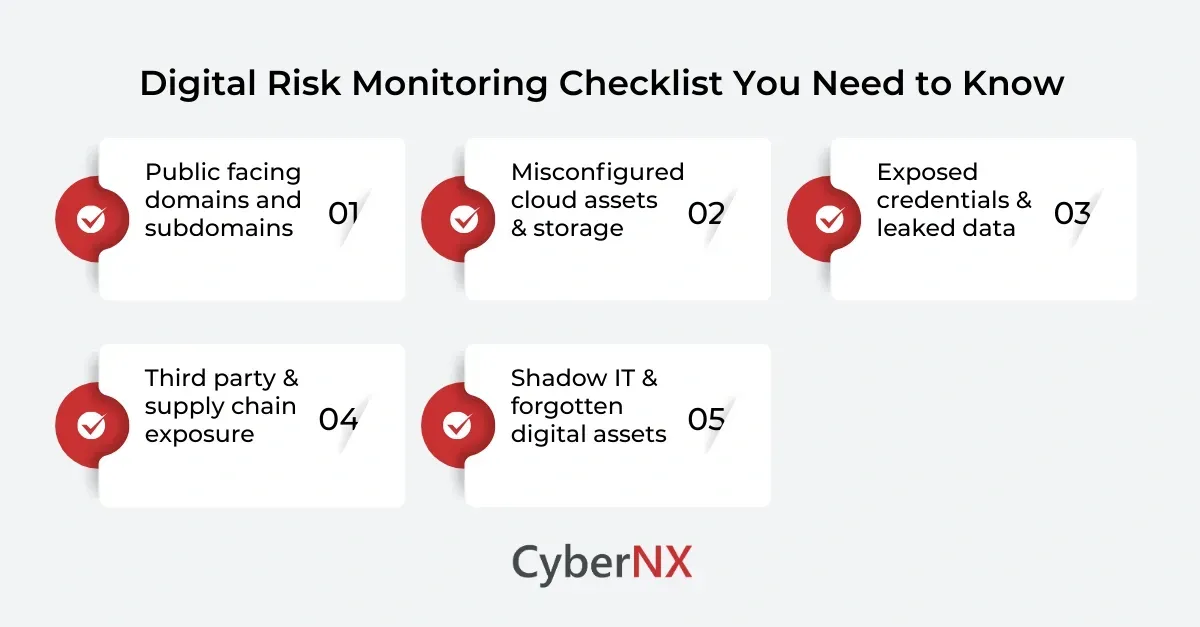
1. Public facing domains and subdomains
Your primary domain is only the beginning. Over time, organisations register multiple domains for campaigns, acquisitions or regional operations. Many remain active but unmanaged.
Your checklist should include:
- All registered domains, including parked and unused ones
- Subdomains created for development or testing
- Expired domains that could be re-registered by threat actors
- DNS misconfigurations
Unmanaged domains often host outdated software. They also become ideal targets for phishing campaigns impersonating your brand. Regular monitoring ensures you detect suspicious lookalike domains before customers do.
2. Cloud assets and storage misconfigurations
Cloud environments evolve rapidly. Teams spin up instances for testing and forget to decommission them. Storage buckets may be configured with public access for convenience.
A robust monitoring checklist must cover:
- Publicly exposed cloud storage
- Misconfigured access controls
- Unused but active cloud accounts
- API endpoints exposed to the internet
According to multiple industry breach reports, misconfigured cloud assets remain a leading cause of data exposure. Continuous monitoring, not annual review, makes the difference.
3. Exposed credentials and leaked data
Credential leaks rarely originate from your core systems. They often surface through third party breaches, developer repositories or employee reuse of passwords.
Your checklist should track:
- Employee credentials on dark web forums
- API keys and tokens exposed in public repositories
- Leaked customer databases linked to your brand
- Third party breach notifications involving your organisation
When exposed credentials are identified early, password resets and access reviews can prevent lateral movement. Security leaders who integrate credential monitoring into their checklist significantly reduce account takeover risk.
4. Brand impersonation and phishing infrastructure
Attackers increasingly exploit brand trust. Fake websites, social media accounts and mobile apps can appear overnight. A comprehensive monitoring checklist includes:
- Lookalike domains
- Fake mobile applications
- Social media impersonation accounts
- Fraudulent payment pages
Brand abuse monitoring protects more than reputation. It prevents financial fraud and data theft targeting customers and partners. We have seen organisations detect phishing domains within hours through proactive monitoring, reducing the window of exploitation.
5. Third party and supply chain exposure
Vendors expand your capabilities. They also expand your attack surface. Your checklist should help you evaluate:
- Public breach disclosures involving critical suppliers
- Security posture of cloud service providers
- Exposed integrations or APIs connected to vendors
- Access privileges granted to external partners
Supply chain risk often sits outside direct control. However, visibility enables informed decisions. It also strengthens contractual security expectations.
6. Shadow IT and forgotten digital assets
Business units often adopt tools without formal approval. Marketing teams may launch microsites. Developers may use unsanctioned SaaS platforms. You must include:
- Unapproved SaaS subscriptions
- Forgotten development environments
- Legacy applications still accessible online
- Orphaned infrastructure from past projects
Shadow IT is not always malicious. It is usually driven by speed. Yet it creates blind spots attackers actively exploit.
Turning a digital risk monitoring checklist into action
Visibility alone is not enough, execution matters. To operationalise your digital risk monitoring checklist:
- Assign clear ownership for each asset category
- Integrate monitoring outputs into your SOC workflows
- Prioritise risks based on business impact
- Automate alerts for critical exposures
- Review and update the checklist quarterly
Small adjustments often deliver meaningful improvements. For example, automated domain monitoring can immediately flag suspicious registrations. Credential monitoring can trigger enforced password resets before abuse occurs.
The key is consistency. A checklist must be embedded into governance, risk and compliance processes. It should inform board level reporting and cyber resilience planning.
Conclusion
Hidden digital assets are not rare. They are common across enterprises of every size. What separates resilient organisations from vulnerable ones is disciplined visibility. A structured digital risk monitoring checklist uncovers exposures before attackers do. It transforms uncertainty into actionable insight.
At CyberNX, we work with security team to map, monitor and manage your digital footprint with precision. If you want a clear view of what is truly exposed and how to reduce risk quickly, let us start with a focused assessment tailored to your environment.
Ready to uncover your hidden digital risks? Speak with our experts to know more about our digital risk protection services and turn your digital risk monitoring checklist into a living defence strategy.
Digital risk monitoring checklist FAQs
How often should a digital risk monitoring checklist be reviewed?
It should be reviewed at least quarterly. However, high risk environments benefit from continuous monitoring with real time alerts.
Is a digital risk monitoring checklist only relevant for large enterprises?
No. Mid-sized organisations are often more exposed due to rapid growth and limited oversight. A digital risk monitoring checklist is valuable for any organisation with an online presence.
How does digital risk monitoring differ from vulnerability management?
Vulnerability management focuses on known software weaknesses inside systems. A digital risk monitoring checklist focuses on external exposure, leaked data and brand related threats across the open web and dark web.
Can digital risk monitoring support regulatory compliance?
Yes. It supports compliance with data protection and cyber resilience regulations by identifying exposed data, third party risks and brand misuse that could lead to reportable incidents.