Detection Engineering in Elastic SIEM has moved from a specialist skill to a core security capability. Security teams are flooded with data, alerts, and tools. Yet breaches still happen because the right signals are missed or ignored. Many organisations invest heavily in Elastic SIEM but struggle to turn raw telemetry into meaningful detections.
We see this challenge often. Teams deploy rules quickly to show progress. Over time, alerts pile up. Analysts lose trust in the system. Leaders question the return on investment. Detection engineering brings discipline back into this process. It focuses on building detections that are accurate, testable, and aligned to real threats.
This guide shares practical best practices for detection engineering in Elastic SIEM. It is written for security leaders and practitioners who want to improve detection quality, not just quantity.
Understanding detection engineering in Elastic SIEM
Detection engineering in Elastic SIEM is the structured practice of designing, building, testing, and improving detection logic using Elastic data sources and tools. It sits between threat intelligence, log management, and security operations.
At its core, detection engineering answers three questions. What threats matter to us? What data proves those threats are happening? How do we alert with confidence and context?
Elastic SIEM provides powerful capabilities for this work. It supports flexible data ingestion, advanced queries, and rule-based alerting. However, tools alone do not guarantee strong detections. A clear engineering mindset is essential.
Why detection engineering often fails in practice
Before exploring best practices, it helps to understand common pitfalls. Many detection programmes fail for predictable reasons.
Teams often start with generic rules copied from blogs or repositories. These rules look impressive but rarely match local environments. As a result, false positives rise quickly. Another issue is weak data foundations. Detections are written before logs are validated. Fields are inconsistent. Time stamps drift. Even well-written rules fail under these conditions.
Finally, detection ownership is unclear. Rules are created but never reviewed. Threats evolve, but detections stay static. Over time, the SIEM becomes noisy and fragile. Detection engineering in Elastic SIEM works best when these issues are addressed early.
Best Practices for Detection Engineering in Elastic SIEM
Here are the best practices you need to make detection engineering work using Elastic SIEM:
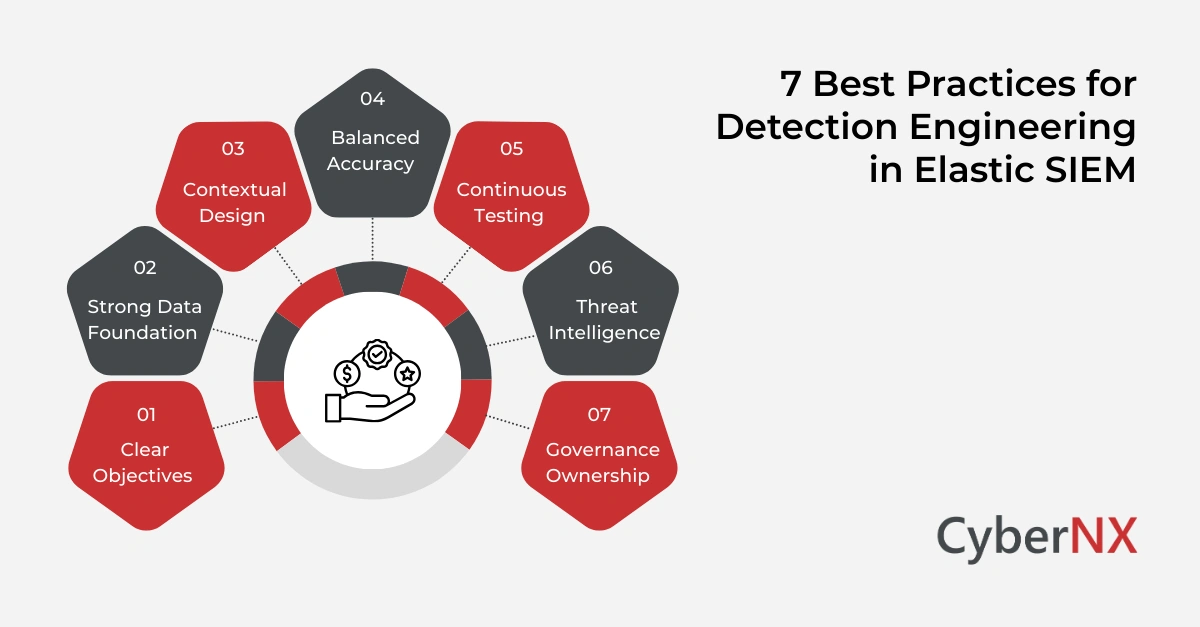
1. Start with clear detection goals/ Clear Objectives
Every effective detection starts with intent. Detection engineering in Elastic SIEM should always align with business risk and threat models.
We recommend mapping detections to adversary behaviour rather than tools or malware names. This approach remains relevant even as attackers change tactics. Frameworks like MITRE ATT and CK provide a strong reference point. Define what success looks like. Is the goal early ransomware detection? Insider threat visibility? Cloud misuse detection? Clear goals guide data onboarding and rule design.
Avoid trying to detect everything at once. Focus on high impact scenarios first. Build depth before breadth.
2. Build on strong data foundations / Strong Data Foundation
Data quality determines detection quality. Detection engineering in Elastic SIEM depends on consistent, reliable telemetry.
Start by validating your log sources. Ensure critical systems are sending data as expected. Common examples include endpoint logs, identity platforms, email security tools, and cloud control planes. Normalisation matters. Elastic Common Schema helps bring consistency across sources. Use it wherever possible. It simplifies queries and reduces rule complexity.
Regularly review data coverage. Ask simple questions. What happens if a domain controller stops logging? How quickly would we notice? Detection engineering is as much about data assurance as rule writing.
3. Design detections with context in mind / Contextual Design
Context turns alerts into decisions. Detection engineering in Elastic SIEM should enrich alerts with enough information for analysts to act quickly.
Include user details, host names, IP addresses, and process information in every detection. Where possible, link activity across multiple events. Elastic allows powerful correlations using queries and thresholds. Use these features to reduce noise. A single failed login may be benign. Ten failures across multiple accounts in minutes tells a different story.
Avoid overly complex logic early on. Start simple. Validate behaviour. Then layer sophistication gradually.
4. Balance false positives and false negatives/ Balanced Accuracy
One of the hardest parts of detection engineering in Elastic SIEM is finding the right balance. Too many alerts overwhelm analysts. Too few create blind spots.
We encourage teams to treat detections as living assets. Initial false positives are expected. What matters is how quickly they are tuned. Use suppression and exceptions carefully. Do not silence alerts without understanding root causes. Often, false positives highlight gaps in asset management or identity hygiene.
Track detection performance. Measure alert volume, analyst response time, and investigation outcomes. These metrics help guide improvements and justify investment.
5. Test detections continuously/ Continuous Testing
Detection engineering without testing is guesswork. Elastic SIEM supports rule previews and historical analysis. Use these features often.
Run detections against historical data before enabling them. This reveals noise patterns and unexpected behaviour. It also builds confidence with stakeholders. Simulate attacks where possible. Red team exercises and automated attack simulations provide invaluable feedback. They show which detections fire and which fail silently.
Document test results. Over time, this creates a knowledge base that improves detection maturity.
6. Integrate threat intelligence thoughtfully/ Threat Intelligence
Threat intelligence can enhance detection engineering in Elastic SIEM when used correctly. The key is relevance.
Focus on intelligence that matches your industry, geography, and technology stack. Generic feeds often create noise. Use intelligence to add context, not panic. An IP reputation hit should not always trigger a high severity alert. Combine it with behavioural evidence.
Review intelligence sources regularly. Retire feeds that add little value. Quality always beats quantity.
7. Establish ownership and governance/ Governance Ownership
Strong detection engineering in Elastic SIEM requires clear ownership. Someone must be responsible for detection quality, lifecycle, and outcomes.
Define processes for rule creation, review, and retirement. Schedule regular detection reviews. Ask whether each rule still aligns with current threats and data. Involve SOC analysts in detection design. They see alert outcomes daily and offer practical insights. This collaboration improves both morale and effectiveness.
We often see success when detection engineering is treated as a product, not a one-off project.
Use Elastic features to their full potential
Elastic SIEM offers advanced capabilities that support mature detection engineering. Leverage rule tags and naming standards. This improves visibility and reporting. Use severity levels consistently. Explore machine learning jobs where appropriate. They can surface anomalies that rules miss. However, always validate outputs carefully.
Dashboards matter. Build views that show detection health, not just security events. This helps leaders understand progress and gaps. Elastic is flexible by design. The value comes from thoughtful configuration, not default settings. As an organisation, Elastic provides the platform. Detection engineering provides the discipline.
Conclusion
Detection engineering in Elastic SIEM is a journey, not a destination. It blends threat understanding, data engineering, and operational feedback into a continuous improvement cycle.
When done well, it reduces noise, improves response, and builds confidence across security teams. Our experience shows that small changes in detection design can make a big difference in security outcomes.
At CyberNX, we help your team to strengthen your defences through practical detection engineering. If you want to improve the quality and impact of your Elastic SIEM detections, let us help you build a programme that delivers real value. Reach out for a focused Elastic Stack Consultation.
Detection engineering in Elastic SIEM FAQs
How long does it take to mature detection engineering in Elastic SIEM?
Most organisations see measurable improvements within three to six months when processes, ownership, and testing are in place.
Can detection engineering work without a large SOC team?
Yes. Smaller teams often succeed by focusing on fewer, high-quality detections and strong automation.
How often should detection rules be reviewed?
Critical detections should be reviewed quarterly. Others can follow a six-month review cycle.
Is machine learning essential for detection engineering in Elastic SIEM?
No. Machine learning can help, but strong rule-based detections remain the foundation for most teams.