Two platforms often appear in enterprise discussions: CrowdStrike NG-SIEM and Splunk. Both offer powerful analytics and security monitoring. Yet they are built with different assumptions about how security operations should run.
Understanding these differences helps CISOs and security leaders make more confident choices. In this comparison of CrowdStrike NG-SIEM vs Splunk, we explore architecture, operational efficiency, and detection capability to see how each platform supports modern security operations.
Why SIEM platforms are being reconsidered
Security environments have expanded rapidly. Organisations now operate across cloud platforms, SaaS applications, remote endpoints, and API-driven services. Traditional SIEM models struggle with three common problems:
- Data volumes growing faster than infrastructure
- Investigation workflows becoming fragmented
- Security teams spending too much time managing tools
Security leaders increasingly look for platforms that reduce operational effort while improving visibility. This shift plays an important role in CrowdStrike NG-SIEM vs Splunk evaluations.
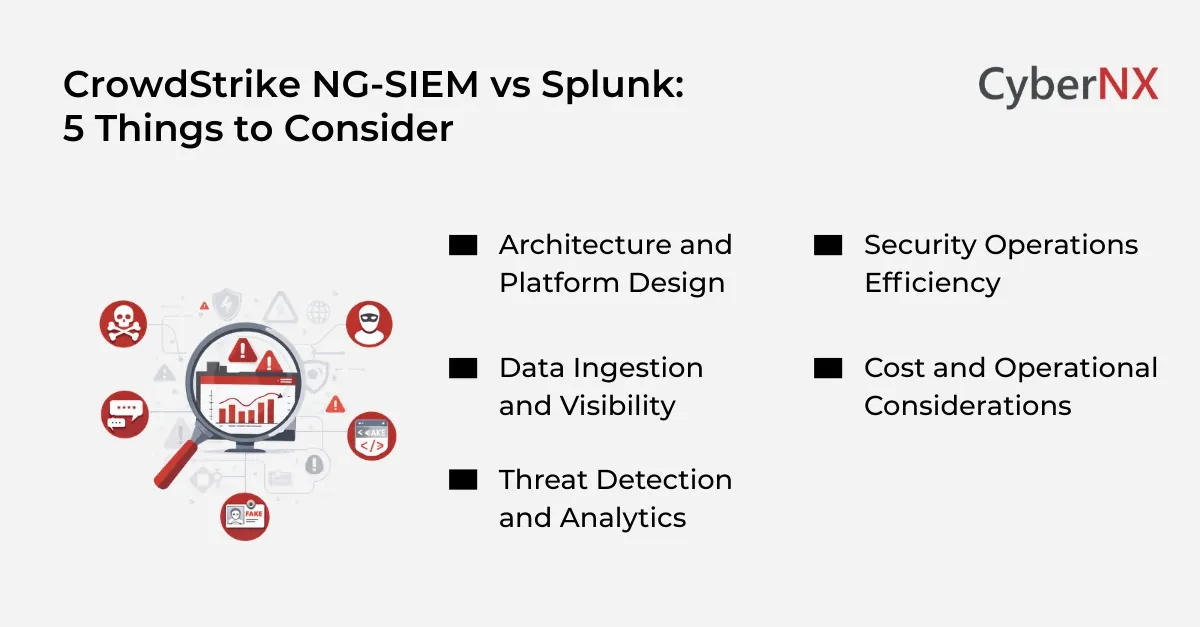
1. Architecture and platform design
Architecture shapes how easily a SIEM platform scales and how much effort teams must invest in maintaining it.
CrowdStrike NG-SIEM
CrowdStrike NG-SIEM is built as a cloud-native security operations platform within the CrowdStrike Falcon ecosystem. This architecture provides several advantages.
- First, the platform ingests telemetry from endpoints, identities, cloud workloads, and third-party sources into a unified data model. This reduces the fragmentation often seen in traditional SIEM environments.
- Second, the infrastructure is fully managed in the cloud. Security teams spend less time maintaining storage clusters, indexing systems, or query infrastructure.
Because of this design, organisations often experience faster deployment and simpler scaling. For teams already using Falcon endpoint protection, adopting NG-SIEM also brings deeper telemetry without adding additional agents.
Splunk
Splunk began as a powerful machine data analytics platform. Over time it evolved into a widely used SIEM through Splunk Enterprise Security. The platform remains highly capable, particularly for organisations that require flexible analytics.
However, Splunk environments often require:
- Data forwarders and indexing infrastructure
- Dedicated engineering teams
- Continuous performance tuning
Even in cloud deployments, many organisations still invest significant effort managing data pipelines and queries.
In practical discussions, the operational simplicity of a cloud-native architecture often becomes an important factor.
2. Data ingestion and visibility
SIEM platforms must process enormous volumes of telemetry. The ability to ingest, analyse, and retain data efficiently shapes long term success.
CrowdStrike NG-SIEM
CrowdStrike uses a security data lake architecture optimised for high volume telemetry. This approach allows organisations to ingest large datasets while maintaining fast search performance. It also enables correlation across multiple security domains.
One advantage is the tight integration with Falcon endpoint telemetry. Security teams gain deep endpoint visibility without needing complex data pipelines.
Investigations often become simpler because the platform already understands relationships between users, devices, and processes.
Splunk
Splunk offers extremely flexible ingestion capabilities. It can process logs from almost any system.
However, many organisations face challenges linked to data ingestion costs and management overhead.
Licensing models tied to ingestion volume often encourage teams to filter logs carefully. While understandable, this can sometimes limit visibility during investigations. Large environments also require ongoing optimisation to maintain search performance. These operational realities influence comparisons.
3. Threat detection and analytics
Detection capability remains one of the most critical SIEM functions.
Both platforms provide advanced analytics, but their approaches differ.
CrowdStrike NG-SIEM
CrowdStrike integrates detection logic with its broader security ecosystem. This creates a unified detection model across endpoints, identity activity, and cloud workloads. Analysts benefit from:
- Behaviour-based detection models
- Integrated threat intelligence
- Automatic correlation across telemetry sources
Because the platform already processes rich endpoint data, investigations often include valuable context from the beginning. Security teams can move from alert to investigation faster.
Splunk
Splunk offers powerful analytics through custom searches and detection rules. Security teams can design highly tailored detection logic suited to their environment. However, this flexibility often comes with additional operational effort. Detection quality depends heavily on the rules and queries built by internal teams.
For organisations with mature SOC engineering resources, this approach works well. For smaller teams, it can become difficult to maintain. In many CrowdStrike NG-SIEM vs Splunk evaluations, built-in detection capability gives CrowdStrike an advantage in reducing operational complexity.
4. Security operations efficiency
Security analysts spend significant time investigating alerts. The platform supporting them should make investigations faster and clearer.
CrowdStrike NG-SIEM
CrowdStrike focuses on unified security operations workflows.
Because telemetry from endpoints, identity systems, and cloud services appears within the same platform, analysts gain a clearer picture of incidents.
Investigation timelines, process trees, and user activity often appear automatically within queries. This reduces the need to pivot across multiple tools. Our experience working with security teams shows that simplifying investigation workflows can significantly reduce analyst fatigue.
Splunk
Splunk environments can deliver similar capabilities but usually require additional integrations.
Organisations often combine Splunk with:
- endpoint detection platforms
- threat intelligence feeds
- security orchestration tools
While this architecture offers flexibility, it can also increase operational complexity.
Analysts may need to move between several dashboards during investigations.
When organisations compare CrowdStrike NG-SIEM and Splunk, many security leaders prioritise the platform that reduces investigation friction.
5. Cost and operational considerations
Technology decisions rarely depend on features alone. Operational cost and staffing requirements play a major role.
CrowdStrike NG-SIEM
CrowdStrike’s approach focuses on platform consolidation.
Organisations using the Falcon ecosystem can unify endpoint detection, threat intelligence, and SIEM capabilities within one environment.
This can reduce:
- infrastructure overhead
- integration complexity
- operational management effort
Many security leaders see value in simplifying their security stack while improving detection visibility.
Splunk
Splunk continues to offer strong analytics capabilities. However, organisations often allocate additional resources for:
- infrastructure management
- data optimisation
- specialised query development
Large SOC teams manage these environments effectively. Smaller security teams sometimes find the operational effort challenging.
Conclusion
The comparison between CrowdStrike NG-SIEM and Splunk reflects a broader shift in security operations.
Splunk remains a powerful analytics platform with deep customisation capabilities. Many enterprises still rely on it for large-scale data analysis.
However, security teams increasingly look for platforms that simplify operations while improving detection speed. CrowdStrike NG-SIEM addresses this need through cloud-native architecture, unified telemetry, and integrated detection workflows. For organisations already adopting the Falcon ecosystem, the platform often delivers faster visibility with less operational overhead.
At CyberNX, we help organisations evaluate SIEM platforms, optimise security architectures, and strengthen SOC operations. If your team is reviewing SIEM platforms or planning a SOC modernisation initiative, connect with us to know more about our SIEM services. Our experts will also guide you through the decision process with practical insights.
CrowdStrike NG-SIEM vs Splunk FAQs
Is CrowdStrike NG-SIEM suitable for organisations without Falcon endpoints?
Yes. While integration with Falcon enhances visibility, CrowdStrike NG-SIEM can ingest data from many third-party security tools and log sources.
How does cloud-native SIEM improve security operations?
Cloud-native SIEM platforms reduce infrastructure management, scale more easily with data growth, and support faster search and analytics.
What skills are required to manage Splunk environments?
Splunk deployments often require engineers familiar with query language, data pipelines, and infrastructure tuning to maintain performance.
Can organisations migrate from Splunk to CrowdStrike NG-SIEM?
Yes. Many organisations evaluate migration strategies as part of SOC transformation initiatives. Migration typically involves log source mapping and detection rule redesign.