Falcon has the capability to satisfy core SEBI CSCRF controls but only when it is configured, monitored and documented for a regulated environment. Default deployment is not a compliance deployment.
CSCRF aligns its controls to NIST CSF functions: Identify, Protect, Detect, Respond and Recover. Falcon addresses obligations across three of these directly. Understanding which modules cover which controls, and where the gaps remain, is what separates a licence from a compliance outcome.
For a full explanation of the framework and its graded applicability across entity tiers, refer to our step-by-step guide to achieving SEBI CSCRF compliance.
What CSCRF demands from your security technology
CSCRF mandates outcomes: continuous monitoring, timely detection, evidence-backed incident response and documented recovery capability. Auditors are interested in checking whether the controls the platform is supposed to deliver can be demonstrated through telemetry records, alert logs, response timelines and configuration documentation.
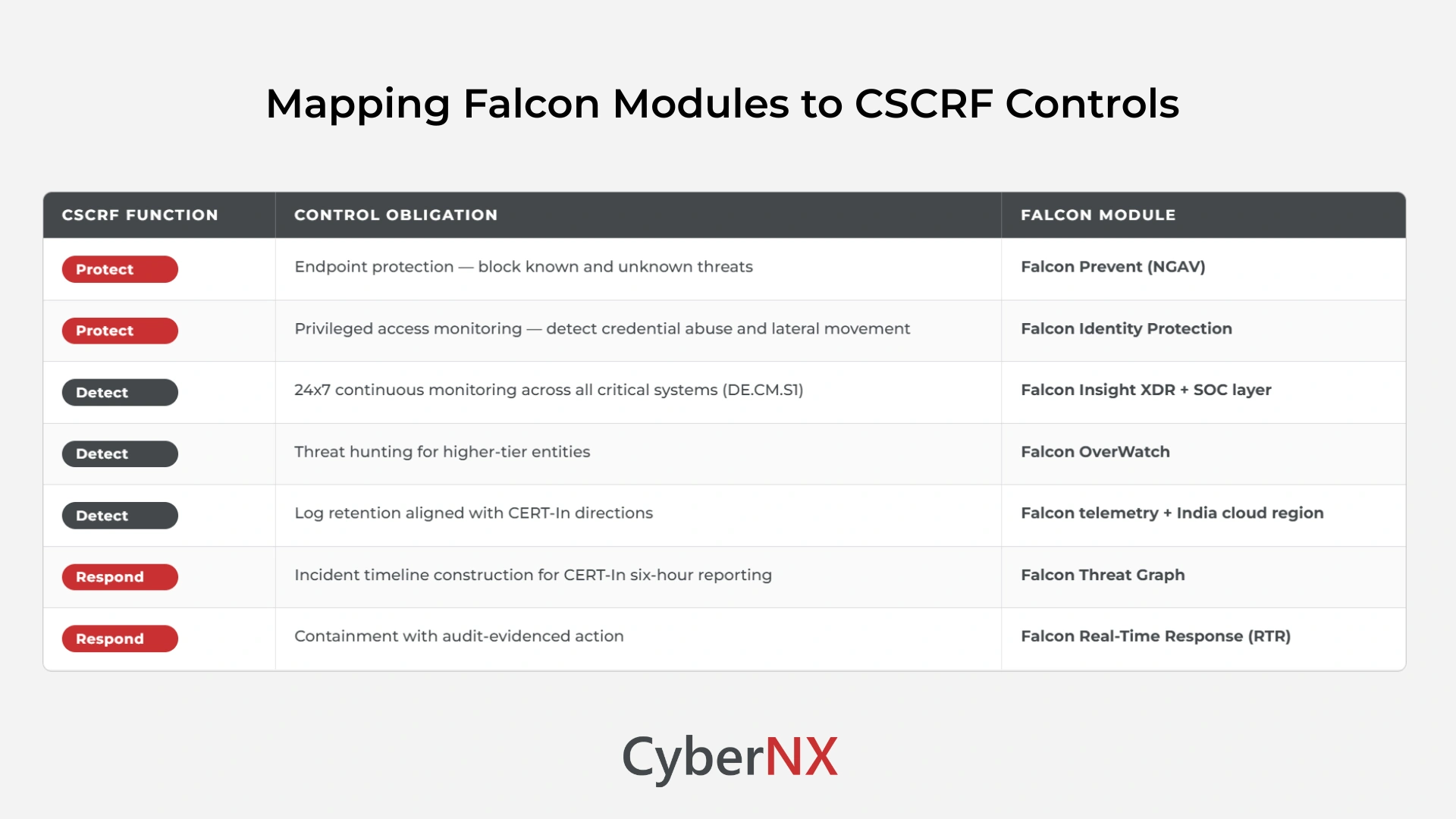
Technology obligations sit most heavily in the Protect, Detect and Respond functions. The table below maps Falcon’s modules to the specific CSCRF controls each addresses.
How Falcon addresses the Protect function
Falcon Prevent addresses CSCRF’s endpoint protection requirement using behavioural analysis and machine learning, without signature files. For regulated entities running trading platforms, order management systems and client-facing applications, it provides the active prevention layer the Protect function requires. The configuration implication is direct: prevention policies must be set to active blocking. Entities still operating in detect-only mode are not meeting the Protect obligation, regardless of whether Falcon is installed.
Privileged access and identity controls
Falcon Identity Protection monitors Active Directory in real time, detecting credential abuse, Pass-the-Hash attacks and privilege escalation before they reach critical systems.
CSCRF’s Protect function includes identity and access management controls – specifically around privileged account monitoring – and this module addresses them directly. Regulated entities holding a Falcon Enterprise or higher licence that have not deployed Identity Protection on their domain controllers are carrying a compliance gap that most discovery assessments surface quickly.
How Falcon addresses the Detect function
Continuous monitoring
CSCRF mandates 24/7/365 SOC coverage. The May 2026 AI Advisory strengthened this, requiring that monitoring covers low-priority alerts, not only high-severity events. Falcon’s detection engine provides the data layer continuous monitoring depends on, but the platform does not constitute a SOC.
MIIs and Qualified Regulated Entities (QREs) that have deployed Falcon without an active monitoring function – in-house or managed – are meeting the technology side of DE.CM.S1 without meeting the operational side.
Log retention and India cloud residency
CSCRF requires log retention aligned with CERT – In’s April 2022 directions – a minimum of 180 days, stored within India. CrowdStrike announced an in-country cloud deployment for India in January 2026. Regulated entities must confirm their tenant is assigned to the India cloud region before treating Falcon’s log storage as CERT – In compliant.
Beyond residency, Falcon covers endpoint and identity telemetry. Network devices and third-party applications require separate ingestion. Entities that assume Falcon’s endpoint telemetry alone satisfies full log coverage will encounter gaps during audit.
How Falcon supports the Respond function
Six-hour CERT-In reporting
CSCRF requires that reportable cyber incidents are notified to SEBI and CERT – In within six hours of detection. Falcon’s Threat Graph assembles the full attack timeline automatically – first observation, lateral movement, files accessed, processes launched – reducing the investigation burden from hours to minutes. The evidence needed for the CERT-In notification is assembled by the platform, not constructed manually under time pressure.
For a structured approach to building this reporting workflow, see our practical guide to incident response under SEBI CSCRF.
Containment and audit trail
Falcon’s Real-Time Response (RTR) capability allows analysts to isolate an affected endpoint, terminate processes and collect forensic artefacts remotely. Every RTR session is logged in the Falcon console with analyst identity, actions taken and timestamps. For CSCRF’s Respond function, which requires documented containment action with a clear audit trail, RTR provides both the capability and the record in one place.
Where Falcon alone is not sufficient
Falcon does not address CSCRF’s Recover function such as disaster recovery planning, tested RTOs and business continuity documentation. These require separate process and governance work. Network security controls, including intrusion detection on network segments and trading system segregation, require additional network-layer controls beyond what Falcon’s Firewall Management module provides. And the Identify function – asset inventory, data classification and vendor risk management – requires inputs that Falcon’s Discover module supports but cannot fulfill independently.
The principle that applies across all of this: a CrowdStrike Falcon licence does not equal CSCRF compliance. Active prevention policies, Identity Protection on domain controllers, India cloud region assignment, 24/7 SOC coverage and documented response workflows are all configuration and operational decisions that determine whether the platform produces audit evidence or audit findings.
Conclusion
CrowdStrike Falcon addresses core CSCRF obligations across the Protect, Detect and Respond functions – provided the platform is configured for a regulated environment, not operated on defaults. The compliance value is real. It is not automatic. Module deployment, prevention policy settings, log residency, SOC coverage and response documentation all determine what an auditor will find.
CyberNX provides CrowdStrike consulting services for SEBI-regulated entities – covering module configuration, detection tuning, SOC integration and audit evidence preparation. Speak with our CrowdStrike consultants to understand precisely where your current Falcon deployment meets CSCRF requirements and where it needs to go further.
CrowdStrike Falcon for SEBI CSCRF Compliance FAQs
Does CrowdStrike Falcon satisfy SEBI CSCRF’s SOC requirement on its own?
No. Falcon provides the detection engine and telemetry a CSCRF-compliant SOC depends on, but DE.CM.S1 requires 24×7 operational coverage with documented alert triage, MTTD metrics and escalation records. These are people and process obligations the platform cannot fulfill without an active monitoring function alongside it.
Which Falcon modules are most relevant for SEBI CSCRF compliance?
Falcon Prevent (Protect), Falcon Identity Protection (Protect), Falcon Insight XDR (Detect), Falcon OverWatch (Detect) and Real-Time Response (Respond) carry the most direct CSCRF relevance. Entities with NG-SIEM module access can also address log aggregation and correlation requirements within the Falcon platform.
How does the India cloud region affect CSCRF compliance?
CERT-In’s directions require that logs are stored within India. CrowdStrike’s India cloud region, announced in January 2026, allows Falcon telemetry to meet this requirement – but only for tenants that are confirmed to be on that region. Entities on global cloud infrastructure should verify their data residency configuration before relying on Falcon’s log storage for CSCRF audit purposes.