Blue team scenarios are no longer tabletop exercises that live in slide decks. For the BFSI sector, they are lived experiences. Banks, insurers and financial services firms face relentless attacks aimed at money, data and trust. Threat actors know the sector runs on uptime, speed and customer confidence. Even a short disruption can trigger regulatory scrutiny and reputational damage.
Our experience shows that many security teams still train in silos. Tools are tested, but people and processes are not. This is where blue team scenarios for BFSI sector organisations make a real difference. They simulate pressure. They test detection, decision-making and communication when stakes are high. Most importantly, they reveal how your defences behave when attackers act like attackers, not checklists.
This blog explores realistic scenarios tailored for BFSI environments. We focus on what matters to CISOs, IT heads and security leaders who want confidence, not compliance theatre.
Why blue team scenarios matter for BFSI
Blue teaming essentially means bolstering defence capabilities of an organisation. Blue team scenarios, on the other hand, help security teams practise defending live systems against realistic threats. In the BFSI sector, the margin for error is small. Financial data, payment systems and customer identities are prime targets.
A recent IBM Cost of a Data Breach Report shows that financial services remain among the most expensive sectors for breaches, with average costs exceeding USD 5.9 million. What stands out is not just the attack vector, but the time to detect and contain incidents.
Blue team scenarios address this gap. They expose delays in alert triage, unclear ownership and brittle response playbooks. Over time, they build muscle memory. Teams stop reacting emotionally and start responding deliberately.
Unique threat landscape of the BFSI sector
Before we dive into scenarios, it helps to ground them in reality. BFSI environments differ from other industries in key ways.
They rely heavily on legacy systems that cannot be easily patched or replaced. They operate under strict regulatory oversight. They support complex third-party ecosystems, from payment processors to fintech partners.
Attackers understand this. They often blend technical attacks with social engineering, knowing that human error can bypass strong controls. Different scenarios for BFSI sector teams must reflect this complexity, not simplify it.
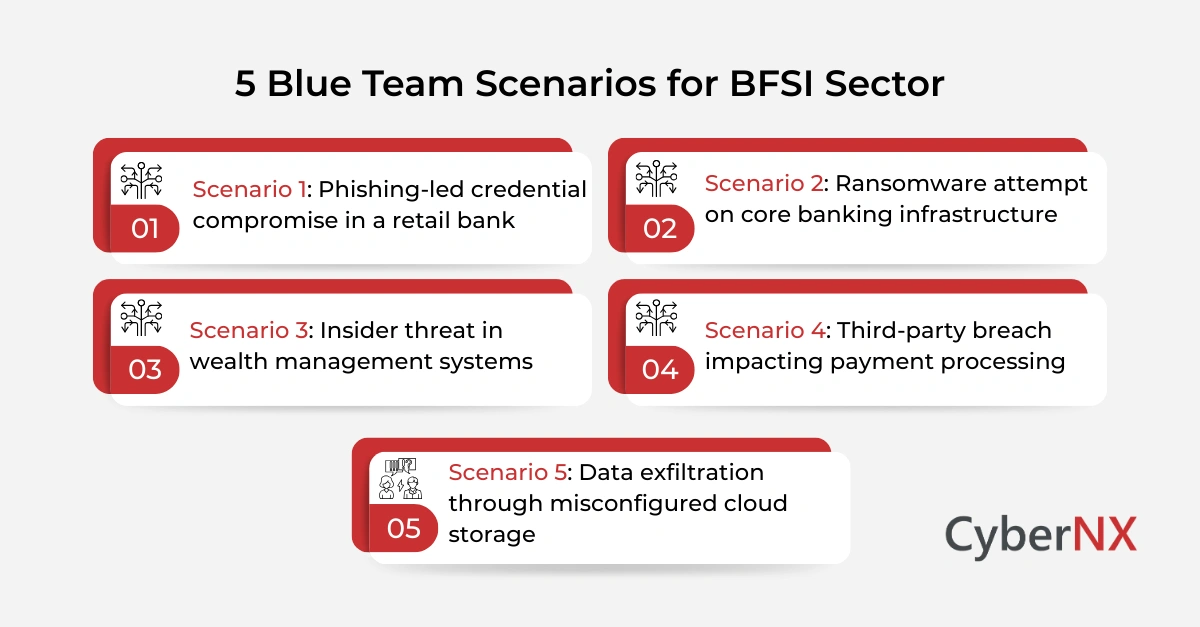
Scenario 1: Phishing-led credential compromise in a retail bank
Phishing remains one of the most effective entry points into BFSI networks. This scenario begins with a well-crafted phishing email sent to branch staff and operations teams. The email mimics an internal compliance update and leads to a fake login page.
Within hours, valid credentials are used to access internal applications. The attacker does not move loudly. Instead, they explore customer databases and transaction systems.
The blue team scenario tests whether your monitoring detects abnormal login patterns. It examines how quickly analysts escalate suspicious access. It also evaluates coordination between IT, security and compliance teams.
In our experience, teams often detect the alert but hesitate on containment. Fear of disrupting business delays action. Practising this scenario helps teams balance speed and caution, especially when customer-facing systems are involved.
Scenario 2: Ransomware attempt on core banking infrastructure
This scenario simulates an attacker exploiting a vulnerable internal service to deploy ransomware. The payload is blocked before encryption completes, but lateral movement attempts are visible.
For BFSI organisations, even a failed ransomware attempt is serious. Regulators expect clear evidence of detection and response.
Blue team scenarios for BFSI sector ransomware incidents focus on early indicators. Unusual PowerShell activity. Unexpected privilege escalation. East-west traffic spikes.
The exercise forces teams to answer hard questions. Who has authority to isolate a core banking server? How do we communicate with business leaders under pressure? What evidence do we preserve for regulators?
According to Sophos’ State of Ransomware report, over 50% of organisations struggle with recovery even when backups exist. Practising response improves confidence and reduces panic when the real incident hits.
Scenario 3: Insider threat in wealth management systems
Insider threats are uncomfortable to discuss, yet highly relevant in BFSI environments. This scenario involves a privileged user accessing sensitive client portfolios outside their normal role.
The activity does not trigger obvious alarms. Access is authorised, but behaviour is unusual. The challenge for the blue team is context.
This scenario tests user behaviour analytics, access reviews and escalation paths. It also examines how HR, legal and security teams collaborate.
We often see technical controls working well, while human processes lag behind. This scenario highlight these gaps early, before trust breaks down internally.
Scenario 4: Third-party breach impacting payment processing
BFSI organisations depend on third parties for payments, analytics and customer engagement. This scenario assumes a trusted vendor suffers a breach that exposes API keys used by your organisation.
Suspicious transactions begin appearing. Customers report anomalies. Social media noise grows.
The blue team must work with incomplete information. They do not control the breached system, yet they own the impact.
This scenario tests external communication, vendor coordination and rapid risk assessment. It also reveals whether contractual and technical controls are enforceable in practice.
Gartner research consistently highlights third-party risk as a top concern for financial institutions. Practising this scenario builds resilience beyond your own perimeter.
Scenario 5: Data exfiltration through misconfigured cloud storage
Cloud adoption in BFSI is accelerating, often under tight timelines. This scenario centres on a misconfigured cloud storage bucket containing customer documents.
An attacker discovers the exposure and begins exfiltrating data quietly. There is no malware. No phishing. Just configuration drift.
These scenarios for BFSI sector cloud incidents test visibility across hybrid environments. They assess how quickly teams correlate cloud alerts with on-premise monitoring.
They also challenge assumptions. Many teams believe cloud providers will catch these issues. In reality, shared responsibility models demand strong internal detection and response.
How to design effective blue team scenarios for BFSI
Effective scenarios are not about overwhelming teams. They are about realism and relevance.
Start with assets that matter most. Core banking systems. Payment gateways. Customer identity platforms. Involve business stakeholders early. Scenarios should reflect real decision-making constraints, not ideal ones. Measure outcomes, not just actions. Time to detect. Time to contain. Clarity of communication. Finally, repeat and evolve scenarios. Threats change. Teams change. Your scenarios should too.
Conclusion
Blue team scenarios for BFSI sector organisations are not about proving strength. They are about revealing reality. They show how systems, people and processes behave under stress.
When done well, they turn uncertainty into confidence. Teams respond faster. Leaders decide better. Customers remain protected.
At CyberNX, we work alongside BFSI security teams to design and run realistic blue team scenarios tailored to their environment. If you want to move beyond theory and test your defences where it counts, our blue teaming services will help you take the next step.
Talk to our experts today and see how focused blue teaming can strengthen your BFSI security posture.
Blue Team Scenarios FAQs
How often should BFSI organisations run blue team scenarios?
Most mature organisations run targeted scenarios quarterly and full-scale exercises annually. Frequency should align with risk and regulatory expectations.
Does blue teaming replace penetration testing?
No. They complement it. Penetration testing finds weaknesses, while scenarios test detection, response and coordination.
Can blue team scenarios help with regulatory audits?
Yes. They provide evidence of operational readiness, incident response maturity and continuous improvement.
Should blue team scenarios include non-technical teams?
Absolutely. Legal, compliance, HR and communications teams play critical roles during real incidents.