You might have run tabletop exercises, documented incident response procedures and established cybersecurity policies. You might have reviewed logs, tuned tools and delivered awareness sessions. But are you truly ready if a real attack hits your systems? This is the critical question every security leader must face.
Practices like planning and paperwork build confidence. Yet nothing proves readiness like a blue team exercise in action. A scenario where defenders are challenged in real time and pressured to detect, respond to and contain threats just as they would during a live incident. Simulations like these move teams beyond theory into practice. They reveal gaps no checklist ever could and validate whether your defences will stand when under fire.
In this blog, we explain what blue teaming is, why it matters and offer practical blue team exercise examples. We also share how we help organisations run meaningful exercises that improve detection, response and overall resilience.
What is a blue team exercise?
A blue team exercise is a structured simulation designed to test your defensive capabilities under realistic attack conditions. Unlike a tabletop talk-through, this type of exercise puts people, processes and technology to the test against real-world scenarios.
It may involve internal or external simulated attacks that force your defenders to detect suspicious activity, analyse alerts, respond effectively and contain the simulated incident within defined metrics.
It’s not simply running a script. It’s about assessing whether your monitoring tools, SIEM alerts, incident playbooks, communication channels and investigative skills work in concert when it matters most. This kind of exercise exposes hidden weaknesses that routine checks and static assessments often miss.
Why blue team exercises are your best defence
Cyber threats are constantly evolving. Defenders must deal with sophisticated tactics, from lateral movement to stealthy persistence mechanisms. Regular planning and compliance activities are necessary but insufficient on their own.
A real blue team exercise:
- Validates tool effectiveness by seeing if alerts fire correctly and are actionable.
- Tests human workflows – how quickly analysts escalate, collaborate and resolve issues.
- Evaluates processes under stress, such as containment and eradication.
- Reveals blind spots in detection rules, telemetry coverage or escalation pathways.
Standards like NIST give the following definition about blue teaming:
“Blue team functions include conducting operational evaluations and providing mitigation strategies based on real-world readiness metrics. Exercises help teams practise this in a controlled environment before an actual adversary hits.”
Moreover, simulated defence drills show where teams are strong and where they need improvement. They help transform static plans into lived experience.
Must-Run scenarios for your next blue team drill
Here are common but impactful exercises you can design to test different facets of your defensive posture:
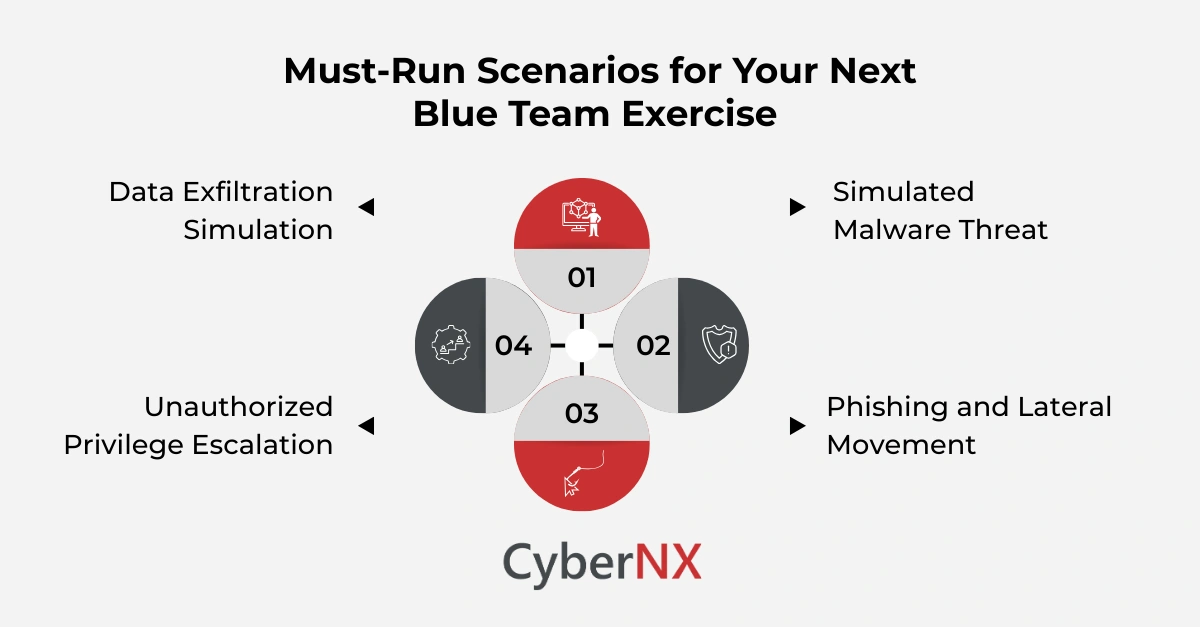
1. Simulated malware threat
In this exercise, defenders receive alerts indicating unusual process execution and network anomalies – mimicking real malware activity. Analysts must piece together log data, confirm the compromise and initiate containment.
This scenario assesses:
- Alert prioritisation accuracy
- Log correlation and threat hunting
- Incident response activation
2. Phishing and lateral movement
Start with a crafted phishing email that results in simulated credential compromise. The red team (or automation) then attempts lateral movement using realistic TTPs. Blue team defenders must detect the early signs, identify lateral hops and isolate affected hosts.
This tests:
- Email security monitoring
- Behavioural anomaly detection
- Segmentation controls
3. Unauthorized privilege escalation
Inject a scenario where a user account begins performing unusual administrative actions. Your security systems should trigger escalation alerts, the response team must verify the anomaly and revoke misuse before escalation.
This evaluates:
- IAM monitoring and alerts
- Response coordination
- Access control hygiene
4. Data exfiltration simulation
Simulate an insider threat or compromised host sending large volumes of sensitive files to an external endpoint. Analysts must spot unusual outbound traffic and contain the flow before data loss occurs.
This tests:
- Network monitoring capabilities
- Data loss prevention alerts
- Automated containment measures
From theory to threat hunting: how blue team exercises actually go down
A successful exercise follows a cycle of planning, execution and reflection.
- Set clear objectives: Define what you are validating – detection, response time, incident handoffs, or containment.
- Launch the scenario unseen: Mimic real-world conditions where defenders must rely on built-in signals and their skills.
- Capture data: Track which alerts triggered, which were ignored and how quickly incidents were resolved.
- Debrief and iterate: Analyse gaps and adjust playbooks, tuning rules and educating teams where needed.
Exercises might run in isolated environments or integrate with your live SOC signals, depending on risk tolerance.
An effective exercise reveals more than a list of issues; it highlights where your organisation’s detection and response maturity is strongest and where it needs focus.
The catastrophic cost of no blue team exercises
Organisations often fall into traps that only exercises can expose:
- Tool alerts are firing, but no one knows what they mean. You may have great telemetry but poor context.
- Playbooks exist on paper, but teams have never executed them outside a drill.
- Communication gaps between detection and response teams delay containment.
- False positives drown genuine threats, leaving defenders fatigued.
Real exercises stress these areas in ways tabletop discussions cannot.
The CyberNX approach to blue team exercises
At CyberNX, we go beyond automated checks or occasional tests. Our blue team services begin by partnering with your team to strengthen detection, accelerate response and embed continuous improvement into your security operations.
We help organisations:
- Move past static assessments to continuous validation of defences.
- Tune and test security tooling and playbooks under realistic conditions.
- Provide tailored blue team exercises aligned with your environment and threat profile.
- Deliver actionable insights that drive better risk decisions and remediation prioritisation.
We blend seasoned operators with pragmatic playbooks, helping build resilience that keeps pace with evolving threats. Whether you want to validate your SOC’s detection logic or stress test your incident response playbooks, a structured blue team exercise from CyberNX boosts confidence and readiness.
Conclusion
A blue team exercise is the only reliable way to answer the question, “Are we truly ready for an attack?” Testing your people, processes and tools under simulated pressure reveals weaknesses before an adversary does. Exercises move your organisation from good intentions to proven defensive capability.
Partnering with experts like CyberNX adds depth, rigour and real-world insights to these exercises. With tailored scenarios, continuous validation and skills transfer, your defenders become more effective, responsive and resilient. Book a consultation today to know more about our blue team service capabilities.
Blue team exercise FAQs
What is a blue team exercise?
A blue team exercise simulates cyberattacks so defenders practise detecting, responding to and containing threats in real time. They validate that your security operations work under pressure and expose gaps that planning alone cannot reveal.
How does a blue team exercise differ from a red team assessment?
A blue team exercise focuses on defence, detection and response, while a red team assessment aims to break in and test the organisation’s external and internal weaknesses. Both exercises complement each other, but blue team drills offer clearer insights into operational readiness. They help validate whether your defenders can stop real-world threats quickly and confidently.
Do blue team exercises disrupt day-to-day operations?
They can be designed to run safely alongside normal activities using controlled simulations. Most organisations choose limited-scope or scheduled scenarios to minimise disruption. When done well, these exercises enhance everyday operations by revealing gaps that would otherwise remain unnoticed until a real incident occurs.
Who should participate in a blue team exercise?
A strong blue team exercise includes SOC analysts, incident responders, cloud engineers, IT ops, and even application teams when relevant. Involving multiple functions creates a clearer picture of how your organisation handles real incidents. It also improves collaboration and speeds up decision-making during live threats.