Today, most companies have firewalls, monitoring tools and certain security policies in place, and yet security breaches find their way in. That’s because true security maturity comes from understanding how well your internal defences will hold under pressure. A blue team assessment can help you figure that out. It reveals if your detection, response and containment processes can keep you safe from threats in the real world.
We’ve conducted and been part of a lot of blue team assessments, and one thing is clear: the most valuable information comes from what happens behind the scenes. This guide shows you the steps, choices and processes that happen during a normal assessment, which most people never see.
What is a blue team assessment?
Blue teaming basically checks how well an organization’s internal security team can find, analyse and deal with threats. It focusses on building defence instead of replicating an assault.
During this exercise, teams look at:
- Monitoring capabilities
- Incident response readiness
- Logging completeness
- Control effectiveness
- Communication processes
Think of it as a security test that shows how well your company can actually protect itself.
Why organisations depend on blue team assessments
Security leaders choose these assessments because they bring clarity that no tool alone can deliver. Here’s why they are so important:
- They expose the blind spots of monitoring and alerting systems.
- They validate how well the current security controls work.
- They test to see how fast and accurate incident response is.
- They check whether logs provide actionable information.
- They highlight where there’s a communication gap between teams.
Blue team assessments help businesses move from assuming security to verified security.
How a blue team assessment works behind the scenes
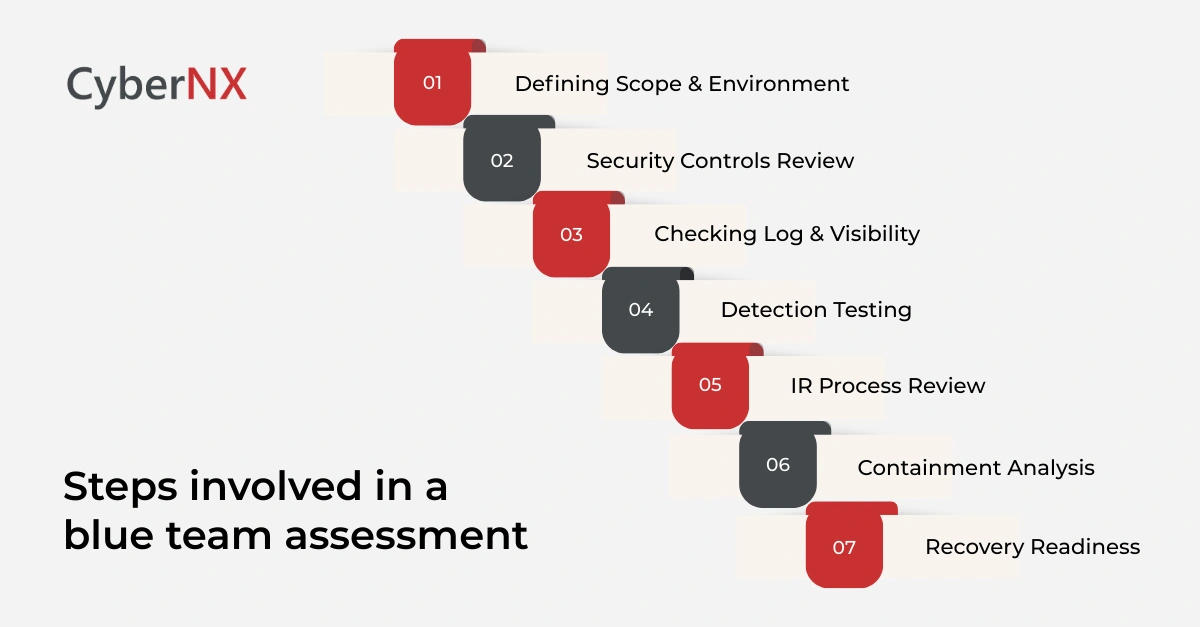
The process is much more extensive than most people realise. Let’s take a closer look at what really happens during the assessment.
1. Defining scope & environment
We start by figuring out what needs to be investigated. This step makes sure that expectations, goals and boundaries are aligned.
Discussions about scope usually include:
- Important systems and applications
- Security controls in place
- Logging and monitoring tools
- Incident response procedures
- Compliance requirements
A clear scope makes sure that the assessment stays accurate and useful.
2. Security controls review
Before starting to test, we look at the current defences.
This involves looking at:
- Configurations for firewalls and networks
- SIEM rules and alert thresholds
- Controls for endpoint security
- Policies for managing identities and access
- Configurations of cloud platforms
This baseline helps find control gaps early.
3. Checking log & visibility
A strong defence depends on good visibility. We check if the organisation is collecting enough data to find threats efficiently.
Some important areas of focus are:
- Log completeness
- Policies for maintaining logs
- Correlation rules
- False positives and alert volumes
- Monitoring all environments
Weak or missing logs often explain why attacks go unnoticed.
4. Detection testing
This is where the test gets more dynamic. Controlled activities are done to test how well security teams can find threats.
These activities could include:
- Suspicious behaviour by users
- Unusual network activity
- Attempts to gain more privileges
- Lateral movement simulations
- Credential misuse tests
Teams that spot early signs quickly show that they have strong defensive maturity.
5. IR process review
Once there is a detection, we look at how fast and well teams react.
Our review looks at:
- Triage accuracy
- Escalation paths
- Team communication
- Decision-making under pressure
- Quality of documentation and tickets
This step reveals whether teams answer with confidence or doubt.
6. Containment analysis
Effective containment stops additional damage. We check if the steps taken in response are both timely and appropriate.
We check:
- Isolation of affected systems
- Blocking of malicious traffic
- Credential resets
- Changes to patches or settings
- Validation to make sure the threat is gone
This makes sure that problems are completely fixed, not just partially resolved.
7. Recovery readiness
A strong blue team doesn’t just react; it improves constantly.
At this point, we look at:
- How quickly things go back to normal
- If post-incident reviews are done
- How lessons are put into practice
- If the documentation is up to date
- If new alerts or controls are added
This phase shows that security has grown over time.
The security professionals use a wide range of blue team tools in the different phases of assessment for best outcomes.
Common weaknesses uncovered during blue team assessments
We see the same gaps over and over again in various sectors. Recognising these helps teams fix issues early.
The most common weaknesses are:
- Too much reliance on automated alerts
- Missing or incomplete logs
- Weak procedures for escalation
- Slow triage processes
- Alert fatigue
- Poor correlation between tools
- Inconsistent incident documentation
- Lack of cross-team collaboration
These problems make it harder for the organisation to find and deal with problems quickly.
What mature blue teams do differently
High-performing blue teams stand out because they take the initiative. They put money into process, clarity, and constant improvement.
They usually:
- Regularly tune alerts to reduce noise
- Update detection rules based on new threats
- Perform exercises to find internal threats
- Every quarter, test the incident response processes
- Document everything in detail
- Work closely with engineering and operations
- Check that fixes and improvements work after each incident
Over time, these habits make their defences stronger.
Conclusion
A strong approach to a blue team assessment helps businesses improve the core of their defence. Detection gets better, responses get faster and risks reduce steadily. Most importantly, teams gain clarity and confidence in their ability to handle real-world threats.
If you want to understand how well your defences perform in real time, we can help. We collaborate with organisations to run clear, practical and actionable blue team assessments. Reach out to us to know more about our blue teaming services, and to build a tailored assessment that supports your goals and security posture.
Blue team assessment FAQs
How often should organisations conduct a blue team assessment?
Most organisations benefit from an annual assessment. High-risk or fast-growing environments may require bi-annual reviews.
Does a blue team assessment replace penetration testing?
No. It focuses on defence, detection and response. Penetration testing focuses on exploiting vulnerabilities.
What tools are typically evaluated in the assessment?
Common tools include SIEM platforms, EDR solutions, firewalls, identity management systems and cloud monitoring tools.
Who should be involved in a blue team assessment?
Security analysts, incident responders, SOC teams, IT operations and cloud/platform teams all play important roles.